
 Algeria
 Key takeaways
- Molecular classification (POLE, MMRd, NSMP, p53abn) now sits alongside FIGO 2023 staging as a determinant of risk and adjuvant treatment intensity — not a replacement for it.
- MMR loss should trigger consideration of Lynch syndrome evaluation, not just guide chemotherapy or immunotherapy decisions.
- PD-L1 is not the relevant biomarker in endometrial cancer, unlike in cervical cancer — MMR/MSI status drives immunotherapy decisions here.
Endometrial cancer is entering a new era of risk-adapted care in Algeria.
For many years, treatment decisions were driven primarily by surgical stage, histological subtype, grade, depth of myometrial invasion, and lymphovascular space invasion. These factors remain essential. But they are no longer sufficient to fully describe tumor biology.
Today, endometrial cancer management increasingly integrates anatomical staging, pathology, and molecular classification — a shift now reflected in Algeria’s updated 2026 Guides Thérapeutiques en Oncologie Médicale.
Worldwide, endometrial cancer is the sixth most common cancer in women, with a global incidence of 420,368 new cases per year and 97,723 deaths per year (GLOBOCAN 2022). In Algeria it ranks 14th, with an incidence of 2.7 per 100,000 inhabitants (National Cancer Registry Network, 2022) — occurring mainly in postmenopausal women between 60 and 65 — a lower relative burden than in high-income countries, but one whose management is now expected to meet the same molecular standard of care.
From Histology to Tumor Biology
The 2026 Algerian guideline incorporates the FIGO 2023 staging system and a molecular approach to endometrial cancer classification, regardless of histological subtype.
The principal molecular groups are:
- POLE-mutated
- MMR-deficient (MMRd)
- No specific molecular profile (NSMP)
- p53-abnormal
MMR assessment using MLH1, PMS2, MSH2 and MSH6 is recommended across endometrial cancer, while POLE and p53 assessment contribute to molecular risk stratification. Hormone-receptor and HER2 assessment may also have therapeutic relevance in selected settings.
This represents an important change in clinical thinking: the same anatomical stage does not necessarily mean the same biological risk. Molecular classification can influence prognosis and, in selected patients, the intensity of adjuvant treatment.
FIGO 2023: Staging and Biology Move Closer Together
The 2023 FIGO staging system introduced important changes to endometrial cancer staging, incorporating histological and molecular characteristics alongside anatomical disease extent. In early-stage disease, POLE-mutated tumors confined to the uterus or with cervical extension are classified as FIGO stage IAm_POLEmut, reflecting their excellent prognosis. Conversely, p53-abnormal tumors confined to the uterus with myometrial invasion are classified as FIGO stage IICm_p53abn, reflecting their less favorable prognosis.
This approach is reflected in the Algerian 2026 guideline and reinforces the concept of integrated risk assessment. Molecular information can therefore help identify patients who may safely avoid unnecessary treatment while identifying those who require greater therapeutic intensity.
Surgery Remains the Foundation
Despite the growing importance of molecular oncology, surgery remains the cornerstone of treatment for localized endometrial cancer in Algeria.
Total hysterectomy with bilateral salpingo-oophorectomy remains the reference procedure, with sentinel lymph-node mapping increasingly incorporated as the preferred approach across most risk groups — optional in low-risk disease, recommended in intermediate risk, and an alternative to full lymphadenectomy in higher-risk groups, particularly for patients with comorbidities. Ovarian preservation may still be considered in carefully selected young patients under 45 with low-grade stage IA disease and no Lynch syndrome or BRCA mutation.
The extent of nodal assessment and subsequent adjuvant therapy should be determined according to the patient’s pathological and molecular risk profile. This is where multidisciplinary decision-making becomes particularly important: the gynecologic surgeon, pathologist, radiologist, radiation oncologist and medical oncologist increasingly need to interpret the same patient through a common biological framework.
Adjuvant Therapy: Risk Rather Than Stage Alone
One of the major consequences of modern classification is the move away from a uniform postoperative strategy.
The Algerian 2026 guideline categorizes patients into low-, intermediate-, high-intermediate-, and high-risk groups, with treatment adapted accordingly:
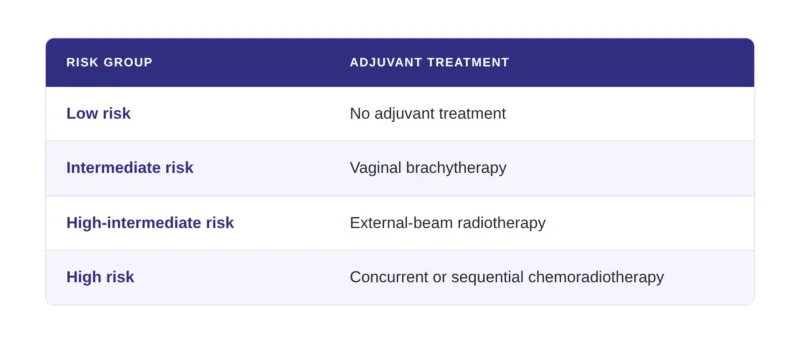
Notably, stage IIIm–IVAm disease with MMR deficiency now warrants adjuvant chemotherapy combined with immune checkpoint inhibition, with or without radiotherapy.
The principle is simple: more treatment is not automatically better treatment. The objective of molecularly informed risk stratification is to balance oncological control against treatment-related toxicity.
MMR: Where Pathology Meets Hereditary Cancer
MMR testing has significance beyond tumor classification.
Loss of MLH1, PMS2, MSH2 or MSH6 may identify patients who require further evaluation for Lynch syndrome, an inherited cancer predisposition syndrome. The 2026 Algerian guideline explicitly links MMR results to genetic counseling when Lynch syndrome is suspected — connecting three aspects of oncology in a single pathology result:
tumor classification → treatment selection → hereditary cancer assessment
This makes pathology an increasingly active component of the oncology pathway, and it raises a practical question for Algeria: genetic counseling capacity for hereditary cancer syndromes remains limited nationally, which means MMR-deficient tumors suspicious for Lynch syndrome will only translate into meaningful family risk reduction if referral pathways to oncogenetic consultation keep pace with molecular testing itself.
Advanced and Recurrent Disease: Immunotherapy Changes the Landscape
The most visible therapeutic evolution in advanced endometrial cancer has been the integration of immune checkpoint inhibitors.
Unlike cervical cancer, PD-L1 status is not a validated biomarker for immunotherapy efficacy in advanced endometrial cancer and is not used in routine practice — the relevant marker here is MMR/MSI status. The Algerian 2026 guideline recommends:
- First line (dMMR endometrioid carcinoma): pembrolizumab, alone or combined with a carboplatin-paclitaxel backbone
- Second line (no prior immunotherapy): pembrolizumab-lenvatinib, regardless of MMR status — one of the more significant additions in this update
- HER2-positive disease: carboplatin, paclitaxel, and trastuzumab for HER2+++ tumors
This represents a major change from the historical approach in which immunotherapy was largely considered a later-line strategy. At the same time, treatment decisions must remain grounded in the therapies and indications actually available within the local healthcare system.
Radiotherapy Remains Essential
The growing role of systemic therapy should not obscure the importance of radiation oncology.
Vaginal brachytherapy, pelvic external-beam radiotherapy, and combined approaches remain important components of treatment for selected patients, particularly those with higher-risk disease. Molecular classification does not replace surgery or radiotherapy — it helps determine who needs them, at what intensity, and in combination with which systemic strategy.
The Implementation Gap in Algeria
The 2026 Algerian therapeutic guidelines provide an important framework for this evolution. The challenge now is implementation.
Precision oncology requires more than a guideline — it requires access to high-quality pathology, molecular testing, appropriate imaging, multidisciplinary RCP discussion, radiation oncology and systemic treatments. Next-generation sequencing (NGS) infrastructure capable of supporting this kind of molecular classification has only recently been installed in Algeria, currently limited to two public hospitals — University Hospital Blida and University Hospital Mustapha — where testing is free of charge for patients but geographically concentrated. Immunohistochemistry and PCR testing for the main cancer types are more broadly available across Algerian healthcare, largely free of charge in public hospitals through collaboration with pharmaceutical companies, but full molecular classification (POLE, MMR, p53 together) still depends on infrastructure that exists in only a handful of centers.
Translating molecular classification into routine practice nationwide will require continued investment in diagnostic capacity and multidisciplinary expertise beyond these two sites.
The New Question for the RCP
The endometrial cancer RCP of today is no longer asking only: “What is the stage?”
It increasingly needs to ask:
- What is the histology?
- What is the molecular profile?
- What is the integrated recurrence risk?
- Could this patient have Lynch syndrome?
- Can treatment safely be de-escalated — or should it be intensified?
- Is immunotherapy relevant, and is it accessible?
That is the real evolution of endometrial cancer care. The objective is not to make treatment more complicated. It is to make it more precise.
Looking Ahead
Endometrial cancer illustrates one of the clearest transitions in contemporary oncology: from treating tumors primarily according to anatomical extent toward treating patients according to the interaction between stage, histology, molecular biology, and individual clinical factors.
For Algeria, the 2026 therapeutic guidelines provide an important framework for this transition. The next challenge is ensuring that molecular classification — currently anchored in two centers — can be translated into consistent clinical practice nationwide.
In the era of precision oncology, the question is no longer simply whether a patient has endometrial cancer. It is: which endometrial cancer does she have — and what does its biology mean for her treatment?
FAQ
Is molecular testing (POLE, MMR, p53) available to every endometrial cancer patient in Algeria?
Not yet uniformly. Immunohistochemistry and PCR testing for common cancer types are broadly available and mostly free of charge in public hospitals. Full NGS-based molecular classification, however, is currently limited to two public university hospitals — Blida and Mustapha — meaning geographic access to complete molecular risk stratification remains uneven.
Does a POLE mutation mean a patient can skip adjuvant treatment entirely?
Not automatically, but it meaningfully changes the risk conversation. POLE-mutated tumors generally carry an excellent prognosis, and under FIGO 2023 a stage I–II POLE-mutated tumor can be reclassified accordingly — but the decision to de-escalate treatment is still made through multidisciplinary discussion, not from the molecular result alone.
If MMR testing suggests Lynch syndrome, what happens next?
The 2026 guideline recommends genetic counseling when MMR results suggest Lynch syndrome. In practice, this depends on referral to oncogenetic consultation services, whose national capacity has not expanded as quickly as molecular testing itself — a gap worth watching as more patients are tested.
Is immunotherapy for endometrial cancer guided by PD-L1, like in cervical cancer?
No. PD-L1 is not a validated biomarker in endometrial cancer and isn't used in routine practice. The relevant marker is MMR/MSI status: dMMR endometrioid carcinoma is the group for which pembrolizumab-based regimens are recommended.
Does every high-risk patient need chemoradiotherapy?
No. Adjuvant treatment intensity follows the four-tier risk classification (low, intermediate, high-intermediate, high), which itself is built from stage, histology, and molecular profile together. Only high-risk disease routinely warrants concurrent or sequential chemoradiotherapy; lower-risk groups may need only brachytherapy, external radiotherapy, or observation.
Can young patients with endometrial cancer preserve their fertility or ovarian function?
Ovarian preservation may be considered for carefully selected young patients — generally under 45, with low-grade stage IA disease, and no Lynch syndrome or BRCA mutation — following multidisciplinary evaluation. It is not a default option and requires careful case selection.