Dr Maite Gorostegui, Chair of GMP and Neil Ranasinghe, Patient Advocate.
Making the invisible visible
London Global Cancer Week (LGCW) took place in November 2026. The International Society of Paediatric Oncology (SIOP) Global Mapping Programme hosted an update session summarising key progress, collaborations and future directions.
Dr Maite Gorostegui, chair of the SIOP Global Mapping Programme (GMP), introduced the GMP’s aim to map all institutions treating children with cancer worldwide. Starting in Africa in 2018, the SIOP GMP has expanded to map over 1800 institutions across 165 countries, providing an unprecedented global overview of childhood cancer services and the resources available at each facility.
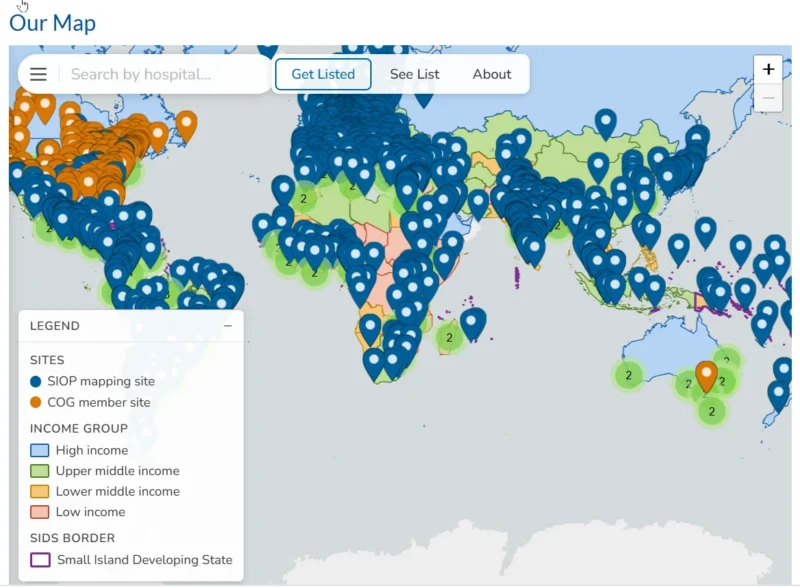
The map showing all mapped institutions treating children with cancer.
This information is being used to inform planning, support collaborations, guide advocacy efforts, and identify capacity-building needs worldwide. Maite encouraged the global pediatric oncology community to work together to transform data into better care through shared expertise and innovation.
The next speaker was Trisha Soosey Raj with the talk “Spotlight on Oceania: Pioneering Regional Advancements in Pediatric Cancer Care”. We listened with tremendous admiration to the remarkable work being done across the region. Trisha highlighted the unique geography of Oceania and the challenges of delivering pediatric cancer care across the SIDS (Small Island Developing States), while also underscoring the striking socioeconomic disparities within the region, where only four countries are classified as high-income countries. The SIOP Global Mapping Programme in Oceania represents the first effort to obtain a comprehensive picture of pediatric oncology capacity across the continent. The findings highlight challenges in diagnosis, access to specialist care, patient referral pathways across a complex geography, and training opportunities, while providing a critical foundation for future collaboration and capacity building.
The session continued with a presentation by Guillermo Chantada, former SIOP President, “Research Support: How the Programme Enables and Strengthens Research Efforts to Improve Patient Outcomes. Guillermo’s talk was fascinating. It isn’t just collecting data, but analysing data. It needs a sharp brain to know what to look for, and what can be found. I have unashamedly taken a phrase from his talk and used it as the title of this article “Making the visible invisible”. One of the uses of data is advocating for children with cancer in remote places.
The session concluded with a discussion on the future of the programme, how the data could be used in the future, an update of the programme in India and how the Latin America data is helping and informing Pan American Health Organization (PAHO) activities.
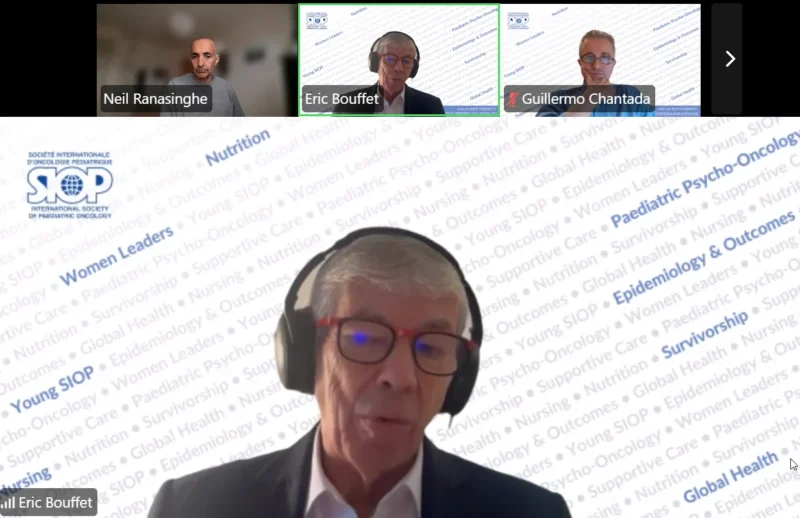
Former SIOP President Eric Bouffet giving his thoughts on the programme and what data we could collect in the future.
Making connections
We saw a post on LinkedIn from Raja Muhammad Harris about the LGCW session. Raja is a first-year medical student at University College of Medicine & Dentistry, Lahore, and childhood cancer survivor. Here is what he thought of the session:
The session resonated with me on a personal level. Diagnosed with leukaemia at seven in Sargodha, I had to travel beyond my hometown and across provincial boundaries to access specialised investigations and treatment unavailable locally. Reaching care meant more than finding a hospital; it required resources for travel, accommodation and repeated journeys for treatment and follow-up. It made me think about children whose families cannot manage those costs or distances.
The Global Mapping Programme offers an opportunity to make these inequalities visible and strengthen referral pathways. I also believe future mapping should look beyond treatment availability to how survivors are faring in the years that follow: whether they have access to psychosocial support, guidance on late effects, structured long-term follow-up and help reintegrating into everyday life. Much of this support was missing from my own experience. Survival matters, but so does the life that follows.
What time does it start?
I was moderating this session and I got the time wrong. I thought it started at 12.30 but actually it was 12. At 11.45 I was getting messages from the presenters saying they were in the Zoom meeting and I thought “you are keen” and just carried on working. I joined at 12.00 thinking I had 30 minutes to get my notes in order, go through the introductions and questions. But then 30 seconds after joining the meeting started. I was completely unprepared, stressed, hot, but fortunately I was working with professionals and everything went smoothly. Some of my friends and family know I don’t like 24 hour clock, I can’t even blame it on that! Notes to self – 1. have everything in a folder well in advance and 2. triple check the start time.
Thank you
Thank you to LGCW for hosting this session. Thank you to the SIOP Secretariat for organising and promoting this event. We are also grateful to the Sanofi Foundation for their support. Finally, we would like to thank all audience members for their valuable comments, insights, and engagement.
More information
If you want to know more about the programme and see the map of institutions treating children with cancer then go here.
A video of this session will also be available on that page.
You may also find this interesting: