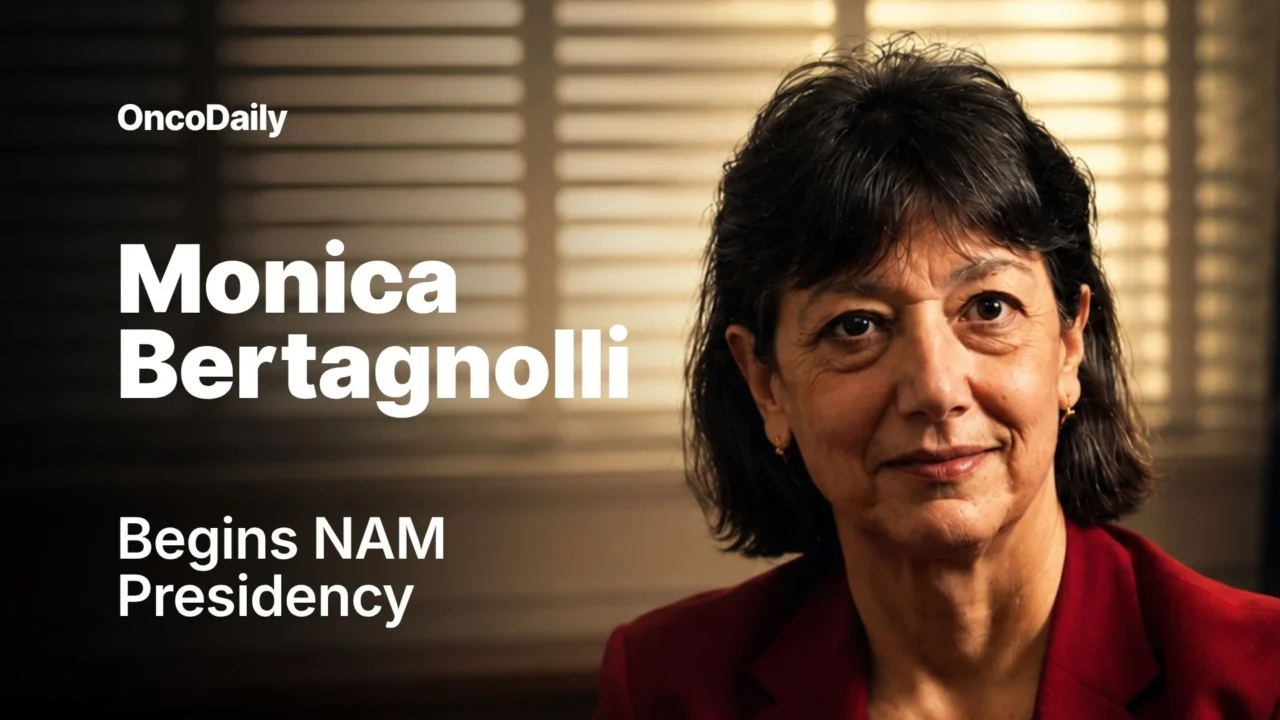
Monica Bertagnolli, MD, has begun her six-year term as president of the National Academy of Medicine (NAM), bringing to the role a career spanning surgical oncology, clinical research, biomedical leadership, and health policy.
Dr. Bertagnolli succeeds Victor J. Dzau, MD, who led the Academy for 12 years. Her appointment marks a new chapter for NAM at a time when health systems are confronting rising chronic disease burdens, increasing costs, persistent inequities, and rapid advances in biomedical science.
An Oncologist at the Helm
Dr. Monica Bertagnolli enters the presidency with deep roots in cancer care and research. A surgical oncologist and translational researcher, she has spent her career caring for patients with cancer while leading major clinical research collaborations.
She previously served as Director of the National Cancer Institute and later as Director of the National Institutes of Health. Her research has contributed to understanding the role of genetics and inflammation in gastrointestinal cancers and soft-tissue sarcomas.
In her first message as NAM president, Dr. Bertagnolli reflected on the perspective that has shaped her career: the extraordinary promise of biomedical discovery, alongside the gaps that remain in access to care and health outcomes.
“I’ve seen both the incredible potential of advances delivered by biomedical research, and also the profound gaps that still exist in our health care delivery system,” she said.
Bridging the Laboratory, Clinic, and Community
Dr. Monica Bertagnolli identified a central challenge for medicine: ensuring that scientific progress reaches people in real time, regardless of where they live or the communities they belong to.
She described a period of remarkable progress across discovery science, biotechnology, data science, and translational research. Yet, she emphasized that innovation alone is not enough.
“The challenge is to deliver better health for everyone by bridging the gap between the laboratory, the clinic, and every community,” Dr. Bertagnolli said.
For oncology, that message carries particular relevance. Cancer research has produced increasingly precise diagnostics, targeted therapies, cellular treatments, and data-driven care models. However, access to clinical trials, specialized treatment centers, early detection, and high-quality supportive care remains uneven across regions and populations.
“All Health Is Local”
Raised in a rural community where access to health care could not be assumed, Dr. Bertagnolli said her experience has reinforced the importance of community-centered medicine.
She called for research and health care to be participatory and rooted in the realities of the people they are designed to serve.
“Because all health is local,” she said.
This approach places communities at the center of decision-making rather than treating them only as recipients of care. It also recognizes that the factors shaping health extend beyond hospitals and laboratories, including geography, trust, financial barriers, infrastructure, and access to information.
Trust as a Foundation for Progress
Dr. Monica Bertagnolli also highlighted public trust as a central responsibility for scientific and medical institutions.
She noted that people must be treated as essential partners in progress and said the question of why an individual should trust medical research must be addressed throughout the work of health care and research organizations.
Her remarks come at a time when the relationship between scientific institutions and communities is under increased scrutiny. Building trust, she suggested, requires more than producing evidence. It requires transparency, meaningful participation, and a clear commitment to improving outcomes for the people research is intended to help.
A Collaborative Role for the National Academy of Medicine
Dr. Monica Bertagnolli described NAM as uniquely positioned to bring together the sectors that influence health and medicine. As part of the National Academies of Sciences, Engineering, and Medicine, NAM convenes scientific experts, clinicians, policymakers, public health leaders, and community voices to address complex challenges.
Her presidency is expected to place strong emphasis on translating research discoveries into practical improvements in care, strengthening the use of health data, and ensuring that advances reach communities that have historically been left behind.
She also acknowledged the legacy of Dr. Dzau, crediting his leadership with strengthening NAM’s role as a trusted voice during a period of major change in health and medicine.
“I am grateful for his clear vision and the strong foundation he has left for us to build on,” Dr. Bertagnolli said.
With a background shaped by oncology, clinical research, and national scientific leadership, Dr. Monica Bertagnolli begins her NAM presidency with a clear focus: connecting discovery to delivery, strengthening trust, and ensuring that progress in medicine translates into better outcomes for every patient and every community.
Written by Nare Hovhannisyan, MD
Find more exclusive oncology content on OncoDaily