
Genitourinary syndrome of menopause can become one of the most persistent and under-recognized consequences of breast cancer treatment. Vaginal dryness, dyspareunia, urinary symptoms, recurrent urinary tract infections, and sexual dysfunction may develop naturally with menopause, but they can appear earlier and more abruptly after chemotherapy, ovarian suppression, endocrine therapy, or treatment-induced menopause.
For patients with a history of hormone-sensitive breast cancer, however, treating these symptoms has long been complicated by concern that even locally administered estrogen could increase the risk of recurrence.
A new 2026 review published in JCO Oncology reassesses that concern using contemporary pharmacokinetic data, large observational cohorts, meta-analyses, and current clinical guidance. Their overall conclusion is increasingly reassuring: low-dose vaginal estrogen appears effective and is not clearly associated with increased breast cancer recurrence or mortality in most survivors, although evidence remains more uncertain for patients receiving aromatase inhibitors (Burns et al., 2026).
The distinction matters. The debate is no longer simply whether estrogen is “safe” or “unsafe” after breast cancer. It is becoming a more nuanced discussion about route, dose, systemic absorption, endocrine therapy, recurrence biology, symptom severity, and shared decision-making.
GSM Is Common, and Often More Severe After Breast Cancer Treatment
Genitourinary syndrome of menopause, or GSM, affects an estimated 50%–75% of perimenopausal and postmenopausal women, with more than two-thirds reporting moderate-to-severe symptoms.
Typical manifestations include vaginal dryness, painful intercourse, urinary frequency, and recurrent urinary tract infections. Local estrogen is highly effective because it restores vaginal epithelium, supports lactobacillus-dominant vaginal flora, and improves tissue health and function (Burns et al., 2026).
Breast cancer survivors are particularly vulnerable. Tamoxifen, aromatase inhibitors, GnRH agonists, cytotoxic chemotherapy, pelvic treatment, and surgical menopause can reduce estrogen exposure substantially and sometimes abruptly. For younger survivors, this can mean developing severe menopausal and sexual symptoms years or decades earlier than expected.
Yet fear surrounding estrogen exposure can leave these symptoms undertreated. That has implications not only for quality of life but potentially also for adherence to cancer-directed endocrine therapy.
Vaginal Estrogen Is Not the Same as Systemic Hormone Therapy
One of the most important distinctions emphasized in the review is the difference between systemic estrogen replacement and low-dose vaginal estrogen. Systemic hormone therapy raises circulating estrogen concentrations and carries a different oncologic risk profile. Vaginal estrogen is intended primarily to act locally and generally produces much smaller changes in serum estradiol.
A 2023 meta-analysis cited by the authors found that vaginal estradiol or estriol increased serum estradiol by an average of approximately 7.67 pg/mL from baseline, with concentrations remaining within the postmenopausal range.
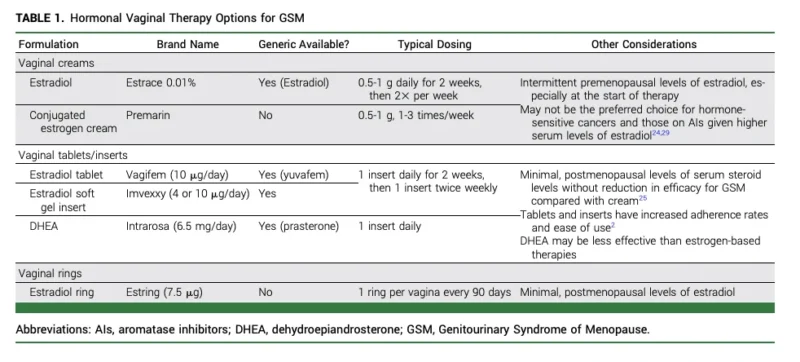
Systemic absorption varies by formulation and dose. Tablets, inserts, and vaginal rings generally produce minimal systemic exposure, whereas estrogen creams may result in larger and more variable increases, particularly early in treatment when severely atrophic vaginal tissue may absorb more estrogen (Burns et al., 2026). This is why formulation matters considerably in breast cancer survivors.
Nonhormonal Therapy Still Comes First
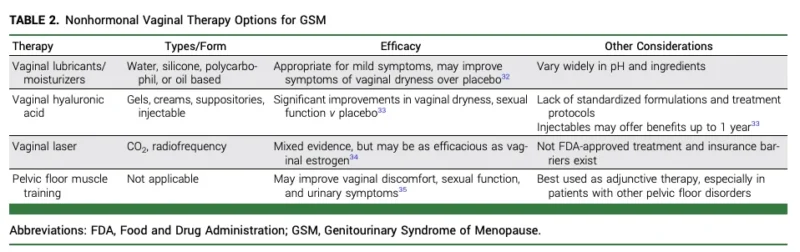
The review does not recommend immediately prescribing vaginal estrogen to every breast cancer survivor with GSM. Instead, nonhormonal therapies remain first-line.
These include vaginal lubricants and moisturizers, hyaluronic acid products, and pelvic floor physical therapy. Such interventions can improve dryness, dyspareunia, urinary symptoms, and sexual function, although they are generally less effective than local estrogen for moderate-to-severe GSM (Burns et al., 2026).
Vaginal laser therapy has also been studied, with some analyses suggesting symptom improvement comparable with vaginal estrogen. However, the review stresses that evidence remains insufficient for strong routine recommendations, long-term randomized data are lacking, and cost can be substantial. When these conservative approaches fail, the discussion shifts toward hormonal local therapy.
What Do the Breast Cancer Recurrence Data Show?
The most reassuring evidence comes from large observational datasets and meta-analyses. A systematic review and meta-analysis cited by Burns and colleagues included six studies and 24,060 breast cancer survivors. Breast cancer recurrence occurred in:
- 11.6% among vaginal estrogen users
versus
- 15.8% among nonusers.
Vaginal estrogen was not associated with an increased risk of recurrence. The same analysis reported no increase in breast cancer mortality or overall mortality, although the authors appropriately note the possibility of healthy-user bias—patients prescribed vaginal estrogen may differ systematically from those who are not I
That limitation is important. These are not randomized oncology trials demonstrating that vaginal estrogen reduces recurrence or mortality. The appropriate interpretation is that large observational datasets have not shown evidence of increased oncologic risk.
Data Are Also Reassuring in ER-Positive Breast Cancer
The question becomes more clinically sensitive in estrogen receptor-positive disease. A Danish registry study of 8,461 women with early-stage invasive ER-positive breast cancer found no association between vaginal estrogen therapy and recurrence after a median follow-up of 9.8 years:
- Relative risk: 1.08
- 95% CI: 0.89–1.32
The study also observed lower mortality among vaginal estrogen users, but this was considered likely to reflect healthy-user bias rather than a protective effect of estrogen (Burns et al., 2026). A separate 2024 cohort similarly found no evidence of increased breast cancer-specific mortality. Taken together, these findings support a more individualized approach rather than a blanket prohibition of low-dose vaginal estrogen in all ER-positive survivors.
Tamoxifen and Aromatase Inhibitors Are Not the Same Clinical Situation
This may be the most important practical distinction in the review.
Tamoxifen: For patients taking tamoxifen, available evidence is relatively reassuring. Tamoxifen blocks estrogen receptor signaling in breast tissue directly, meaning that a small rise in circulating estrogen from vaginal treatment should theoretically have less potential to compromise endocrine suppression.
A 2025 meta-analysis including women taking tamoxifen who were exposed to topical estrogen found no increase in breast cancer recurrence or all-cause mortality. Thus, in a patient receiving tamoxifen with persistent severe GSM despite nonhormonal therapy, low-dose vaginal estrogen can reasonably enter a shared decision-making discussion.
Aromatase inhibitors: The situation is more complex with aromatase inhibitors. AIs work by suppressing systemic estrogen production to extremely low concentrations, often below those seen in ordinary postmenopausal physiology. Even a relatively small increase in serum estradiol can therefore be more biologically relevant. In the Danish cohort, a subgroup receiving vaginal estrogen together with an aromatase inhibitor showed an increased recurrence signal, although mortality was not increased.
A later study found no increased mortality among AI-treated vaginal estrogen users but did not examine recurrence. The authors therefore emphasize that the evidence in AI users remains insufficient and should not be interpreted with the same confidence as the broader breast cancer survivor population (Burns et al., 2026). This is precisely the population in which multidisciplinary discussion becomes most important.
If Vaginal Estrogen Is Needed During AI Therapy, Formulation Matters
When symptoms remain severe despite adequate trials of nonhormonal treatment, the review recommends prioritizing formulations that minimize systemic estrogen absorption. These include low-dose vaginal tablets or inserts and vaginal rings, rather than higher-absorption cream formulations.
The paper’s treatment tables show that low-dose tablets/inserts and the estradiol ring are associated with minimal postmenopausal-range serum exposure, whereas creams may produce higher transient estradiol concentrations and therefore may be less attractive for women with hormone-sensitive disease or those receiving an AI.
A 2026 multidisciplinary expert panel reviewed by the authors concluded that vaginal estrogen or vaginal DHEA does not appear to increase breast cancer relapse after DCIS, ER-negative breast cancer, or ER-positive breast cancer, while recommending greater caution in AI-treated patients. For patients receiving aromatase inhibitors, low-dose preparations with minimal systemic absorption should be favored when local estrogen is required after failure of nonhormonal therapy.
Vaginal DHEA Is Another Option, but the Evidence Is Less Mature
Vaginal dehydroepiandrosterone, or DHEA/prasterone, provides another potential strategy. DHEA is converted locally within vaginal tissue into active estrogens and androgens through intracrine pathways, producing local therapeutic effects with relatively little systemic hormonal exposure.
In a randomized trial of 464 postmenopausal women with a history of breast or gynecologic cancer, vaginal DHEA improved vaginal dryness and dyspareunia and appeared to produce more rapid symptom improvement than moisturizer alone. Among breast cancer survivors receiving aromatase inhibitors, mean estradiol levels remained very low after six months of vaginal DHEA treatment.
However, Burns and colleagues emphasize that long-term oncologic safety data are substantially less mature than those available for vaginal estrogen (Burns et al., 2026). DHEA is therefore an option, not a clearly proven safer substitute.
Current Guidelines Are Becoming More Permissive
The review highlights an important evolution in expert recommendations. Current survivorship guidance increasingly supports considering local vaginal estrogen in appropriately selected breast cancer survivors after nonhormonal therapies have failed.
The NCCN survivorship guidance cited by the review allows consideration of local estrogen even in patients with hormone-dependent cancers, with preference for formulations such as rings and suppositories that minimize systemic absorption.
The 2025 joint guideline from the American Urological Association, Society of Urodynamics, Female Pelvic Medicine & Urogenital Reconstruction, and American Urogynecologic Society similarly states that clinicians may recommend low-dose local vaginal estrogen for patients with GSM who have a personal history of breast cancer (Burns et al., 2026). This represents a significant departure from the historical tendency to avoid all estrogen exposure categorically after breast cancer.
The FDA Labeling Change Requires an Important Qualification
The review also discusses the FDA’s November 2025 decision to remove much of the longstanding boxed-warning language from menopausal hormone therapy products. The previous warning had broadly linked estrogen-containing therapies with risks including breast cancer, cardiovascular events, dementia, and stroke, based largely on evidence generated with systemic hormone therapy.
Contemporary evidence has increasingly challenged the relevance of applying these systemic risks directly to low-dose vaginal estrogen. However, the review emphasizes a crucial limitation: the 2025 labeling revisions do not apply in the same way to individuals with a history of estrogen-responsive cancers. Thus, breast cancer survivors should not interpret the revised FDA approach as unconditional reassurance for all estrogen products or formulations (Burns et al., 2026). Systemic hormone therapy and low-dose vaginal therapy remain very different clinical decisions.
The Paper Proposes a Practical Treatment Pathway
The treatment algorithm presented on page 5 of the review offers a simple clinical framework. For a cancer survivor with GSM, treatment begins with nonhormonal therapy, particularly moisturizers and lubricants. If symptoms remain uncontrolled, clinicians should determine whether the patient has a hormone-sensitive malignancy or is receiving an aromatase inhibitor.
For patients without those concerns, vaginal estrogen can be considered at the lowest effective dose. For patients with hormone-sensitive disease or current AI therapy, the authors recommend considering low-dose vaginal estrogen preparations with minimal systemic absorption or vaginal DHEA, together with multidisciplinary discussion.
That algorithm captures the broader message of the review: treatment should not be dictated by fear of the word “estrogen” alone. It should be based on actual exposure, formulation, breast cancer biology, endocrine therapy, symptom severity, alternatives, and patient preference.
Why Treating GSM Matters for Oncology
GSM is sometimes framed as a quality-of-life issue separate from cancer treatment. That distinction can be misleading. Severe vaginal dryness, sexual pain, urinary symptoms, and menopausal side effects may influence whether patients continue long-term endocrine therapy.
If untreated symptoms contribute to AI or tamoxifen discontinuation, avoiding a highly effective local GSM therapy out of theoretical concern could potentially have unintended consequences for adherence to proven anticancer treatment. Burns and colleagues specifically note that effective GSM management may help patients remain adherent to cancer-directed therapy.
Survivorship care therefore becomes part of oncology care rather than an optional addition after treatment ends.
The Bottom Line
The contemporary evidence summarized by Burns and colleagues challenges the longstanding assumption that vaginal estrogen should automatically be avoided after breast cancer. For most survivors with persistent GSM, nonhormonal therapies should remain first-line, but low-dose vaginal estrogen appears effective and has not shown a clear increase in recurrence or mortality in large observational datasets.
Evidence is particularly reassuring for survivors not receiving aromatase inhibitors and for patients treated with tamoxifen. The greatest uncertainty remains among women receiving aromatase inhibitors, where one observational subgroup demonstrated an increased recurrence signal and prospective evidence remains limited.
For these patients, clinicians should favor formulations with the lowest systemic absorption and involve the oncology team in individualized decision-making. The authors ultimately support an approach built around symptom severity, endocrine therapy, breast cancer biology, formulation, and shared decision-making rather than universal avoidance.
For breast cancer survivorship, that is an important shift. The question is no longer simply:
“Can a breast cancer survivor ever use vaginal estrogen?”
It is increasingly: “For which survivor, on which endocrine therapy, at what dose, and after which alternatives have been tried?”
Reference
- Burns, J. B., AlHilli, M. M., Ali, A., Roesch, E., & Das, D. (2026). Use of vaginal estrogen in breast and gynecologic cancer survivors. JCO Oncology Practice. https://doi.org/10.1200/OP-26-00625.