Two doses of preoperative durvalumab can rapidly transform the immune microenvironment of stage I triple-negative breast cancer, but immune activation alone rarely translates into complete tumor eradication.
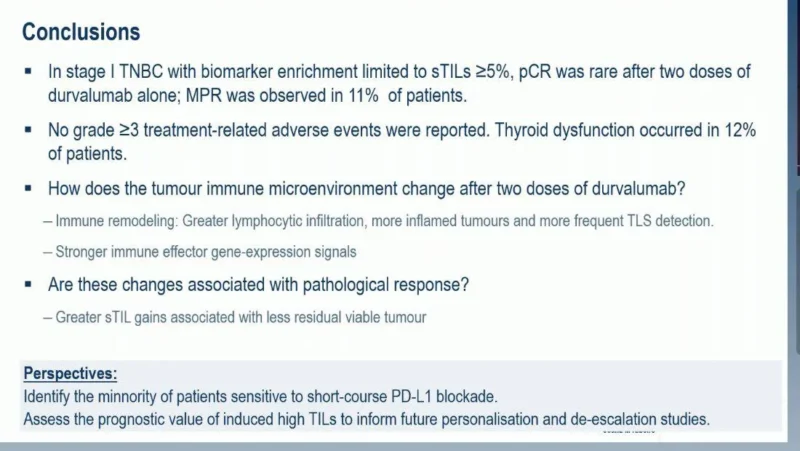
First results from the phase II UNLOCK 14–POP-DURVA trial, presented at ESMO Congress 2026, showed that short-course durvalumab monotherapy produced a pathologic complete response in only 1.4% of patients, while major pathologic response was observed in approximately 11%.
Despite the limited clinical response, the translational findings were striking. After just two doses of the PD-L1 inhibitor, tumors showed substantial increases in stromal tumor-infiltrating lymphocytes, PD-L1 expression, immune-effector gene programs and evidence of T-cell clonal remodeling.
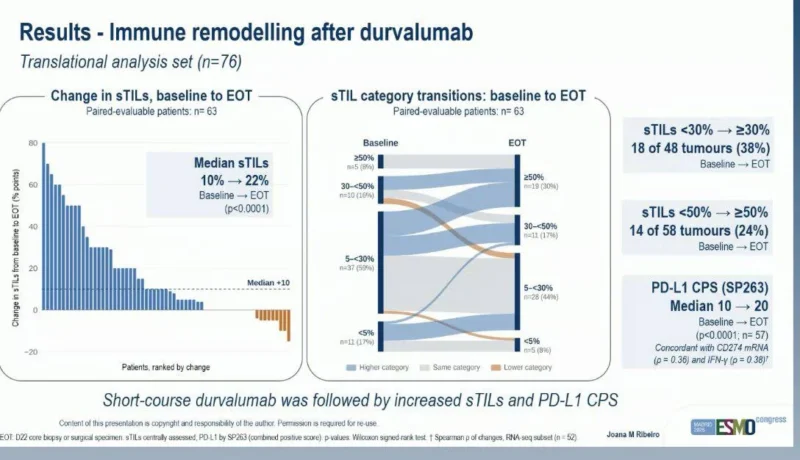
Median stromal TIL levels increased from approximately 10% at baseline to 22% at the end of treatment, while median PD-L1 combined positive score increased from 10 to 20.
The study therefore highlights an important distinction in early TNBC: immunologic activation does not necessarily equal sufficient antitumor activity to replace chemotherapy.
For POP-DURVA, the most important finding may not be the low pCR rate itself, but the opportunity to understand which small subset of tumors can translate rapid immune remodeling into meaningful pathologic regression.
Why Test Immunotherapy Alone in Stage I TNBC?
Checkpoint inhibition has already transformed treatment for higher-risk early TNBC. In stage II–III disease, the KEYNOTE-522 strategy of pembrolizumab combined with neoadjuvant chemotherapy followed by adjuvant pembrolizumab significantly improved event-free survival and later demonstrated an overall survival advantage.
Stage I disease presents a different problem. Patients generally have smaller, node-negative tumors and a substantially different absolute recurrence risk. Chemotherapy remains standard when clinically indicated, but some patients may ultimately be exposed to more systemic treatment than their individual tumor biology requires.
This creates a strong rationale for de-escalation research. Rather than adding another treatment to chemotherapy, POP-DURVA asked whether a short exposure to immune checkpoint inhibition alone could identify patients whose tumors are exceptionally sensitive to immunotherapy and potentially open a path toward less chemotherapy.
Gustave Roussy emphasized that the trial was designed as an early signal-finding and translational study rather than an attempt to replace chemotherapy in current practice.
POP-DURVA Used Only Two Doses of Durvalumab
POP-DURVA was a multicenter, single-arm phase II study enrolling patients with untreated clinical stage I, node-negative TNBC. Tumors were required to have stromal TILs of at least 5% at baseline, reflecting an attempt to enrich for cancers with pre-existing immune infiltration.
Patients received durvalumab 10 mg/kg on days 1 and 15, followed by either surgery or an end-of-treatment biopsy before subsequent standard treatment. This extremely short exposure created a unique window into the earliest biological consequences of PD-L1 blockade.
Rather than evaluating months of systemic therapy, investigators could compare paired tumor samples before and after only two doses and directly observe how immune cells, PD-L1 expression, transcriptional programs and T-cell populations changed.
The primary objective was pathologic complete response. The translational program, however, became central to understanding the result.
pCR Was Rare
Clinical efficacy was limited. Among the efficacy population, only one patient achieved pCR, corresponding to approximately 1.4%. Major pathologic response was observed in approximately 11%.
These findings make it clear that two doses of durvalumab alone are insufficient for the large majority of patients with stage I TNBC selected only by sTIL ≥5%.
Radiologic response was similarly uncommon. The abstract reported an objective response rate of approximately 11.6%, while a substantial proportion of patients still had some degree of tumor downstaging before surgery.
The distinction is important. A tumor may shrink or show evidence of immune-mediated destruction without reaching complete pathologic eradication.
For a de-escalation strategy intended potentially to replace chemotherapy, however, the threshold must be much higher than simply demonstrating biological activity. POP-DURVA did not reach that threshold.
Yet the Tumors Became Much More Immune-Inflamed
The low pCR rate contrasts sharply with what happened biologically inside the tumors. Among paired evaluable specimens, median stromal TIL levels increased from approximately 10% before treatment to 22% after treatment.
The changes were highly significant. Importantly, the immune remodeling was not limited to tumors that already had high lymphocyte infiltration.
Among tumors with baseline sTIL levels below 30%, 18 of 48, or 38%, increased to at least 30% after durvalumab. Among tumors with baseline sTIL below 50%, 14 of 58, or 24%, rose to at least 50%.
In other words, a meaningful subset of relatively less inflamed tumors could be rapidly shifted into substantially more lymphocyte-rich states after PD-L1 blockade.
This provides direct evidence that even very short immunotherapy exposure can modify the tumor immune microenvironment in early TNBC.
PD-L1 Expression Also Increased
PD-L1 expression changed in parallel. Median PD-L1 CPS increased from approximately 10 at baseline to 20 at end of treatment. The increase was statistically significant.
The relationship between PD-L1, stromal TILs and interferon-gamma signaling was also biologically coherent, suggesting that the rise in PD-L1 may represent an adaptive response to a more activated local immune environment rather than an isolated biomarker shift.
This reinforces a broader principle in immuno-oncology: PD-L1 expression is dynamic. A single pretreatment biopsy may not fully describe the immune state of a tumor after therapy begins.
For future de-escalation studies, on-treatment biomarker changes may therefore be more informative than baseline classification alone.
Durvalumab Activated Multiple Immune Gene Programs
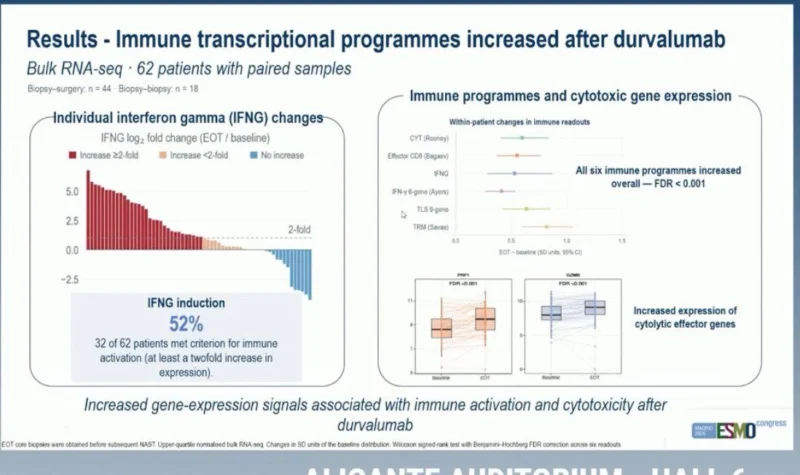
Bulk RNA sequencing further demonstrated that immune remodeling extended beyond histologic changes. Among 62 patients with paired samples, 32, or 52%, showed at least a two-fold increase in interferon-gamma expression.
All six immune transcriptional programs evaluated increased overall, with a false-discovery rate below 0.001. These included signatures related to cytotoxic activity, effector CD8 T cells, interferon signaling, tumor-infiltrating lymphocytes and other immune-response pathways.
Expression of cytotoxic effector genes also increased. The findings indicate that the rise in stromal lymphocytes reflected active immune engagement rather than simply greater numbers of inactive immune cells.
Durvalumab was turning on biologically relevant antitumor immune programs within a matter of weeks.
T-Cell Clonal Remodeling Adds Another Layer
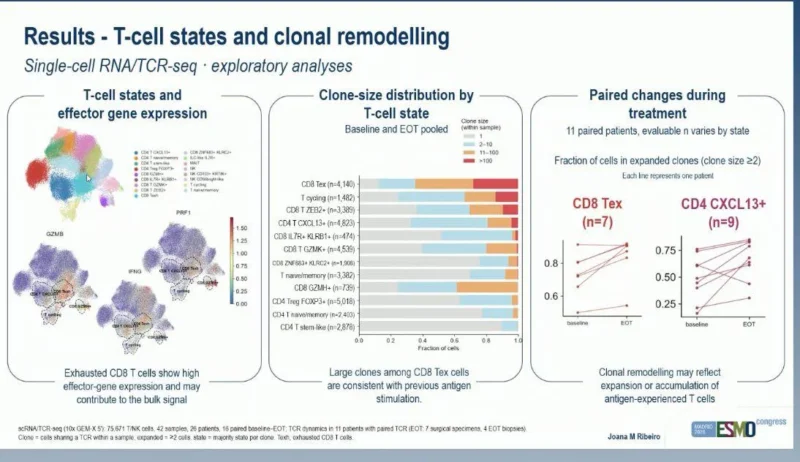
Single-cell RNA and T-cell receptor sequencing provided a deeper exploratory view of the response. The analysis identified multiple T-cell states, including exhausted CD8 populations with high expression of effector genes.
Large T-cell clones were particularly evident among some exhausted CD8 populations, consistent with previous antigen stimulation. In a small set of paired samples, several patients demonstrated expansion or accumulation of specific T-cell clones following treatment.
The investigators interpreted this as evidence that PD-L1 blockade may trigger clonal remodeling of antigen-experienced T cells. These analyses are exploratory and based on small numbers, so they should not yet be treated as validated biomarkers.
Nevertheless, they provide an important mechanistic clue. The biologically relevant effect of checkpoint inhibition may involve not only bringing more lymphocytes into the tumor, but selectively expanding T-cell populations already capable of recognizing tumor antigens.
Immune Remodeling Was Related to Pathologic Effect
The most clinically interesting translational finding was the relationship between increased stromal TILs and residual tumor. Greater increases in sTILs were associated with less residual viable tumor.
That relationship suggests that immune remodeling was not merely an incidental pharmacodynamic effect. Patients with stronger immune activation tended to experience greater tumor regression.
The problem is that the response was still not strong enough in most patients to produce pCR. This distinction may define the next step for the field.
Rather than asking whether durvalumab can increase TILs, it clearly can, the more important question is why only a minority of immune-remodeled tumors translate that activation into major pathologic response.
The answer may involve T-cell specificity, antigen presentation, tumor-intrinsic immune resistance, spatial organization of lymphocytes, tertiary lymphoid structures, or additional suppressive mechanisms within the microenvironment.
Baseline sTIL ≥5% Was Not a Sufficient Selection Biomarker
POP-DURVA specifically enrolled patients with stromal TILs of at least 5%. Yet pCR remained rare. This demonstrates that modest baseline immune infiltration alone does not sufficiently enrich for sensitivity to immunotherapy monotherapy.
That is one of the most clinically important negative findings of the trial. TNBC is immunologically heterogeneous. Two tumors may both contain ≥5% stromal TILs while differing substantially in T-cell clonality, immune-cell spatial organization, interferon signaling, antigen presentation and the presence of tertiary lymphoid structures.
A successful chemotherapy-free immunotherapy strategy will probably require a more sophisticated biomarker than a single TIL threshold.
The investigators are therefore pursuing integrated multi-omic analyses to identify the minority of tumors with exceptional checkpoint-inhibitor sensitivity. Gustave Roussy has framed this work as part of a broader effort toward “precision immunology” and future treatment de-escalation.
Safety Was Favorable
Short-course durvalumab was generally well tolerated. The final ESMO presentation reported no grade ≥3 treatment-related adverse events. Thyroid dysfunction occurred in approximately 12% of patients and was low grade.
The safety profile is relevant because any de-escalation strategy for stage I disease must operate under a particularly high tolerability standard. These patients have potentially curable cancers and may already have favorable outcomes with existing therapy.
A new strategy therefore needs not only sufficient anticancer efficacy but also a meaningful reduction in toxicity burden. Two doses of durvalumab clearly satisfy the second requirement. The challenge is achieving the first.
POP-DURVA Does Not Support Replacing Chemotherapy
The study should not be interpreted as evidence that immunotherapy monotherapy is ready to replace chemotherapy for stage I TNBC. The pCR rate was far too low for that conclusion.
Patients with stage I TNBC should continue to receive established local and systemic treatment according to their clinical risk and current standards.
The value of POP-DURVA lies elsewhere. It demonstrates that the immune microenvironment can be profoundly altered after an extremely short exposure to checkpoint blockade, even when visible clinical response remains limited.
This creates a powerful experimental platform for identifying the biological features of exceptional responders.
A Different Kind of De-Escalation Trial
Traditional neoadjuvant trials often begin by asking whether adding treatment improves pCR. POP-DURVA approaches the problem from the opposite direction.
It asks whether treatment can be stripped down to immunotherapy alone in carefully selected patients, and then uses deep translational profiling to understand why that strategy succeeds in only a minority.
The first answer is clear: selecting patients only by stage I disease and sTIL ≥5% is not enough. The second answer is still emerging.
The induced changes in TILs, PD-L1, interferon signaling, tertiary lymphoid structures and T-cell clonality may eventually help construct a composite biomarker capable of identifying truly immune-sensitive TNBC.
If successful, that could inform future trials in which chemotherapy is omitted only for patients whose tumors demonstrate convincing evidence of rapid immune-mediated regression.
OncoDaily Takeaway
POP-DURVA provides a striking example of the difference between biological activity and clinical efficacy. After only two doses of durvalumab, stage I TNBC tumors underwent substantial immune remodeling.
Median stromal TILs increased from approximately 10% to 22%, median PD-L1 CPS increased from 10 to 20, interferon-gamma induction occurred in 52% of paired samples, and multiple cytotoxic immune transcriptional programs were activated.
T-cell clonal remodeling was also observed in exploratory single-cell analyses. Yet pCR occurred in only approximately 1.4%, while major pathologic response was observed in 11%. The message is therefore not that short-course durvalumab is ready to replace chemotherapy.
It is that some TNBCs can become profoundly immune activated within weeks—and that we still do not know precisely which tumors can convert that activation into sufficient tumor eradication.
Baseline sTIL ≥5% alone was not enough. The next phase of POP-DURVA research will be about identifying the minority of exceptional immune-sensitive patients through integrated biomarkers.
If those patients can be prospectively recognized, the trial may eventually contribute to a more ambitious goal in early TNBC: not simply improving cure rates, but achieving cure with less treatment for the right patient.
Source
- Ribeiro JM, et al. Short-term preoperative durvalumab for stage I TNBC: First results from the phase II UNLOCK 14–POP-DURVA trial. Presented at ESMO Congress 2026, October 24, 2026. Abstract LBA26. ClinicalTrials.gov identifier NCT05215106. Gustave Roussy confirmed the ESMO presentation and described the study as a translational effort to identify patients potentially suitable for future treatment de-escalation.