
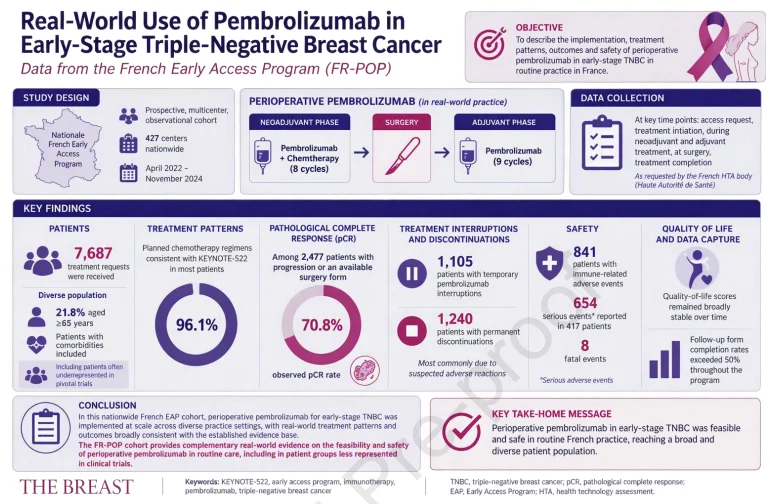
A large prospective French real-world study provides new evidence on the implementation of perioperative pembrolizumab in patients with high-risk early-stage triple-negative breast cancer (TNBC). The FR-POP cohort, conducted through France’s national Early Access Program, documented 7,687 validated treatment requests across 427 centers and reported a pathological complete response (pCR) rate of 70.8% among patients with evaluable response data. The findings support the feasibility of delivering KEYNOTE-522-based treatment in routine clinical practice while highlighting important challenges involving treatment discontinuation, immune-related toxicity, and incomplete real-world outcome reporting.
The study, led by A. de Nonneville and colleagues, was accepted for publication in The Breast on October 23, 2026. Unlike the randomized phase III KEYNOTE-522 trial, which established the efficacy of neoadjuvant pembrolizumab plus chemotherapy followed by adjuvant pembrolizumab, FR-POP was designed to examine how this treatment strategy was implemented across a broad national healthcare network.
The study included patients frequently underrepresented in randomized trials, particularly older adults, individuals with comorbidities, and patients receiving treatment outside specialized academic centers. Among 2,477 patients included in the pathological response analysis, 1,755 achieved pCR, corresponding to 70.8% (95% CI 69.1–72.6).
However, the analysis also identified 1,105 patients with temporary pembrolizumab interruptions and 1,240 with documented permanent discontinuation. Immune-related adverse events were reported in 841 patients, including 417 with serious events and eight patients with fatal outcomes.
These findings provide important insights into the opportunities and challenges associated with implementing perioperative immunotherapy at a national level.
Beyond KEYNOTE-522: Why Real-World Evidence Matters
The KEYNOTE-522 trial established perioperative pembrolizumab as a major advance in the treatment of high-risk early-stage TNBC. The trial demonstrated that adding pembrolizumab to neoadjuvant chemotherapy, followed by postoperative pembrolizumab, significantly improved pCR, event-free survival, and ultimately overall survival.
The initial pathological response analysis demonstrated pCR in 64.8% of patients receiving pembrolizumab plus chemotherapy compared with 51.2% receiving chemotherapy alone. Subsequent follow-up established a significant overall survival advantage, with estimated five-year survival of 86.6% versus 81.7%.
These results transformed the management of stage II–III TNBC and supported the incorporation of pembrolizumab into curative-intent treatment. However, randomized clinical trials are conducted under carefully controlled conditions, with predefined eligibility criteria, standardized treatment schedules, and intensive monitoring.
Routine practice introduces additional complexities. Patients may be older, have cardiovascular or metabolic comorbidities, require treatment adjustments, or receive care in hospitals with different organizational resources.
Real-world evidence is therefore important for understanding whether the efficacy and safety observed in clinical trials can be translated into broader clinical populations. The French Early Access Program provided an opportunity to examine these questions during the implementation of pembrolizumab before routine reimbursement.
FR-POP: A Nationwide Prospective Observational Study
FR-POP was a prospective, multicenter observational cohort conducted within France’s pembrolizumab Early Access Program between April 13, 2022, and November 20, 2024. The program was authorized by the French National Authority for Health and enabled eligible patients to receive pembrolizumab before completion of the national reimbursement process.
Eligible patients were adults with histologically confirmed stage II–III TNBC who met the program’s treatment criteria. Importantly, the French definition also permitted inclusion of tumors with estrogen receptor expression of 1%–9%, a population generally classified as ER-low rather than strictly hormone receptor-negative under conventional definitions.
This distinction should be considered when comparing the cohort with the original KEYNOTE-522 population. The treatment strategy followed the KEYNOTE-522 approach.
Patients received pembrolizumab combined with paclitaxel and carboplatin, followed by anthracycline–cyclophosphamide chemotherapy. After surgery, pembrolizumab was continued as adjuvant monotherapy.
The recommended pembrolizumab schedule was 200 mg every three weeks or 400 mg every six weeks. Patients could receive up to nine postoperative cycles at the three-week schedule or five cycles at the six-week schedule.
Data were collected through physician-completed electronic forms at predefined treatment milestones, including treatment initiation, neoadjuvant therapy, surgery, adjuvant treatment, and completion. The analyses were descriptive, without formal hypothesis testing or a contemporaneous control group.
Consequently, the study was designed to describe implementation and outcomes, not to demonstrate comparative superiority over alternative treatment strategies.
National Implementation: More Than 7,600 Validated Requests
During the 31-month Early Access Program, 7,687 treatment access requests were validated. These requests originated from 1,259 prescribing physicians across 427 French centers. The breadth of participation is an important feature of the study.
Private healthcare facilities accounted for 35.7% of requests, comprehensive cancer centers for 34.0%, public regional hospitals for 19.5%, and university hospitals for 10.8%. This distribution demonstrates that perioperative pembrolizumab was implemented across diverse healthcare settings rather than being confined to specialized academic institutions.
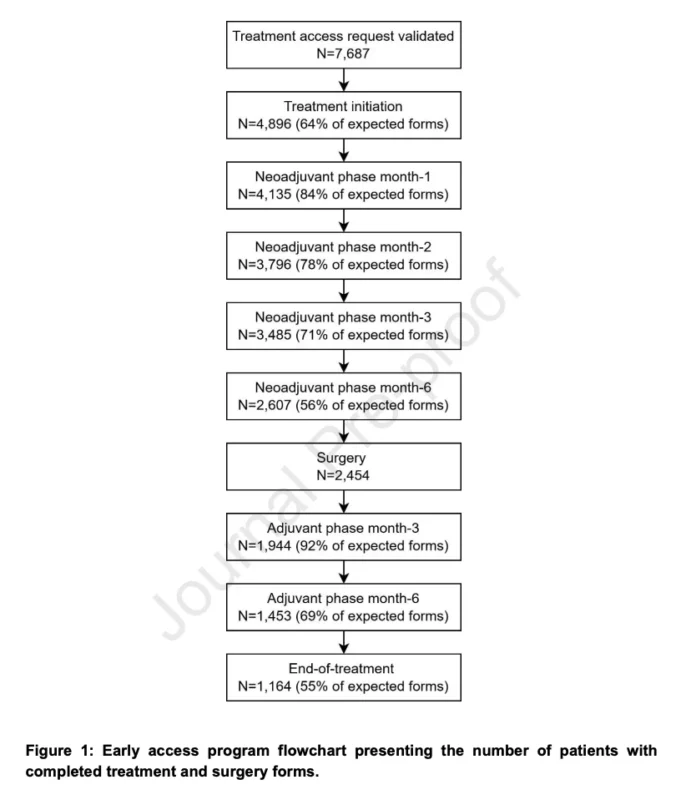
However, a key methodological distinction concerns the number of patients who actually started treatment. Treatment initiation was confirmed for 5,112 patients, representing 66.5% of validated access requests.
This does not necessarily mean that the remaining patients never received pembrolizumab. Missing initiation documentation and incomplete reporting limit definitive interpretation. Similarly, completed surgery forms were available for 2,454 patients.
Therefore, the 7,687 validated requests should not be interpreted as 7,687 confirmed treated patients with complete outcome assessment. Understanding these changing denominators is essential when interpreting response, safety, and treatment-delivery findings.
A Broader Patient Population Than Conventional Clinical Trials
The FR-POP population included patients with characteristics that may complicate treatment delivery. Median age was 52 years, with an interquartile range of 43–63 years. Approximately 32.3% were aged 60 years or older, including 12.5% aged at least 70 years.
The cohort also included patients with cardiovascular disease (8.4%), diabetes (5.7%), and elevated body mass index. More than half of participants were classified as overweight or obese. Most patients had favorable baseline performance status, with 85.7% having ECOG 0 and 13.8% ECOG 1.
However, patients with ECOG performance status of 2 or higher were also represented. At diagnosis, 60.9% had stage II disease and 39.1% had stage III disease. These characteristics provide a broader view of the patients receiving perioperative pembrolizumab in clinical practice.
However, the presence of more heterogeneous patients should not automatically be interpreted as proof that the treatment is equally effective or tolerable across every subgroup. The observational design did not allow robust adjustment for differences in patient characteristics, comorbidity burden, or chemotherapy dose intensity.
Treatment Delivery Closely Followed KEYNOTE-522
One of the most reassuring findings concerned adherence to the established chemotherapy backbone. Planned chemotherapy was consistent with the KEYNOTE-522 sequence in 96.1% of patients. The predominant regimen was paclitaxel–carboplatin followed by epirubicin–cyclophosphamide, used in 75.9%.
An additional 20.2% were scheduled to receive paclitaxel–carboplatin followed by doxorubicin–cyclophosphamide. The majority of patients were intended to receive pembrolizumab at 200 mg every three weeks.
These observations suggest that the treatment approach evaluated in KEYNOTE-522 could be broadly implemented across the participating French centers. However, planned treatment and delivered treatment are not equivalent.
The study could not comprehensively quantify chemotherapy relative dose intensity or confirm completion of the entire regimen in all patients. Thus, while treatment planning closely reflected the randomized trial, the extent of actual treatment delivery remains less certain.
Pathological Complete Response Reaches 70.8%
The main effectiveness finding was the observed pathological complete response rate. Among 2,454 patients with completed surgery forms, together with 23 patients who experienced documented progression during neoadjuvant treatment, the evaluable response population comprised 2,477 patients.
Within this group, 1,755 achieved pCR, corresponding to 70.8% (95% CI 69.1–72.6). This represents an encouraging response rate in routine practice. For context, the original KEYNOTE-522 trial reported a pCR rate of 64.8% in the pembrolizumab-containing treatment arm.
However, the numerical difference between 70.8% and 64.8% should not be interpreted as evidence that the French population experienced superior treatment efficacy. The response populations and assessment methods differed substantially.
KEYNOTE-522 evaluated a prospectively defined randomized trial population, whereas FR-POP relied on available surgery documentation and reported progression events. A substantial proportion of validated access requests did not have completed pathological assessment forms.
The reasons for incomplete documentation could include administrative factors, early program closure, treatment discontinuation, loss of follow-up, or other circumstances that were not fully captured. Consequently, the reported 70.8% is an observed response rate among evaluable patients rather than a population-wide pCR estimate for all individuals granted access.
The study nevertheless provides reassuring evidence that high pathological response rates are achievable during routine implementation of perioperative pembrolizumab.
Clinical Subgroups: Stage, Age, and Treatment Sequence
Exploratory analyses examined pathological response across clinically relevant subgroups. Patients with stage II disease demonstrated a pCR rate of 71.9%, compared with 69.0% among those with stage III disease.
The numerical difference was modest. Age-related differences were more noticeable. Patients aged 30–39 years had a pCR rate of 76.2%, while those aged 70 years or older had a rate of 63.5%. Among patients younger than 30 years, pCR was reported in 71.7%, although this estimate was based on only 46 evaluable patients.
Patients aged 70 years or older also had a higher prevalence of comorbidities and less favorable performance status. The authors noted that chemotherapy dose reductions might have contributed to lower pathological response in older patients, but the dataset did not include sufficient information to evaluate this hypothesis.
Body mass index appeared to have a relatively limited association with pCR. Rates ranged from 74.2% among underweight patients to approximately 69% among patients with obesity. The investigators also observed a numerical difference according to chemotherapy sequence.
Patients receiving carboplatin–paclitaxel followed by anthracycline–cyclophosphamide achieved a pCR rate of 71.1%, compared with 61.8% among those receiving the reverse sequence. However, the reverse-sequence subgroup was small, and the analysis did not adjust for differences between patients.
Therefore, the findings cannot establish that one chemotherapy sequence is causally superior. All subgroup results should be considered descriptive and hypothesis-generating.
Temporary Pembrolizumab Interruptions Were Common
The ability to deliver treatment according to schedule is an important consideration in curative-intent immunotherapy. In FR-POP, 1,105 patients experienced a documented temporary pembrolizumab interruption.
The median time from treatment initiation to the first interruption was 63 days, while the median interruption duration was 13 days. A total of 1,419 temporary interruptions were documented. Approximately 74.3% occurred during neoadjuvant treatment, with the remaining 25.7% during the adjuvant phase.
Among 1,533 recorded reasons for interruption, suspected adverse reactions accounted for 35.3%. Other causes included laboratory abnormalities, concurrent medical conditions, patient decisions, scheduling constraints, and clinical assessments.
The predominance of neoadjuvant interruptions is clinically understandable because this phase combines immunotherapy with multiagent chemotherapy. However, the dataset does not allow every interruption to be attributed specifically to pembrolizumab or to chemotherapy.
These findings illustrate the importance of coordinated supportive care, treatment monitoring, and clear communication between the oncology team and patients.
Permanent Discontinuation: Toxicity Was the Leading Recorded Reason
Permanent pembrolizumab discontinuation was documented in 1,240 patients. The median interval from treatment initiation to discontinuation was 155 days. Among recorded discontinuation reasons, suspected adverse reactions were the leading category, accounting for 48.8% of documented reasons.
Disease progression or recurrence accounted for 16.1%, while patient preference contributed 7.8%. The investigators also documented other medical decisions and treatment-related circumstances. Importantly, these percentages describe recorded reasons for discontinuation rather than the proportion of all treated patients discontinuing specifically because of toxicity.
Some discontinuations had multiple contributing reasons, and the number of reported reasons exceeded the number of patients. The study also did not establish the impact of interruption or discontinuation on event-free or overall survival.
These results nevertheless demonstrate that treatment persistence and toxicity management are substantial practical considerations when implementing perioperative pembrolizumab at scale.
Immune-Related Adverse Events: A Significant Safety Concern
The study’s pharmacovigilance findings deserve particular attention A total of 1,586 immune-related adverse events were reported in 841 patients, corresponding to 10.9% of the validated-access population. Serious immune-related adverse events were reported in 417 patients (5.4%), involving 654 serious events.
Eight patients experienced fatal immune-related adverse events. Reported fatal outcomes included blood and lymphatic disorders, an endocrine disorder, a cardiac disorder, and cases of general clinical deterioration without more detailed attribution.
These findings reinforce the importance of careful immune-toxicity monitoring in early-stage TNBC, where treatment is administered with curative intent. However, the observed reporting proportions should not be directly compared with immune-related adverse-event rates in KEYNOTE-522.
FR-POP used the full validated-access population as its safety denominator even though confirmed initiation data were incomplete. Furthermore, spontaneous and program-based pharmacovigilance reporting may fail to capture less severe adverse events.
The authors specifically acknowledged potential underreporting. Therefore, the apparently lower frequency of recorded immune-related events should not be interpreted as evidence that perioperative pembrolizumab is less toxic in routine practice than in clinical trials.
The eight fatal cases are an important safety finding, but the dataset does not permit a reliable exposure-adjusted estimate of fatal immune-toxicity risk.
Quality of Life: Reassuring Overall Findings With Important Data Limitations
Patient-reported outcomes were assessed using the EORTC QLQ-C30 questionnaire.mThe investigators described quality-of-life scores as broadly stable over time. However, individual domains demonstrated changes during treatment.
Fatigue, nausea, appetite loss, and physical functioning worsened during parts of the neoadjuvant phase, followed by improvement in later assessments. The quality-of-life summary score declined during neoadjuvant therapy and subsequently improved.
These patterns are consistent with the expected burden of intensive systemic treatment followed by recovery. Nevertheless, questionnaire completion was limited, and the number of patients with available assessments varied substantially between treatment time points.
Consequently, the findings should not be interpreted as proof that perioperative pembrolizumab has no meaningful impact on quality of life. Instead, they provide preliminary descriptive information about patient experience during real-world treatment.
What Does FR-POP Tell Us About Older Patients?
One of the study’s strengths is the representation of older adults. Patients aged at least 70 years accounted for 12.5% of the validated-access population. This subgroup had more frequent comorbidities, including diabetes and cardiovascular disease, and a higher proportion of patients with ECOG performance status 1 or greater.
The observed pCR rate was 63.5%, lower than the overall cohort rate. However, rates of documented treatment interruption and discontinuation were broadly similar across age categories. These observations suggest that older age does not automatically preclude treatment delivery.
Nevertheless, the findings do not establish equivalent benefit-risk profiles across age groups. Geriatric assessment, functional reserve, organ function, patient priorities, and the potential for severe immune toxicity remain essential considerations.
Prospective studies with standardized geriatric assessment and more complete treatment-exposure data are needed to define which older patients derive the greatest net benefit from perioperative immunotherapy.
Clinical Implications: From Trial Efficacy to Routine Implementation
The most important contribution of FR-POP is not the identification of a new treatment strategy. KEYNOTE-522 has already established the benefit of perioperative pembrolizumab in appropriately selected high-risk early-stage TNBC.
Instead, FR-POP demonstrates the feasibility of implementing this approach across a large national healthcare network. The high proportion of patients receiving planned KEYNOTE-522-consistent chemotherapy indicates substantial adherence to the established treatment framework.
The observed pCR rate provides encouraging evidence of treatment activity in routine practice. However, treatment interruption, permanent discontinuation, and serious immune-related events underscore the need for structured toxicity management.
For clinical practice, these findings reinforce the importance of baseline comorbidity assessment, early recognition of immune-related toxicities, multidisciplinary supportive care, and standardized documentation.
They also highlight the value of collecting complete treatment and outcome data when national early-access programs are used to assess real-world performance.
Limitations: Why Long-Term Outcomes Remain Unanswered
Although FR-POP represents a large real-world cohort, several limitations must be considered. First, the study was observational and lacked a concurrent chemotherapy-only comparison group. Second, treatment initiation was not confirmed for every validated request.
Third, pathological response was available for a subset of the overall population. Fourth, follow-up documentation was incomplete, and data collection stopped when the Early Access Program closed, including for patients who had not completed treatment or follow-up.
Fifth, the program did not systematically collect several potentially important variables, including germline BRCA status, detailed chemotherapy dose intensity, and geriatric assessment results. The inclusion of ER-low tumors also introduces differences from more restrictive definitions of TNBC, and separate outcomes for these patients were unavailable.
Finally, the cohort could not provide robust long-term event-free survival or overall survival estimates. Therefore, FR-POP cannot independently establish the survival benefit of pembrolizumab in routine practice.
The randomized KEYNOTE-522 trial remains the definitive source for comparative efficacy, while FR-POP offers complementary information about treatment delivery, pathological response, and safety.
OncoDaily Takeaway
The prospective French FR-POP study provides important real-world support for the feasibility of implementing perioperative pembrolizumab in high-risk early-stage TNBC across diverse clinical settings.
A total of 7,687 treatment-access requests were validated across 427 centers, and 96.1% of planned chemotherapy regimens followed the KEYNOTE-522 treatment sequence. Among 2,477 patients with evaluable pathological response data, pCR reached 70.8%, providing encouraging evidence of treatment activity outside a randomized trial.
However, the study also documented substantial treatment modifications, including 1,105 patients with temporary pembrolizumab interruptions and 1,240 with permanent discontinuation. Serious immune-related adverse events were reported in 417 patients, including eight fatal cases.
These safety findings emphasize that even established curative-intent immunotherapy strategies require vigilant monitoring and coordinated supportive care.
Most importantly, the 70.8% pCR rate should not be interpreted as demonstrating superiority over KEYNOTE-522, and incomplete outcome data prevent definitive conclusions about long-term real-world survival.
The central clinical message is that perioperative pembrolizumab can be implemented at national scale, but successful implementation requires not only access to treatment, but also reliable toxicity monitoring, treatment continuity, and comprehensive outcome reporting.
As immunotherapy becomes increasingly embedded in the management of early-stage TNBC, the next priority is ensuring that the survival improvements demonstrated in randomized trials are translated into safe, equitable, and measurable benefits in routine clinical practice.
Sources
- de Nonneville A, Frenel JS, Loirat D, et al. Real-World Use of Pembrolizumab in Early-Stage Triple-Negative Breast Cancer: Data from the French Early Access Program. The Breast. 2026. Journal pre-proof; accepted October 23, 2026. DOI: 10.1016/j.breast.2026.104948