
Genomic assays have fundamentally transformed adjuvant treatment decisions in hormone receptor-positive, HER2-negative early breast cancer, allowing many patients to avoid chemotherapy without compromising disease outcomes. Now, findings from the phase III OPTIMA trial are extending this approach into populations with substantially greater clinical risk, including selected patients with four to nine positive lymph nodes. However, important uncertainties remain regarding premenopausal women, the biological mechanisms underlying chemotherapy benefit, and the applicability of existing genomic signatures to contemporary treatment strategies.
A new commentary published October 30, 2026, in the Journal of Clinical Oncology by Yara Abdou, MD, MSCR, and Lisa A. Carey, MD, ScM, from the University of North Carolina Lineberger Comprehensive Cancer Center, examines the evolution of genomically guided chemotherapy from MINDACT and TAILORx through RxPONDER and OPTIMA.
The authors argue that the central question in precision breast oncology is evolving. Rather than simply determining whether genomic assays identify patients with a favorable prognosis, clinicians must increasingly establish whether these tests can guide treatment escalation and de-escalation in higher-risk populations, particularly when modern endocrine therapy and emerging targeted agents are available.
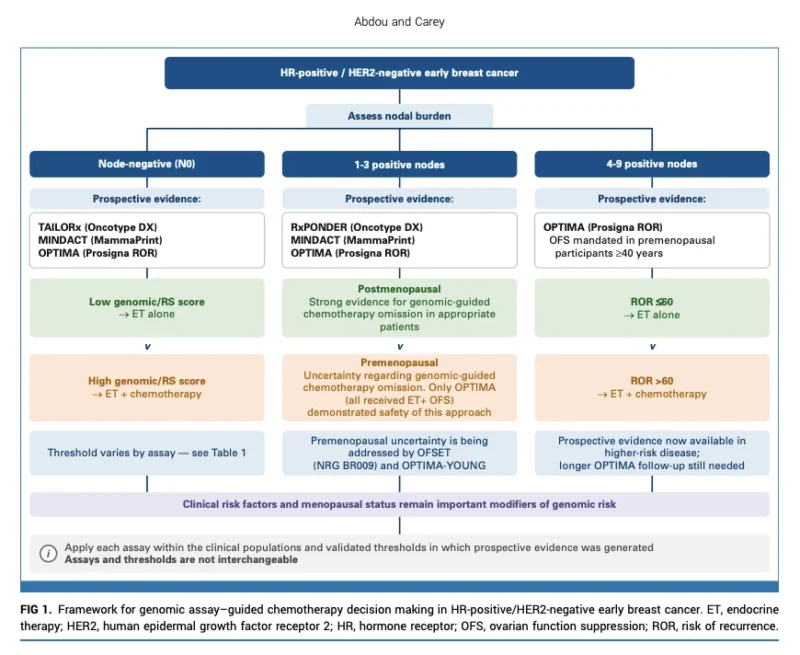
The commentary highlights OPTIMA as an important extension of prospective evidence. In the randomized study, a Prosigna-guided strategy was noninferior to standard chemoendocrine therapy for invasive breast cancer–free survival while allowing approximately two-thirds of patients assigned to genomic-guided treatment to omit chemotherapy.
However, the authors emphasize that this result does not establish the predictive utility of the Prosigna Risk of Recurrence score for chemotherapy benefit, nor does it resolve the long-standing uncertainty surrounding chemotherapy omission in younger premenopausal women.
A New Era of Chemotherapy Decision-Making
Historically, decisions regarding adjuvant chemotherapy in HR-positive/HER2-negative early breast cancer relied primarily on tumor size, histological grade, lymph node involvement, and patient age. Although these characteristics remain important, they cannot fully capture the biological diversity of HR-positive tumors.
Patients with apparently similar clinicopathological features may experience substantially different long-term outcomes, reflecting differences in proliferation, estrogen receptor signaling, intrinsic molecular subtype, and sensitivity to systemic treatment.
Genomic assays were developed to improve this assessment by measuring gene-expression patterns associated with recurrence risk. Over the past two decades, several prospective randomized studies have demonstrated that genomic risk can meaningfully refine chemotherapy recommendations.
The most important contribution of these trials has been identifying populations in which chemotherapy can be omitted while maintaining favorable clinical outcomes. However, the clinical boundaries of this approach have evolved progressively, from predominantly node-negative disease to selected node-positive populations and, most recently, higher nodal burden.
MINDACT: When Genomic Risk Challenges Clinical Risk
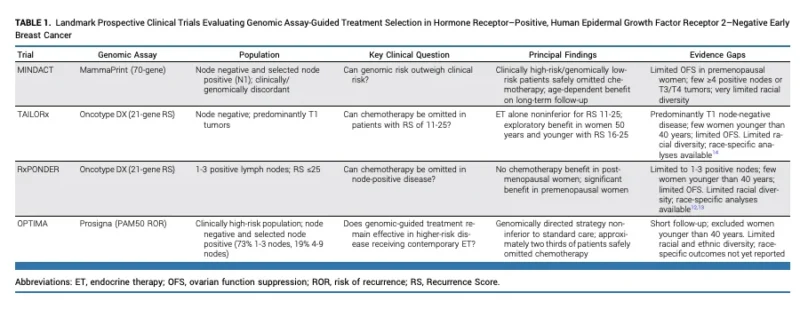
The phase III MINDACT trial established an important principle: high clinical risk does not necessarily indicate high genomic risk. The study evaluated more than 6,600 patients using conventional clinical characteristics and the 70-gene MammaPrint signature.
Its central question was whether patients considered clinically high risk but genomically low risk could safely omit adjuvant chemotherapy. The findings demonstrated favorable outcomes without chemotherapy in this discordant-risk population, supporting the use of genomic information to refine traditional treatment decisions.
Importantly, MINDACT included selected patients with one to three positive lymph nodes, extending its relevance beyond node-negative disease. Longer follow-up, however, suggested that younger women, particularly those aged 50 years or younger, might derive greater benefit from chemotherapy despite favorable genomic characteristics.
This observation introduced one of the most persistent controversies in genomic-guided breast cancer treatment: whether younger patients benefit from chemotherapy because of direct tumor cytotoxicity, treatment-induced ovarian suppression, or both.
TAILORx: Establishing Chemotherapy Omission in Node-Negative Disease
TAILORx provided prospective evidence for the clinical utility of the 21-gene Oncotype DX Recurrence Score. The trial enrolled more than 10,000 patients with HR-positive/HER2-negative, node-negative early breast cancer.
Among women with intermediate Recurrence Scores of 11–25, endocrine therapy alone was noninferior to chemotherapy followed by endocrine therapy. These findings established that most patients in this genomic-risk category could avoid chemotherapy without sacrificing clinical outcomes.
However, exploratory analyses identified a potential chemotherapy benefit among women aged 50 years or younger with Recurrence Scores of 16–25. The results therefore supported substantial treatment de-escalation while demonstrating that genomic scores should not be interpreted independently of patient age and menopausal characteristics.
TAILORx also highlighted an important limitation: most participants had relatively favorable anatomical risk, leaving uncertainty about whether similar treatment decisions could be applied to patients with extensive nodal involvement.
RxPONDER: Menopausal Status Becomes Central to Treatment Selection
RxPONDER extended prospective genomic-guided treatment decisions to patients with one to three positive axillary lymph nodes. More than 5,000 patients with HR-positive/HER2-negative disease and Oncotype DX Recurrence Scores of 0–25 were randomized to endocrine therapy alone or chemotherapy followed by endocrine therapy.
The findings revealed a clinically important distinction according to menopausal status. Postmenopausal women did not demonstrate a meaningful invasive disease-free survival benefit from adding chemotherapy. In contrast, premenopausal women experienced a statistically significant benefit.
Notably, the magnitude of chemotherapy benefit in premenopausal patients did not progressively increase across the tested Recurrence Score range. This observation challenged the assumption that higher genomic risk within the low-to-intermediate category necessarily predicted greater chemotherapy sensitivity.
It also raised the possibility that part of chemotherapy’s benefit in premenopausal women could result from ovarian function suppression rather than direct cytotoxic effects alone. However, RxPONDER did not definitively establish the relative contributions of these mechanisms.
The trial therefore transformed treatment decisions for postmenopausal patients with limited node-positive disease while leaving a major unanswered question for younger women.
OPTIMA: Genomic-Guided Treatment Reaches Higher-Risk Disease
The phase III OPTIMA trial represents the next major development. Unlike earlier studies, OPTIMA specifically evaluated a clinically higher-risk population, including patients with more extensive lymph node involvement.
A total of 4,429 patients aged 40 years or older with HR-positive/HER2-negative early breast cancer were randomized to standard chemoendocrine therapy or a genomic-guided treatment strategy based on the Prosigna PAM50 Risk of Recurrence (ROR) score.
In the test-directed group, patients with ROR scores of 60 or lower received endocrine therapy alone, while those with scores above 60 received chemotherapy followed by endocrine therapy. Premenopausal participants were required to receive ovarian function suppression.
Approximately 73% of participants had one to three positive lymph nodes, and 19% had four to nine positive nodes. The remaining participants had node-negative or micrometastatic nodal disease within the trial’s eligibility criteria.
Approximately 68% had low ROR scores, allowing most patients in the genomic-guided group to avoid chemotherapy. At a median follow-up of 3.9 years, the Prosigna-directed strategy met the prespecified noninferiority criterion for invasive breast cancer–free survival.
According to the primary ASCO 2026 report, estimated five-year invasive breast cancer–free survival was 90.4% in the test-directed group versus 91.5% with standard chemoendocrine therapy. The reported hazard ratio was 0.99 (90% CI 0.81–1.20; noninferiority p=0.013).
The findings demonstrate the clinical utility of genomic-guided treatment selection in a population with substantially higher anatomical risk than many earlier de-escalation trials. However, noninferiority at the current follow-up does not establish that late recurrence outcomes will remain equivalent indefinitely.
This distinction is especially important in HR-positive breast cancer, where recurrence risk can persist for more than a decade. Longer observation will be essential, particularly among patients with four to nine positive lymph nodes.
Clinical Utility Does Not Automatically Establish Predictive Utility
One of the commentary’s most important contributions is its distinction between clinical utility and predictive utility. A genomic assay may provide valuable prognostic information by identifying patients with a relatively low or high probability of recurrence.
It may also demonstrate clinical utility when a prospectively tested treatment strategy using that assay produces acceptable outcomes. However, establishing that a biomarker predicts differential chemotherapy benefit requires a more specific type of evidence.
Under a strict statistical definition, predictive utility requires demonstration of a treatment-by-biomarker interaction. In other words, the relative effect of chemotherapy should differ according to the biomarker result.
The authors emphasize that the major genomic-guided trials generally established the clinical utility of treatment strategies rather than definitive predictive performance through formal interaction testing. OPTIMA compared a Prosigna-guided management strategy against standard chemotherapy-containing care.
It therefore established that the strategy could guide chemotherapy omission within the studied population and follow-up period. It did not independently prove that the ROR score quantitatively predicts the magnitude of chemotherapy benefit. This distinction has major implications for clinical interpretation.
A patient with a low genomic score may have an excellent prognosis with endocrine therapy, but that finding alone does not necessarily establish the complete biological mechanism underlying the absence of an apparent chemotherapy benefit.
Equally important, the validated thresholds for MammaPrint, Oncotype DX, and Prosigna are not interchangeable. Each assay should be used within the patient populations, scoring definitions, and clinical contexts supported by its prospective evidence.
Premenopausal Women: Is Chemotherapy Benefit Partly an Endocrine Effect?
The most important unresolved biological question concerns younger women. Across MINDACT, TAILORx, and RxPONDER, younger or premenopausal patients appeared more likely to benefit from chemotherapy despite relatively favorable genomic findings. Three potential explanations remain relevant.
Chemotherapy may provide a direct cytotoxic effect against residual malignant cells. It may also suppress ovarian estrogen production, thereby intensifying endocrine treatment. Finally, existing genomic signatures may incompletely reflect the biology and treatment sensitivity of tumors occurring in younger patients.
OPTIMA adds important information because ovarian function suppression was mandated for premenopausal participants. The study did not identify significant heterogeneity in treatment outcomes according to menopausal status.
This finding raises the hypothesis that optimized endocrine therapy incorporating ovarian suppression may reduce some of the age-related differences previously observed. However, the hypothesis remains unproven.
Exploratory RxPONDER analyses did not demonstrate a clear difference in chemotherapy benefit between women younger than 40 years and those aged 40 years or older, despite differences in the likelihood of treatment-induced ovarian insufficiency.
These findings suggest that ovarian suppression alone may not explain the full treatment effect. Furthermore, OPTIMA excluded women younger than 40 years, limiting extrapolation to an important population of premenopausal patients.
The central clinical question is therefore not simply whether premenopausal women benefit from chemotherapy. It is whether chemotherapy provides additional benefit beyond contemporary optimized endocrine therapy that includes effective ovarian function suppression.
OFSET and OPTIMA-YOUNG: The Next Critical Trials
Two ongoing prospective studies are addressing this uncertainty. The NRG BR009/OFSET trial (NCT05879926) is investigating whether optimized endocrine therapy incorporating ovarian function suppression can replace chemotherapy in selected premenopausal patients with node-positive or certain node-negative HR-positive/HER2-negative tumors and intermediate genomic risk.
OPTIMA-YOUNG (NCT07106632) is examining a related question using the Prosigna assay in women aged 35–45 years. These trials may clarify whether endocrine intensification can provide outcomes comparable to chemotherapy-containing treatment in carefully selected younger patients.
They may also help determine whether the chemotherapy benefit observed in earlier trials is primarily endocrine-mediated, cytotoxic, or dependent on biological characteristics not fully captured by current signatures.
Until mature randomized results are available, chemotherapy omission in young premenopausal patients should remain grounded in established evidence and individualized clinical assessment.
Equity and the Limitations of Existing Genomic Assays
The authors also emphasize that precision oncology must be supported by representative clinical evidence. Across major genomic-guided trials, younger women and racially and ethnically diverse populations have been underrepresented.
Analyses from TAILORx and RxPONDER have demonstrated that patients from different racial groups may have similar Recurrence Score distributions yet experience different clinical outcomes. These observations suggest that genomic assays capture important aspects of tumor biology but do not fully account for all determinants of recurrence and survival.
Differences in endocrine therapy adherence, access to treatment, comorbidities, social determinants of health, intrinsic tumor biology, and the tumor microenvironment may all contribute. Importantly, observed outcome differences do not establish that chemotherapy benefit varies by race.
OPTIMA also enrolled a predominantly White population, and race-specific outcomes had not been reported in the commentary. Future prospective validation must therefore extend to populations that more accurately reflect the diversity of patients receiving genomic-guided care.
Beyond Chemotherapy: The Next Generation of Precision Treatment
The expansion of adjuvant CDK4/6 inhibitors and the development of newer endocrine therapies are introducing additional complexity into genomic-guided decision-making. Most landmark genomic assay trials were conducted before these treatments became integrated into contemporary practice.
Consequently, it remains uncertain whether existing signatures can reliably identify patients most likely to benefit from adjuvant CDK4/6 inhibition or newer endocrine strategies.
The authors also highlight the potential value of combining genomic information with other biological measurements. Tools such as RSClin already integrate Recurrence Scores with clinicopathological variables to refine individual risk estimates.
Future approaches may incorporate circulating tumor DNA to identify molecular residual disease, digital pathology and artificial intelligence to improve tumor characterization, and immune biomarkers that capture biological features not represented by conventional genomic signatures.
However, these strategies require prospective evidence demonstrating that biomarker-guided treatment changes improve clinical outcomes. The objective is evolving beyond deciding whether a patient needs chemotherapy toward determining which systemic treatment, treatment intensity, and duration are most appropriate.
OncoDaily Takeaway
The 2026 JCO commentary by Yara Abdou and Lisa A. Carey highlights a major evolution in precision treatment for HR-positive/HER2-negative early breast cancer: genomic testing is expanding from chemotherapy de-escalation in lower-risk disease toward prospective treatment selection in patients with substantially higher clinical risk.
MINDACT demonstrated that genomic risk can refine clinical risk assessment, TAILORx established chemotherapy omission in many patients with node-negative disease, and RxPONDER extended this approach to postmenopausal women with one to three positive nodes.
OPTIMA now provides prospective evidence supporting a Prosigna-guided strategy in selected higher-risk patients, including those with four to nine involved nodes, while allowing approximately two-thirds of patients in the genomic-guided group to avoid chemotherapy.
However, the findings should not be interpreted as establishing chemotherapy omission for every patient with extensive nodal disease. Longer follow-up, particularly for late recurrence, remains essential.
The greatest unresolved challenge concerns younger premenopausal women, in whom the contribution of ovarian suppression versus direct chemotherapy cytotoxicity remains uncertain.
The next era of genomic-guided breast cancer care will depend not simply on identifying patients with low recurrence risk, but on establishing which patients can safely omit chemotherapy in the context of modern endocrine therapy, targeted treatment, and increasingly sophisticated molecular biomarkers.
Source
- Abdou Y, Carey LA. From TAILORx to OPTIMA: Evolving Evidence for Genomically Guided Chemotherapy in Hormone Receptor–Positive Human Epidermal Growth Factor Receptor 2–Negative Breast Cancer. Journal of Clinical Oncology. Published October 30, 2026. DOI: 10.1200/JCO-26-01976