
The long-term results of the phase III OlympiA trial strengthen one of the most important advances in hereditary breast cancer: a single year of adjuvant olaparib produces benefits that persist well beyond completion of treatment in patients with germline BRCA1/2 pathogenic variants and high-risk, HER2-negative early breast cancer.
In the third prespecified interim analysis, published in Annals of Oncology report outcomes after a median follow-up of 6.1 years. The benefit of olaparib remained evident across all three major efficacy endpoints: invasive disease-free survival, distant disease-free survival, and overall survival (Garber et al., 2026).
The updated analysis is clinically important for two reasons. First, it demonstrates that the effect of one year of PARP inhibition is not simply an early delay in recurrence; separation between the survival curves remains evident years after therapy has ended. Second, longer follow-up provides increasingly reassuring information regarding one of the major concerns surrounding adjuvant PARP inhibition, the potential risk of myelodysplastic syndrome and acute myeloid leukemia.
OlympiA Established a Genotype-Directed Adjuvant Strategy
OlympiA randomized 1,836 patients with high-risk HER2-negative early breast cancer and pathogenic or likely pathogenic germline BRCA1 or BRCA2 variants to receive olaparib 300 mg twice daily for one year or placebo after completion of surgery, chemotherapy, and radiotherapy when indicated (Garber et al., 2026).
The population was enriched for particularly high-risk disease. Approximately 82% had triple-negative breast cancer, while roughly 18% had hormone receptor-positive/HER2-negative disease. Around half had received neoadjuvant chemotherapy and half adjuvant chemotherapy; approximately one-quarter had previously received platinum.
Eligibility reflected different definitions of high risk according to tumor subtype. Patients with TNBC were eligible after neoadjuvant therapy if residual invasive disease remained, or after adjuvant chemotherapy if they had node-positive disease or a node-negative tumor larger than 2 cm. For hormone receptor-positive disease, eligibility required a CPS+EG score ≥3 after neoadjuvant chemotherapy or at least four positive lymph nodes after upfront surgery.
This distinction remains clinically important. OlympiA did not evaluate olaparib broadly across all patients with a germline BRCA variant; it evaluated patients whose clinicopathologic characteristics placed them at substantial risk of recurrence.
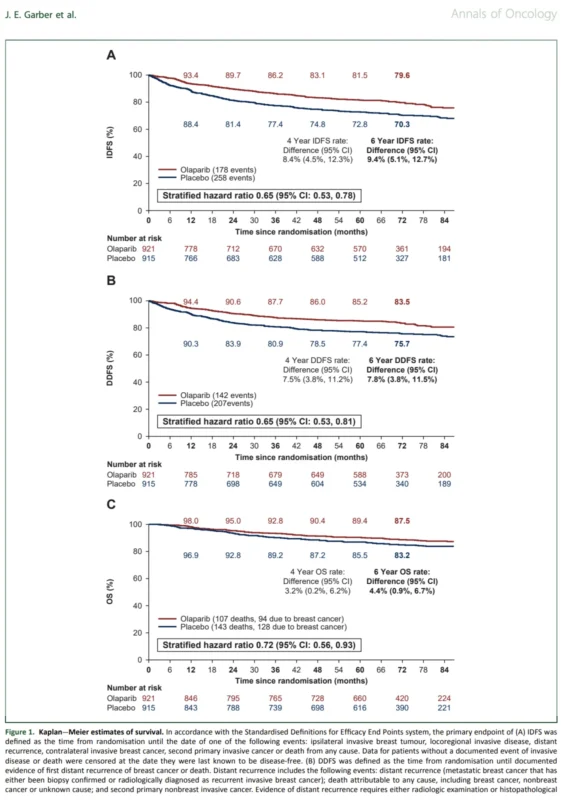
The IDFS Benefit Continues to Widen in Absolute Terms
With an additional 2.6 years of follow-up since the previous analysis, the invasive disease-free survival benefit remained substantial.
At six years, IDFS was:
- 79.6% with olaparib
versus
- 70.3% with placebo
corresponding to an absolute difference of 9.4 percentage points and a hazard ratio of:
- HR 0.65; 95% CI, 0.53–0.78
The Kaplan–Meier curves presented on page 5 show persistent separation between treatment groups through extended follow-up. Importantly, the absolute six-year difference in IDFS is larger than the four-year difference, supporting the interpretation that the early advantage was not lost once olaparib was discontinued.
This is particularly relevant in adjuvant therapy, where one of the central questions is whether treatment changes the long-term disease course or simply postpones recurrence. The current data favor a durable treatment effect.
Distant Recurrence Remains Meaningfully Reduced
The same pattern was observed for distant disease-free survival.
Six-year DDFS was:
- 83.5% with olaparib
versus
- 75.7% with placebo
for an absolute difference of 7.8 percentage points.
The hazard ratio was:
- HR 0.65; 95% CI, 0.53–0.81
There were 142 distant recurrences in the olaparib group compared with 207 in the placebo group. For patients with high-risk early breast cancer, this endpoint is particularly consequential because prevention of distant metastatic recurrence is ultimately one of the principal objectives of curative-intent systemic therapy.
Overall Survival Benefit Is Maintained at Six Years
The most clinically meaningful result is the persistence of the overall survival advantage.
Six-year overall survival was:
- 87.5% with olaparib
versus
- 83.2% with placebo
representing an absolute improvement of 4.4 percentage points.
The hazard ratio for death was:
- HR 0.72; 95% CI, 0.56–0.93
A total of 107 deaths occurred in the olaparib group compared with 143 in the placebo group, with breast cancer recurrence accounting for most deaths. The survival curves on page 5 remain separated at six years, despite patients having received only one year of study therapy. The updated data therefore reinforce a particularly important feature of OlympiA: olaparib is not merely reducing recurrence endpoints. Its effect translates into more patients remaining alive years after treatment.
Benefit Remains Consistent Across Major Clinical Subgroups
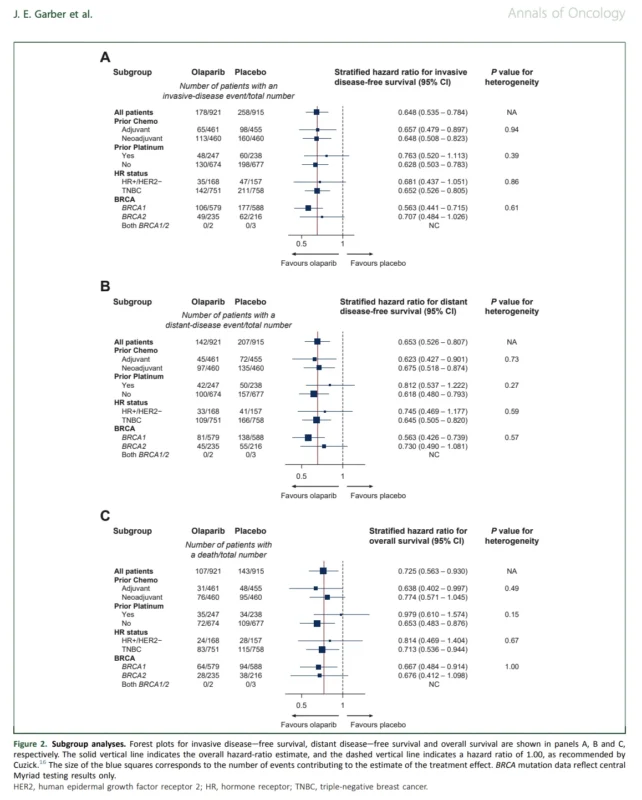
The updated analysis found no meaningful evidence of heterogeneity according to timing of chemotherapy, previous platinum exposure, hormone receptor status, or BRCA1 versus BRCA2 variant status This is important because the biology of BRCA-associated breast cancer differs substantially across subtypes.
BRCA1-associated breast cancers are predominantly triple-negative, whereas BRCA2-associated tumors are more frequently hormone receptor-positive and HER2-negative. OlympiA intentionally included both populations, based on the principle that PARP inhibition exploits homologous recombination deficiency regardless of hormone receptor phenotype (Garber et al., 2026).
The forest plots on page 7 support broadly consistent treatment effects across TNBC and HR-positive/HER2-negative disease, although the hormone receptor-positive subgroup is considerably smaller and therefore associated with wider confidence intervals. That nuance matters. The data support olaparib in the high-risk HR-positive population represented in OlympiA, but they should not automatically be extrapolated to lower-risk germline BRCA-associated HR-positive disease.
One Year of Therapy Produces Benefit Years Later
A particularly notable feature of OlympiA is the relationship between treatment duration and persistence of benefit. Patients received olaparib for only one year. Yet the current analysis occurs at a median follow-up of 6.1 years, with maximum follow-up approaching 9.6 years .
This suggests that targeting residual BRCA-deficient micrometastatic disease during a relatively limited postoperative therapeutic window can have durable consequences. The concept is biologically plausible. BRCA1- or BRCA2-deficient tumor cells have impaired homologous recombination repair and are particularly vulnerable to PARP inhibition through synthetic lethality. Eliminating residual susceptible clones early may reduce the reservoir from which future distant recurrence would otherwise develop.
The sustained separation of IDFS, DDFS, and OS curves provides clinical support for that strategy.
Long-Term MDS/AML Risk Remains Reassuring
One of the most closely watched aspects of extended PARP inhibitor follow-up is the risk of therapy-related myeloid malignancy. At 6.1 years, MDS/AML occurred in 0.4% of patients receiving olaparib and 0.7% receiving placebo. There were four cases in the olaparib group and six in the placebo group.
Pneumonitis occurred in 1.0% versus 1.4%, while new primary malignancies were reported in 4.9% versus 7.5%, respectively. Overall adverse events of special interest occurred in:
- 6.3% with olaparib
versus
- 9.3% with placebo
These findings are reassuring because MDS/AML has been an important long-term concern with PARP inhibition, particularly after substantial prior exposure to DNA-damaging chemotherapy.
However, the authors appropriately avoid considering the issue closed. Therapy-related hematologic malignancies can have long latency, and blinded follow-up of OlympiA is planned through 2029, ten years after enrollment of the final patient (Garber et al., 2026).
Fewer BRCA-Associated Second Cancers Were Observed
Extended follow-up also allows OlympiA to begin exploring an intriguing secondary question: could temporary PARP inhibition influence the development of additional BRCA-associated cancers? Fewer new invasive breast cancers were reported after randomization in the olaparib arm: 34 with olaparib versus 42 with placebo (Garber et al., 2026). The competing-risk HR for contralateral invasive breast cancer was 0.83 (95% CI, 0.52–1.32), and event numbers for ovarian and fallopian tube cancers remained too small for reliable hazard-ratio estimation.
The authors emphasize that these analyses remain exploratory. Risk-reducing mastectomy and salpingo-oophorectomy alter the amount of breast and ovarian tissue at risk over time, making interpretation complex. Nevertheless, continued follow-up may provide additional information on whether transient PARP inhibition has effects beyond recurrence of the index breast cancer.
The HR-Positive Population Raises Important Sequencing Questions
The long-term OlympiA data are increasingly relevant to a modern HR-positive early breast cancer landscape in which adjuvant CDK4/6 inhibitors may also be indicated.
The study authors note that patients meeting OlympiA criteria and carrying a germline BRCA1/2 pathogenic variant should receive one year of olaparib together with standard endocrine therapy. When CDK4/6 inhibition is also indicated, they describe a sequential approach in which olaparib precedes the CDK4/6 inhibitor rather than being given concurrently, because safety data for the combination are lacking and overlapping toxicities are a concern (Garber et al., 2026).
This is one of the practical challenges created by therapeutic progress. High-risk HR-positive disease may now have several evidence-based adjuvant options, but randomized trials have not defined every possible combination or sequence. OlympiA provides strong evidence for olaparib in the specific high-risk germline BRCA-positive population it studied. It does not establish the optimal integration of olaparib with every newer adjuvant therapy.
TNBC Has Changed Since OlympiA Was Designed
The treatment landscape for high-risk early TNBC has also evolved substantially since OlympiA enrollment. No patient in OlympiA received neoadjuvant pembrolizumab because the trial accrued before pembrolizumab became established in this setting. Consequently, OlympiA cannot directly answer whether adjuvant olaparib should be given concurrently with continued pembrolizumab after neoadjuvant chemoimmunotherapy.
The authors note that olaparib–checkpoint inhibitor combinations have demonstrated feasibility in metastatic disease, and contemporary consensus practice may use olaparib alongside continued pembrolizumab in germline BRCA-positive TNBC with residual disease. However, efficacy of the combination in early breast cancer has not been established in a randomized trial and the combination does not have specific regulatory approval for this setting.
This distinction should remain clear when translating OlympiA into current clinical practice.
Germline Testing Becomes a Treatment Decision, Not Only a Hereditary Cancer Question
Perhaps the most important implementation message from OlympiA is that germline BRCA testing can directly determine curative-intent systemic therapy. Historically, genetic testing was often viewed primarily through the lens of hereditary cancer counseling, surveillance, and risk-reducing surgery.
OlympiA fundamentally changed that framework. Failing to identify a germline BRCA1/2 pathogenic variant in an otherwise eligible patient may now mean missing an adjuvant therapy associated with an absolute 9.4% improvement in six-year IDFS and 4.4% improvement in six-year OS.
Garber and colleagues therefore emphasize the need for broad access to germline genetic testing so that appropriate patients can be identified while adjuvant treatment decisions are still being made (Garber et al., 2026). This may ultimately be one of OlympiA’s most durable effects on breast oncology practice.
Important Boundaries of the Evidence
The updated results are compelling, but several boundaries should remain clear. OlympiA evaluated germline, not solely somatic, BRCA1/2 pathogenic variants. It enrolled HER2-negative disease and cannot be extrapolated to HER2-positive breast cancer.
The HR-positive cohort represented high-risk disease, defined by CPS+EG ≥3 after neoadjuvant chemotherapy or at least four positive nodes after surgery. The benefit of olaparib in more moderate-risk HR-positive germline BRCA-associated disease remains unknown (Garber et al., 2026).
The study also predates several contemporary treatment strategies, including neoadjuvant pembrolizumab for TNBC and widespread adjuvant CDK4/6 inhibition for high-risk HR-positive disease. These limitations do not weaken the primary conclusion. They define the population in which the conclusion is strongest.
The Bottom Line
After a median follow-up of 6.1 years, one year of adjuvant olaparib continues to provide durable benefit for patients with germline BRCA1/2 pathogenic variants and high-risk HER2-negative early breast cancer.
The magnitude of benefit remains clinically meaningful:
- 6-year IDFS: 79.6% vs 70.3%. Absolute difference: 9.4% | HR 0.65
- 6-year DDFS: 83.5% vs 75.7%. Absolute difference: 7.8% | HR 0.65
- 6-year OS: 87.5% vs 83.2%. Absolute difference: 4.4% | HR 0.72
The benefit remains broadly consistent across major subgroups, including TNBC and high-risk HR-positive disease, BRCA1 and BRCA2 carriers, prior platinum exposure, and neoadjuvant versus adjuvant chemotherapy.
Equally important, extended follow-up has not revealed an excess of MDS/AML or other adverse events of special interest. OlympiA therefore provides a particularly strong example of precision oncology in the curative setting: one year of treatment selected by an inherited DNA-repair defect translates into fewer invasive recurrences, fewer distant recurrences, and more patients alive six years later.
The clinical implication extends beyond olaparib itself. For appropriate patients with high-risk HER2-negative early breast cancer, identifying germline BRCA1/2 status early enough to influence adjuvant therapy should be viewed as an integral part of treatment planning.
Reference
- Garber, J. E., Cameron, D., Campbell, C., Yothers, G., Taboada, M., El-Abed, S., Rastogi, P., McConnell, R., Correa, A., Delaloge, S., Liu, W. T., Sharma, P., Bergh, J., Janni, W., Balmaña, J., Loman, N., Španić, T., Friedman, S., Freeman, T., Armstrong, A., et al. (2026). Sustained benefit of adjuvant olaparib in women with germline BRCA1- and BRCA2-associated high-risk HER2-negative early breast cancer: Updated results from the OlympiA phase III trial. Annals of Oncology. Advance online publication. https://doi.org/10.1016/j.annonc.2026.08.002.