
Adjuvant therapy for hormone receptor-positive, HER2-negative early breast cancer is becoming increasingly effective, and increasingly intensive. For patients considered at intermediate or high risk of recurrence, endocrine therapy may now be combined with years of CDK4/6 inhibition in an effort to reduce the probability of distant relapse.
But not every patient who meets clinicopathologic eligibility criteria will ultimately recur. That creates a major unanswered question in contemporary breast oncology: can we identify, after definitive treatment, which patients truly need treatment escalation and which patients can safely avoid it?
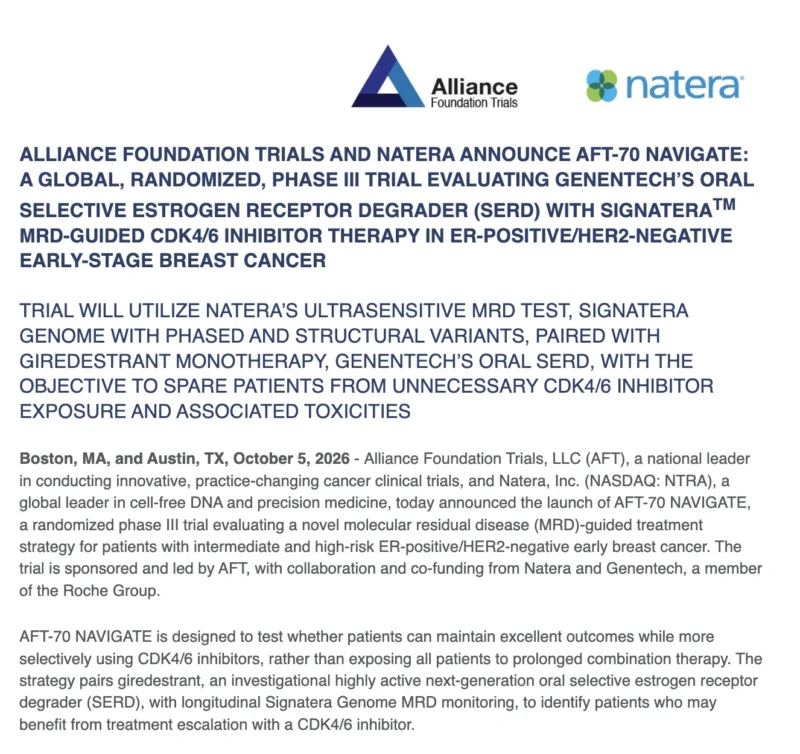
The newly announced phase III AFT-70 NAVIGATE trial will test an ambitious answer. Rather than giving every eligible patient an upfront CDK4/6 inhibitor, the study will use longitudinal circulating tumor DNA-based molecular residual disease testing to determine when escalation is necessary. The investigational strategy pairs giredestrant, a next-generation oral selective estrogen receptor degrader, with serial Signatera Genome MRD monitoring, adding a CDK4/6 inhibitor only if molecular residual disease becomes detectable.
If successful, NAVIGATE could shift adjuvant treatment from a model based predominantly on risk measured at diagnosis toward one in which treatment intensity changes dynamically according to molecular evidence of residual disease.
The Problem: Risk at Diagnosis Is Not the Same as Residual Risk
Adjuvant treatment decisions in ER-positive/HER2-negative early breast cancer traditionally rely on features available around diagnosis and surgery: tumor size, nodal involvement, grade, proliferation, genomic assays, menopausal status, and other clinicopathologic factors. These tools are essential for estimating recurrence risk, but they remain probabilistic.
Two patients with apparently similar stage II or III disease may have very different outcomes after surgery, radiation, chemotherapy when indicated, and endocrine therapy. One may already have been cured by local and systemic treatment. Another may harbor microscopic disease capable of eventually producing distant recurrence. Current treatment decisions cannot directly visualize that difference.
NAVIGATE is built around the possibility that serial ctDNA MRD testing can provide a more dynamic estimate of residual cancer risk after treatment. Rather than asking only, “Was this patient high risk at diagnosis?”, the trial asks a different question:
“Is there molecular evidence that cancer remains?”
More Than 2,000 Patients and Approximately 200 Sites
Alliance Foundation Trials expects AFT-70 NAVIGATE to enroll more than 2,000 patients with stage II–III ER-positive/HER2-negative breast cancer who are candidates for endocrine therapy.
The study is planned across approximately 200 sites in the United States and internationally. It is sponsored and led by Alliance Foundation Trials, with collaboration and co-funding from Natera and Genentech. allianceforclinicaltrialsinoncology.org
Patients will first complete appropriate standard-of-care treatment, including:
- surgery
- radiotherapy
- chemotherapy when indicated.
The key population for randomization is then patients in whom Signatera does not detect molecular residual disease. That design is important. NAVIGATE is not asking how to treat patients who are already clearly ctDNA positive at study entry. Instead, it is testing whether MRD negativity can be used to justify deferring CDK4/6 inhibition while continuing intensive molecular surveillance.
Two Very Different Adjuvant Strategies
MRD-negative patients will be randomized between two approaches. The control arm will receive standard-of-care endocrine therapy plus upfront CDK4/6 inhibition. The investigational arm will receive giredestrant monotherapy, with serial Signatera monitoring. A CDK4/6 inhibitor will be introduced only if the patient’s MRD test subsequently becomes positive.
This distinction is fundamental. The experimental strategy is not simply: CDK4/6 inhibitor versus no CDK4/6 inhibitor.
It is:
- treat everyone upfront
versus
- monitor molecularly and reserve escalation for patients showing evidence of residual disease.
The second approach therefore transforms ctDNA from a prognostic biomarker into a potential treatment-triggering biomarker. That is a much higher evidentiary bar.
The Primary Question Is Non-Inferiority
The primary endpoint is 4-year distant recurrence-free survival, evaluated using a non-inferiority framework. allianceforclinicaltrialsinoncology.org This choice reflects the trial’s central objective. NAVIGATE does not primarily aim to show that withholding upfront CDK4/6 inhibition produces superior cancer outcomes.
Instead, it asks whether a biomarker-guided strategy can preserve excellent distant disease control while reducing unnecessary exposure to prolonged CDK4/6 therapy. A positive trial would therefore need to establish that de-escalation does not result in an unacceptable loss of efficacy.
That is precisely the type of question increasingly relevant in modern breast oncology. Once effective escalation strategies become available, the next step is determining who actually requires them.
Why CDK4/6 De-Escalation Matters
Adjuvant CDK4/6 inhibition has expanded treatment options for patients with HR-positive/HER2-negative early breast cancer at increased risk of recurrence. But these therapies also create treatment burden. Depending on the specific agent and regimen, patients may face prolonged therapy, laboratory monitoring, gastrointestinal or hematologic toxicities, fatigue, drug interactions, dose modifications, treatment interruptions, and the practical burden of maintaining another anticancer therapy for years.
The question is therefore not whether CDK4/6 inhibitors can reduce recurrence risk in appropriately selected populations. They can. The more difficult question is whether every clinically eligible patient needs the same treatment intensity from the beginning.
As study co-chair Gaorav Gupta summarized in the trial announcement, the rationale is rooted in a simple principle: more treatment is not necessarily better treatment if the same cancer control can be maintained with less exposure.
Giredestrant Becomes the Endocrine Backbone
NAVIGATE also represents an important step for giredestrant. Giredestrant is an investigational next-generation oral SERD designed to inhibit and degrade the estrogen receptor.
Alliance selected it as the endocrine backbone for the experimental arm following the phase III lidERA trial, which was reported to have met its primary endpoint, demonstrating a statistically significant and clinically meaningful improvement in invasive disease-free survival compared with standard endocrine monotherapy in ER-positive/HER2-negative early breast cancer. allianceforclinicaltrialsinoncology.org
The NAVIGATE design therefore combines two emerging concepts:
- a next-generation endocrine backbone
and
- longitudinal MRD-guided escalation.
That combination makes the trial particularly interesting, but it also creates an important interpretive consideration. If NAVIGATE is positive, the study will validate the overall treatment strategy. Because the experimental arm differs from the control arm both in endocrine backbone and in timing of CDK4/6 inhibition, the contribution of each individual component cannot necessarily be separated from the randomized comparison.
That is not a flaw in the design; it simply means NAVIGATE should be interpreted as a strategy trial rather than a pure test of ctDNA alone.
What Makes Signatera Genome Different?
The trial will use Signatera Genome with Phased and Structural Variants, which Natera describes as an ultrasensitive MRD platform with analytical sensitivity below 1 part per million. According to the Alliance announcement, the assay was selected partly because of existing clinical evidence in HR-positive/HER2-negative early breast cancer, including analyses from AFT-05 PALLAS and monarchE.
The sensitivity question is particularly important in HR-positive breast cancer. Unlike some more aggressive subtypes, ER-positive disease can recur many years after initial diagnosis. Minimal residual tumor burden may therefore remain extremely low for prolonged periods before becoming clinically apparent.
For MRD-guided de-escalation to be safe, a negative blood test must carry enough prognostic reassurance that treatment can reasonably be deferred, and serial testing must detect emerging molecular relapse early enough for therapeutic intervention to still make a meaningful difference. NAVIGATE is designed to test that concept prospectively rather than assuming it.
MRD Positivity Becomes an Intervention Trigger
Many ctDNA studies in early breast cancer have shown that molecular detection can precede clinical relapse. But detecting recurrence earlier is not automatically useful. For an MRD test to change outcomes, clinicians need evidence that acting on the result improves or preserves clinically meaningful endpoints.
This is where NAVIGATE moves beyond purely prognostic ctDNA research. In the experimental arm, conversion from MRD negative to MRD positive will directly change treatment by triggering addition of a CDK4/6 inhibitor. The critical question is therefore not merely whether Signatera predicts recurrence. It is whether using serial MRD results to determine the timing of therapy can preserve distant recurrence-free survival. That is a fundamentally different clinical question.
A Negative ctDNA Test Cannot Yet Be Interpreted as “No Cancer”
This distinction will be essential while the trial is ongoing. MRD negativity should not currently be interpreted as proof that a patient is cured. Every ctDNA assay has limits of detection. Tumors may shed different quantities of DNA into circulation, and very small residual deposits may remain below detection thresholds.
This challenge is especially relevant in ER-positive disease, where late recurrence can occur after a prolonged clinically silent interval. For that reason, AFT-70 NAVIGATE should not be interpreted as evidence that clinicians can currently omit an indicated adjuvant CDK4/6 inhibitor simply because a commercially available ctDNA assay is negative. The trial is being conducted precisely because that strategy still requires prospective validation.
Dynamic Risk Rather Than Static Risk
Study chair Komal Jhaveri, MD, highlighted one of the most important conceptual aspects of NAVIGATE: conventional adjuvant treatment decisions are largely determined by clinical and pathological features measured at diagnosis, whereas longitudinal MRD testing could provide a dynamic measure of recurrence risk. allianceforclinicaltrialsinoncology.org
This may represent the broader importance of the trial. Today, a patient might be classified as high risk once and then receive years of intensified therapy based on that initial classification.
A future MRD-directed model could theoretically look different:
- high baseline clinical risk
→ definitive treatment
→ MRD negative
→ endocrine therapy with surveillance
→ continued MRD negativity
→ avoid unnecessary escalation
or
→ molecular conversion to MRD positive
→ escalate therapy before radiographically visible relapse.
That would turn adjuvant treatment into an adaptive process rather than a decision made almost entirely at the beginning of therapy.
But Several Questions Must Be Answered
The scientific promise is substantial, but so are the unanswered questions. First, how reliable is persistent MRD negativity as a negative predictive marker in ER-positive breast cancer, particularly given the long natural history of late recurrence?
Second, if ctDNA becomes positive, is adding a CDK4/6 inhibitor at that point early enough to prevent clinical metastatic relapse? Third, what proportion of initially MRD-negative patients will eventually convert to positive? Fourth, how frequently should MRD testing occur to balance sensitivity, cost, patient anxiety, and clinical usefulness?
And finally, will reductions in treatment exposure and toxicity be sufficiently large to justify a surveillance-based approach? AFT-70 NAVIGATE is ambitious because it addresses several of these questions simultaneously.
The Trial Also Reflects a Broader De-Escalation Movement
Breast oncology has increasingly embraced the principle that precision medicine should not mean only adding therapies. Modern trials are also attempting to identify situations in which surgery, radiation, chemotherapy, endocrine therapy, or targeted therapy can be safely reduced.
NAVIGATE applies this philosophy to molecular monitoring. The trial does not begin with the assumption that all intermediate- or high-risk patients require maximum adjuvant treatment.
Instead, it asks whether highly sensitive longitudinal biology can identify who can safely receive less, and who needs more later. That is a distinctly different form of precision oncology.
The Bottom Line
AFT-70 NAVIGATE is a global randomized phase III trial expected to enroll more than 2,000 patients with stage II–III ER-positive/HER2-negative early breast cancer at approximately 200 sites. Patients who remain MRD negative after standard local and systemic treatment will be randomized between:
- standard endocrine therapy + upfront CDK4/6 inhibition
and
- giredestrant alone with longitudinal Signatera Genome monitoring, adding CDK4/6 inhibition only if MRD becomes detectable.
The primary endpoint is non-inferiority in 4-year distant recurrence-free survival. allianceforclinicaltrialsinoncology.org No efficacy results are available yet, and current standards should not change on the basis of the trial announcement.
But the question NAVIGATE is asking may be one of the most important in modern adjuvant breast oncology. Until now, escalation has largely been based on estimating who might recur. NAVIGATE asks whether circulating tumor DNA can identify who still appears to harbor disease, and therefore who actually needs escalation.
If that strategy works, MRD could move from predicting recurrence to directing the intensity and timing of adjuvant treatment itself.
Source
- Alliance Foundation Trials. (2026, October 5). Alliance Foundation Trials and Natera announce AFT-70 NAVIGATE: A global, randomized, phase III trial evaluating Genentech’s oral selective estrogen receptor degrader with Signatera MRD-guided CDK4/6 inhibitor therapy in ER-positive/HER2-negative early-stage breast cancer.