
Could Michelangelo have intentionally depicted breast cancer more than five centuries ago? An interdisciplinary investigation published in The Breast identified anatomical abnormalities in a female figure in the Sistine Chapel fresco The Flood. Although the researchers concluded that the changes were suggestive of breast carcinoma, a subsequent scientific exchange has challenged how confidently medicine can diagnose disease in historical works of art.
The intersection of medicine and art history has produced an unusual debate surrounding one of the Renaissance’s most celebrated masterpieces. In a study published online on October 19, 2024, in The Breast, Andreas G. Nerlich and colleagues examined a female figure in Michelangelo’s The Flood, one of the biblical scenes painted on the ceiling of the Sistine Chapel.
The investigators proposed that the woman’s right breast contains several morphological abnormalities consistent with breast cancer, including nipple retraction, skin deformation, and possible nodular lesions. Their findings were based on a multidisciplinary approach known as iconodiagnosis, which combines medical observations with historical and artistic analysis.
However, the interpretation has remained controversial. In March 2026, radiologist Paul Gelinsky questioned whether the visible abnormalities necessarily indicated malignancy, suggesting that posture, aging, and artistic symbolism could provide alternative explanations.
The original investigators responded in June 2026, defending the anatomical basis of their hypothesis while acknowledging the importance of careful interpretation.
Together, the publications raise a fascinating question: Can a Renaissance painting provide meaningful evidence of disease, or does modern medical expertise risk projecting contemporary diagnoses onto artistic representations?
The Flood: A Biblical Scene With an Unexpected Medical Detail
Michelangelo began painting the Sistine Chapel ceiling in 1508 under the commission of Pope Julius II. Among its earliest scenes was The Flood, depicting humanity’s desperate attempts to survive the catastrophic deluge described in the Book of Genesis.
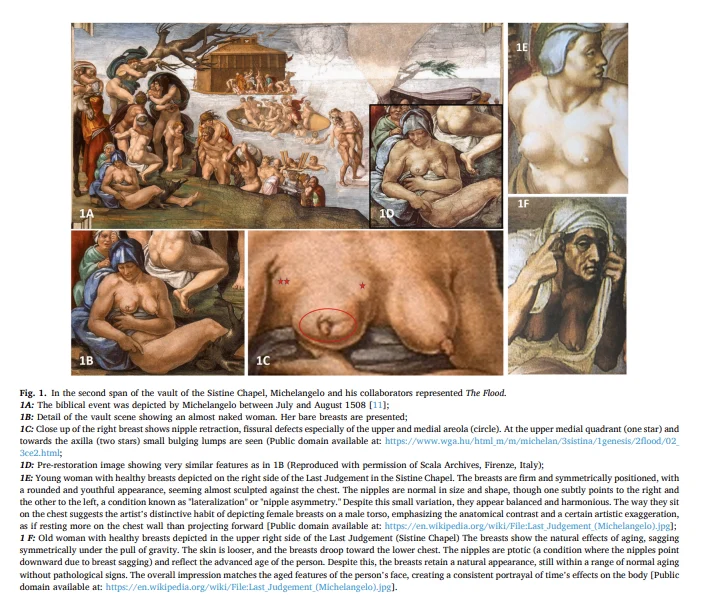
The fresco presents numerous figures attempting to escape rising water, carrying possessions, protecting children, and seeking refuge. Amid this dramatic composition, the researchers focused on a partially clothed woman wearing a blue headscarf and cloak.
Her right breast is exposed, allowing relatively detailed observation of its shape and surface. Although the scene has been studied extensively for its artistic and theological significance, the authors proposed that the woman’s breast morphology could also carry a medically recognizable message.
The investigation was conducted by specialists from several fields, including medical oncology, pathology, paleopathology, genetics, and art history. Rather than relying exclusively on a contemporary clinician’s visual impression, the team attempted to evaluate the artwork systematically.
What Did the Researchers Identify?
The study’s central observation concerns the asymmetry between the woman’s breasts. According to the investigators, the left breast shows relatively smooth contours and a prominent nipple, with changes potentially compatible with normal aging or previous breastfeeding.
The right breast, however, appears markedly different. The authors identified several anatomical findings that they considered suspicious. First, the nipple appears retracted and deformed. Second, the surrounding areolar region shows irregularity and apparent skin retraction.
Third, a deep indentation is visible above the nipple, creating a scar-like appearance. The investigators also described a slight bulge in the upper medial breast, interpreted as potentially representing a palpable mass.
An additional prominence toward the axillary region was considered a possible manifestation of enlarged lymph nodes.
Importantly, the authors did not identify a clearly visible ulcer. They also cautioned that an area of discoloration should not automatically be interpreted as the characteristic skin changes associated with inflammatory breast cancer.
From a contemporary clinical perspective, acquired nipple retraction, focal skin tethering, and a suspicious breast mass can be manifestations of invasive breast carcinoma. However, such findings are not specific to malignancy.
Their diagnostic significance in living patients depends on clinical history, physical examination, imaging, and, when indicated, tissue sampling. A painted representation cannot provide those additional forms of evidence. Consequently, the researchers’ interpretation is best understood as a retrospective anatomical hypothesis rather than an established diagnosis.
Iconodiagnosis: Diagnosing Disease Through Historical Art
The methodology used in the investigation is called iconodiagnosis. This interdisciplinary field examines representations of physical abnormalities in paintings, sculptures, and other historical artworks to determine whether they may reflect recognizable medical conditions.
The approach can involve physicians, pathologists, historians, archaeologists, and art conservation specialists. Its central challenge is distinguishing genuine pathological features from artistic conventions, anatomical exaggeration, damage, restoration artifacts, and the limitations of the medium itself.
In the Michelangelo study, the investigators applied published iconodiagnostic recommendations. They examined the anatomical appearance of the female figure, considered possible alternative diagnoses, and compared the fresco with images obtained before restoration.
The comparison was particularly important because restoration can alter perceived color, texture, and visual contrast. According to the authors, the relevant breast abnormalities were also visible in historical images, suggesting that they were not introduced by modern restoration.
The team additionally compared the fresco with other female figures depicted by Michelangelo, particularly in The Last Judgment. The authors argued that Michelangelo’s broader body of work demonstrates an ability to represent normal breast anatomy in different forms, making the apparent asymmetry in The Flood potentially meaningful.
Their paper characterized the diagnosis using a Level I designation within the iconodiagnostic framework. This designation, however, should not be confused with Level I clinical evidence from randomized trials or histopathologically confirmed disease. It reflects the authors’ assessment of the artwork under an interpretive framework.
Could Other Conditions Explain the Abnormalities?
The investigators considered several alternative explanations. Benign inflammatory conditions, including mastitis, can produce breast changes that resemble cancer. Tuberculous mastitis, although uncommon, can present with nodularity and breast distortion.
Chronic inflammatory processes, trauma, and other nonmalignant abnormalities may also produce irregularities involving the breast and nipple. Some of these conditions were considered less consistent with the morphology depicted in the fresco.
Nevertheless, their exclusion remains inherently limited. The patient does not exist as an identifiable clinical subject, and no information is available regarding symptoms, disease duration, medical history, or subsequent outcomes.
Furthermore, Michelangelo’s representation was not a clinical drawing. The anatomy may have been modified to achieve compositional balance, express emotion, or communicate a symbolic message. This creates a central methodological problem: features that would merit investigation in a real patient do not necessarily indicate that the artist intended to reproduce a medical condition.
Michelangelo’s Anatomical Knowledge: A Possible Explanation
The study also examines Michelangelo’s familiarity with human anatomy. Michelangelo is widely recognized for his detailed understanding of muscular and skeletal structures. His anatomical studies and experience with dissection may have influenced the extraordinary physical realism of his paintings and sculptures.
The authors suggest that this background could have enabled him to recognize and reproduce visible signs of disease. They also refer to earlier medical interpretations of Michelangelo’s sculpture Night, located in the Medici Chapels in Florence.
Previous investigators proposed that the sculpture’s breast morphology might be compatible with malignancy. That interpretation has itself generated debate. The new study therefore places The Flood within a broader history of attempts to identify medical conditions in Renaissance art.
However, anatomical sophistication does not independently establish that Michelangelo deliberately depicted breast carcinoma. The presence of a visually unusual breast, even if accurately rendered, cannot reveal the artist’s intentions without additional historical evidence.
Cancer as a Symbol of Mortality
Beyond the anatomical interpretation, the researchers explored the fresco’s theological meaning. The Flood portrays human vulnerability, divine judgment, destruction, and mortality. The investigators proposed that a visibly diseased breast might reinforce these themes.
Within their interpretation, the woman’s physical abnormalities could symbolize the fragility of life and the inevitability of death. They also discuss the position of the woman’s hand, suggesting that its downward-pointing gesture might evoke the biblical association between human mortality and returning to dust.
This interpretation places the suspected pathology within the visual language of Renaissance religious art. However, the symbolic explanation remains speculative. There is no surviving statement from Michelangelo confirming that the breast represents cancer or that the artist intended to connect the figure’s physical appearance with a specific theological message.
It is also important to distinguish the historical interpretation of religious symbolism from contemporary medicine. Cancer is a biological disease, not a punishment for moral conduct. Discussions of historical religious imagery should not be confused with medical explanations of disease causation.
A New Scientific Challenge Emerges in 2026
The interpretation attracted further scrutiny when Paul Gelinsky published a letter in The Breast in March 2026. Gelinsky acknowledged that the woman’s right breast could resemble a tumor but argued that individual anatomical features should be interpreted cautiously.
One of his principal criticisms concerned the apparent prominence near the axilla. He suggested that the positioning and elevation of the breast by the woman’s arm could explain the visible contour without requiring enlarged lymph nodes.
This distinction is important because a raised or compressed breast can create folds and protrusions that resemble pathological changes. Gelinsky also questioned whether the fresco required a specific medical interpretation.
He proposed that the female figure might instead represent aging and acceptance of inevitable death, themes already embedded in the biblical narrative. His criticism extended to the broader methodological risks of iconodiagnosis.
When clinicians observe historical art, their specialized knowledge may influence which details they notice and how they interpret them. A physician familiar with breast cancer may be particularly attentive to anatomical features that resemble malignancy.
This phenomenon raises the possibility of interpretation bias. In the absence of clinical confirmation, several competing explanations may remain plausible.
The Original Authors Defend Their Interpretation
In June 2026, Serena Di Cosimo and colleagues published a formal response to Gelinsky’s criticism. The authors emphasized that their hypothesis was not based on a single visible abnormality. Instead, they argued that the combined morphology of the nipple, areola, surrounding skin, and breast contour made the interpretation worth considering.
They acknowledged that posture could contribute to the axillary prominence but maintained that this alone did not explain the full appearance of the breast. The response also challenged the assumption that artistic symbolism and anatomical accuracy must be mutually exclusive.
According to the authors, Michelangelo could have used a recognizable physical abnormality as an artistic device within a larger religious allegory. In this framework, medical detail and symbolic meaning could reinforce each other.
The researchers further argued that iconodiagnosis should remain open to structured interpretation rather than dismissing unusual anatomical details as artistic distortion. At the same time, they recognized that media sensationalism can misrepresent an appropriately qualified scientific hypothesis.
The exchange illustrates the central tension in the field. One perspective emphasizes the possibility that historical artists deliberately incorporated realistic medical observations. The other emphasizes the danger of assigning clinical diagnoses to images that were never intended as medical evidence. Neither position can conclusively establish whether the figure in The Flood represents breast carcinoma.
Why the Diagnosis Cannot Be Confirmed
Despite the detailed anatomical discussion, several fundamental limitations remain. First, the study examines a painted figure rather than an identifiable historical patient. There is no medical record, tissue specimen, imaging study, or pathological confirmation. Second, the relationship between artistic representation and actual anatomy is uncertain.
Michelangelo frequently employed idealized or exaggerated anatomy to communicate movement, emotion, and symbolic meaning. Third, historical restoration and changes in visual perception can influence the appearance of details.
Although the investigators evaluated pre-restoration images, this cannot eliminate every source of interpretive uncertainty. Fourth, the presence of breast cancer-like characteristics does not determine whether the underlying condition was malignant.
Even in modern clinical practice, nipple inversion or skin distortion requires appropriate diagnostic evaluation rather than interpretation from appearance alone. Finally, the artist’s intentions remain unknown.
It is possible that Michelangelo consciously depicted disease. It is also possible that the apparent abnormalities reflect anatomy, posture, aging, or an artistic decision unrelated to malignancy. The study cannot distinguish definitively among these possibilities.
What This Debate Reveals About Medicine and Visual Interpretation
The significance of this research extends beyond the possibility of identifying breast cancer in a Renaissance masterpiece. It illustrates how medical expertise shapes the interpretation of visual information. Clinical medicine often begins with the recognition of patterns.
A radiologist examines changes in tissue architecture, a pathologist identifies cellular abnormalities, and an oncologist integrates multiple findings to formulate a diagnosis. However, the reliability of those interpretations depends on the quality of available evidence and the opportunity for independent confirmation.
Historical artwork lacks many of those safeguards. Consequently, iconodiagnosis must be approached as a multidisciplinary interpretive exercise rather than a substitute for conventional medical diagnosis. At its strongest, the field can identify clinically recognizable features, generate historical questions, and encourage collaboration between medicine and the humanities.
At its weakest, it risks transforming visual resemblance into unsupported diagnostic certainty. The debate surrounding Michelangelo’s The Flood demonstrates both the potential and the limitations of this approach.
OncoDaily Takeaway
More than five centuries after Michelangelo painted The Flood, an unusual anatomical detail has become the subject of a modern scientific debate. The 2024 study by Nerlich and colleagues identified nipple retraction, skin deformation, and possible nodular changes that the investigators considered consistent with breast cancer.
However, subsequent correspondence published in 2026 highlighted alternative explanations, including posture, aging, and artistic symbolism. The original authors defended their interpretation, emphasizing the combined morphological findings and the possibility that Michelangelo intentionally integrated medical realism into a religious allegory.
The debate remains unresolved. The most defensible conclusion is not that Michelangelo definitively painted breast cancer, but that his artwork contains features recognizable to contemporary breast specialists—features whose meaning cannot be established without historical or clinical confirmation.
The story offers a compelling reminder that medicine and art share a reliance on careful observation, but that recognizing a pattern is not the same as proving a diagnosis.
Sources
- Nerlich AG, Dewaal JC, Perciaccante A, Di Cosimo S, Cortesi L, Wimmer J, Donell ST, Bianucci R. Did Michelangelo Paint a Young Adult Woman With Breast Cancer in “The Flood” (Sistine Chapel, Rome)? The Breast. 2024;78:103823. DOI: 10.1016/j.breast.2024.103823
- Gelinsky P. Letter to the Editor on the Proposed Diagnosis of Breast Cancer in Michelangelo’s “The Flood”. The Breast. 2026;88:104755. DOI: 10.1016/j.breast.2026.104755
- Di Cosimo S, Nerlich AG, DeWaal JC, et al. Reply to Letter to the Editor Concerning Michelangelo’s “The Flood”. The Breast. 2026;88:104827. DOI: 10.1016/j.breast.2026.104827