
A new retrospective study published in JCO Precision Oncology highlights the persistent challenges of treating metaplastic breast cancer, a rare and aggressive histologic subtype frequently characterized by triple-negative disease and resistance to conventional systemic therapy. Among 85 patients receiving neoadjuvant treatment, pathologic complete response was achieved in 17.6% of patients treated with chemotherapy alone and 26.5% of those receiving chemotherapy plus immunotherapy. Although distant metastatic recurrence was observed less frequently in the chemoimmunotherapy cohort, important differences in baseline characteristics and follow-up limit direct comparisons. Notably, none of the patients achieving pathologic complete response developed distant metastases during follow-up, underscoring the potential prognostic importance of treatment response in this challenging disease.
The treatment of metaplastic breast cancer remains one of the most difficult challenges in breast oncology. Although metaplastic breast cancer (MpBC) accounts for approximately 1% of breast cancers, its clinical behavior differs substantially from that of more common invasive breast carcinomas.
Characterized by heterogeneous histologic differentiation, frequent triple-negative receptor status, high tumor grade, and relative resistance to systemic treatment, MpBC is associated with unfavorable outcomes and an increased risk of recurrence. Over the past several years, the treatment landscape of early triple-negative breast cancer (TNBC) has evolved significantly.
The introduction of pembrolizumab into neoadjuvant chemotherapy through KEYNOTE-522 established a new treatment standard for many patients with stage II–III TNBC, improving pathologic complete response (pCR), event-free survival, and overall survival.
However, whether these advances translate into comparable benefits for patients with metaplastic histology has remained uncertain. Patients with MpBC represent a biologically distinct subgroup, and their outcomes have not been separately characterized in the pivotal KEYNOTE-522 publications.
A new study led by Kaitlin Demarest and colleagues at the University of Pennsylvania provides important evidence addressing this gap. Published in JCO Precision Oncology on November 25, 2026, the study examined pathologic response and recurrence following neoadjuvant chemotherapy alone or chemotherapy combined with immunotherapy among patients with nonmetastatic metaplastic breast cancer.
The findings reveal that pCR rates remained relatively low even with contemporary chemoimmunotherapy, while achievement of pCR was associated with favorable outcomes during follow-up.
Understanding the Challenge of Metaplastic Breast Cancer
Metaplastic breast cancer represents a heterogeneous group of tumors characterized by differentiation into epithelial and nonepithelial cellular components. Recognized as a distinct histologic entity by the World Health Organization, MpBC includes several subtypes, such as squamous cell carcinoma, spindle cell carcinoma, and tumors showing heterologous mesenchymal differentiation.
Some tumors contain multiple histologic patterns, further complicating classification and treatment selection. Most metaplastic breast cancers lack estrogen receptor, progesterone receptor, and HER2 expression. Consequently, many patients are treated according to therapeutic approaches developed for conventional TNBC.
However, shared receptor status does not necessarily indicate shared biological behavior or treatment sensitivity. Historically, neoadjuvant chemotherapy has produced substantially lower pCR rates in MpBC than in conventional triple-negative invasive ductal carcinoma.
Previous reports have described chemotherapy-induced pCR rates ranging from approximately 0% to 23% in metaplastic disease, compared with substantially higher response rates in broader TNBC populations receiving contemporary multiagent chemotherapy.
Molecular studies have also identified biological alterations involving the PI3K/AKT pathway, cell-cycle regulation, MAPK signaling, and Wnt pathway activity in selected metaplastic tumors.
These observations have raised questions about whether conventional chemotherapy is sufficient for this histologic subtype and whether immunotherapy could overcome some mechanisms of treatment resistance.
Although increased PD-L1 expression and genomic instability have been reported in subsets of MpBC, clinical evidence supporting immunotherapy specifically in this population remains limited. The study by Demarest and colleagues therefore addresses an important clinical uncertainty: whether the incorporation of immunotherapy into neoadjuvant treatment meaningfully changes response and recurrence outcomes in metaplastic breast cancer.
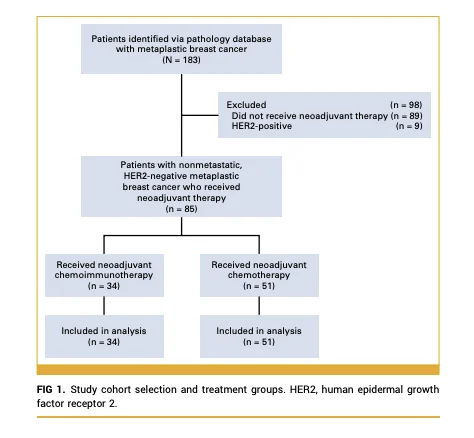
Study Design: 85 Patients Treated Across Different Therapeutic Eras
The investigators conducted a retrospective observational study using pathology and treatment records from the University of Pennsylvania. Eligible patients had nonmetastatic, HER2-negative metaplastic breast cancer and received neoadjuvant systemic therapy between January 2010 and June 2024.
Patients were identified through pathology database searches followed by review of electronic health records and available tumor specimens. The analysis included 85 patients, divided into two treatment cohorts. Fifty-one patients received neoadjuvant chemotherapy alone (NAC), while 34 received neoadjuvant chemotherapy combined with immunotherapy (NACI).
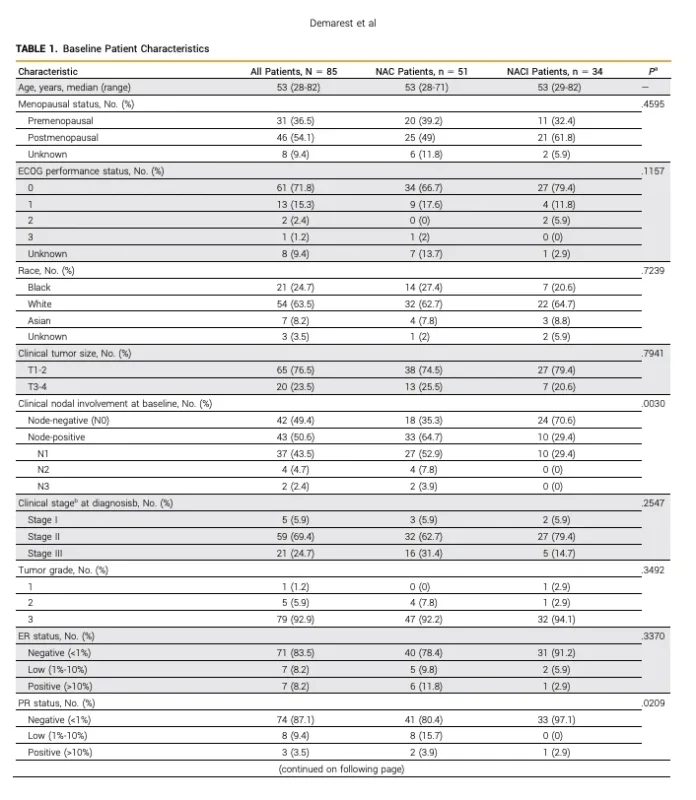
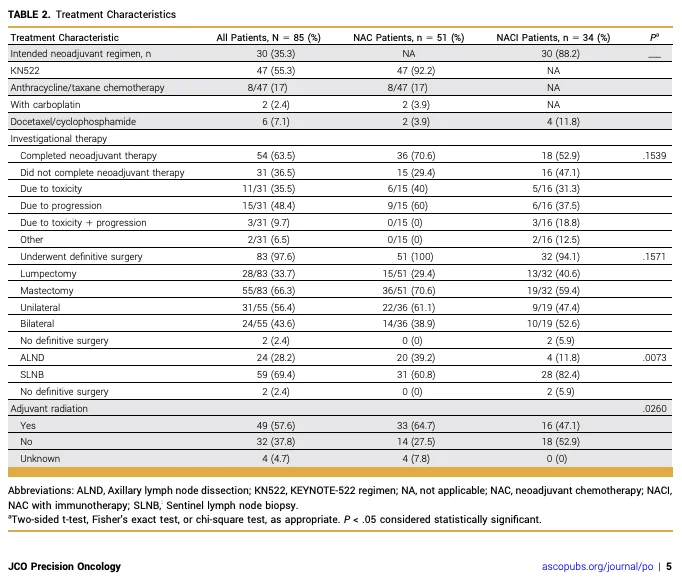
Most patients in the chemotherapy-only cohort were treated with anthracycline- and taxane-based regimens, with or without carboplatin. In the chemoimmunotherapy cohort, 88.2% initiated a KEYNOTE-522–based regimen incorporating carboplatin, paclitaxel, pembrolizumab, anthracycline, and cyclophosphamide.
The remaining patients received alternative chemoimmunotherapy approaches, including investigational regimens. Median age was 53 years, and most patients had stage II disease. Overall, 92.9% had grade 3 tumors, while 83.5% were estrogen receptor-negative.
The study included different histopathologic subtypes, most commonly mixed metaplastic carcinoma, followed by tumors with heterologous mesenchymal differentiation. Importantly, the two treatment cohorts were not clinically equivalent.
Baseline nodal involvement was considerably more common among patients receiving chemotherapy alone. Approximately 64.7% of NAC patients were clinically node-positive, compared with 29.4% of NACI patients. The difference was statistically significant (P = 0.003).
Treatment periods also differed substantially. Most chemotherapy-only patients received treatment before routine incorporation of immunotherapy, whereas the chemoimmunotherapy cohort reflected more contemporary practice. These differences are essential when interpreting the results, particularly recurrence outcomes.
Pathologic Complete Response Remains Low Despite Chemoimmunotherapy
The study’s principal finding was that the addition of immunotherapy did not produce the high pCR rates typically associated with contemporary treatment of histologically unselected TNBC. Among all 85 patients who initiated neoadjuvant treatment, the overall pCR rate was 21.2%.
Pathologic complete response occurred in 9 of 51 patients (17.6%) receiving chemotherapy alone and 9 of 34 patients (26.5%) receiving chemotherapy plus immunotherapy. Although the pCR rate was numerically higher in the chemoimmunotherapy cohort, the difference was not statistically significant (P = 0.1087).
Among the 83 patients who underwent definitive surgery, the corresponding pCR proportions were 17.6% and 28.1%. These findings suggest that metaplastic histology may remain relatively resistant to neoadjuvant systemic treatment even in the immunotherapy era.
The observed pCR rate with chemoimmunotherapy was notably lower than the rates reported in the broader KEYNOTE-522 population. However, direct cross-study comparisons should be interpreted cautiously because MpBC differs in its clinical and biological characteristics, and the current study included relatively few patients.
Importantly, the absence of a statistically significant difference does not establish that immunotherapy provides no benefit. The cohort was small, nonrandomized, and not adequately powered to determine the incremental efficacy of immunotherapy in metaplastic breast cancer. Nevertheless, the results highlight a persistent therapeutic gap.
The substantial improvement in pCR observed with chemoimmunotherapy in conventional TNBC cannot automatically be assumed to extend to metaplastic breast cancer.
Treatment Completion May Influence Pathologic Response
An additional finding concerned the relationship between treatment completion and pCR. Only 54 of 85 patients (63.5%) completed their intended neoadjuvant treatment. Completion was achieved in 70.6% of patients receiving chemotherapy alone and 52.9% of those receiving chemoimmunotherapy.
Treatment discontinuation occurred because of toxicity, disease progression, or other circumstances. Among patients who completed all planned neoadjuvant treatment, the overall pCR rate was 29.6%. The rate was 22.2% among chemotherapy-only patients and 44.4% among patients receiving chemoimmunotherapy.
By comparison, pCR was achieved by only 6.5% of patients who did not complete their intended treatment. The association between treatment completion and pCR was statistically significant in the overall cohort (P = 0.0131). Within the chemoimmunotherapy cohort, pCR was achieved by 44.4% of treatment completers compared with 6.3% of noncompleters.
However, this comparison requires caution. Patients may fail to complete treatment precisely because their disease is progressing or because they experience treatment-related toxicity. Consequently, treatment completion cannot be interpreted as an independent cause of improved response.
Rather, these findings highlight the clinical complexity of managing MpBC, including the risk of progression during preoperative treatment. Indeed, 21 of 85 patients (24.7%) experienced clinical disease progression while receiving neoadjuvant therapy.
Progression occurred in 23.5% of chemotherapy-only patients and 26.5% of chemoimmunotherapy patients, with no significant difference between groups. All reported on-treatment progression events were local rather than newly detected distant metastatic disease.
This observation is particularly relevant when deciding between neoadjuvant systemic therapy and upfront surgery in patients with operable metaplastic disease.
Distant Recurrence Was Lower in the Immunotherapy Cohort, but Interpretation Requires Caution
One of the most striking numerical differences concerned distant metastatic recurrence. At a median follow-up of 29.6 months after surgery, 33 patients (38.8%) developed distant metastatic disease. Recurrence occurred in 27 of 51 patients (52.9%) receiving chemotherapy alone, compared with 6 of 34 patients (17.6%) receiving chemotherapy plus immunotherapy.
The unadjusted comparison was statistically significant (P = 0.0023). At first glance, these findings might suggest a substantial reduction in distant recurrence associated with immunotherapy. However, several important factors prevent a causal interpretation. First, the chemotherapy-only group had a substantially higher proportion of patients with clinically node-positive disease at baseline.
Nodal involvement is an established adverse prognostic factor and may partly explain the higher recurrence frequency in this cohort. Second, follow-up duration differed between treatment groups. Median follow-up was 29.8 months in the chemotherapy-only cohort compared with 26.0 months in the chemoimmunotherapy cohort.
Third, treatment practices evolved substantially between 2010 and 2024, including broader incorporation of postoperative treatment strategies for patients with residual disease. Most importantly, the investigators reported that when recurrence was assessed within a common 26-month follow-up window, the difference was no longer statistically significant.
Within 26 months, distant recurrence was documented in 35.3% of chemotherapy-only patients and 17.6% of chemoimmunotherapy patients (P = 0.1273). Therefore, the observed recurrence difference should not be presented as definitive evidence that pembrolizumab reduces distant metastatic recurrence by the corresponding magnitude in MpBC.
Rather, the findings are hypothesis-generating and support the need for larger, more appropriately controlled studies.
No Distant Metastatic Recurrences Among Patients Achieving pCR
Perhaps the most clinically meaningful observation was the relationship between pathologic response and subsequent recurrence. Among the 18 patients who achieved pCR, none developed distant metastatic disease during the available follow-up.
This finding was consistent across both treatment cohorts. No distant recurrence occurred among the nine patients achieving pCR with chemotherapy alone or the nine achieving pCR with chemoimmunotherapy. In contrast, distant metastatic recurrence occurred in 33 of 67 patients (49.3%) who did not achieve pCR, including the two patients who did not undergo definitive surgery.
Among patients without pCR, recurrence was documented in 64.3% of those treated with chemotherapy alone and 24.0% of those receiving chemoimmunotherapy. These findings reinforce the prognostic significance of pathologic response in metaplastic breast cancer.
They also suggest that patients achieving pCR may represent a biologically distinct, treatment-sensitive subgroup. Nevertheless, the number of complete responders was small, and follow-up was relatively limited for definitive long-term conclusions.
The absence of observed recurrence should not be interpreted as proof of cure or a guarantee that late recurrence cannot occur. Identifying molecular and immune characteristics associated with pCR may offer an important route toward improving treatment selection in MpBC.
Younger Age Was Associated With Higher Response Rates
The investigators also explored clinical characteristics associated with pathologic response. One notable observation involved patient age. Among patients younger than 40 years, 10 of 17 (58.8%) achieved pCR. In contrast, pCR was achieved by only 8 of 68 patients aged 40 years or older (11.8%).
The difference was statistically significant in the overall cohort (P = 0.0001). The association was also observed in the chemotherapy-only subgroup. However, the number of younger patients was small, particularly in the chemoimmunotherapy cohort. Moreover, subgroup analyses were exploratory, and the statistical testing was not adjusted for multiple comparisons.
The results therefore do not establish younger age as a validated independent predictor of treatment response. They raise the possibility that age-related differences in tumor biology or other patient characteristics may influence treatment sensitivity.
Further investigation will be needed to determine whether these observations remain significant in larger cohorts.
Histopathologic Subtypes Did Not Reliably Predict Response
Given the biological heterogeneity of metaplastic breast cancer, the investigators also evaluated treatment response according to histopathologic subtype. The cohort included squamous cell, spindle cell, mixed metaplastic, and heterologous mesenchymal tumors.
Although numerical differences in pCR were observed, no statistically significant association between histopathologic subtype and treatment response was demonstrated. For example, overall pCR rates were 16.7% in squamous cell tumors, 15.8% in tumors with heterologous mesenchymal differentiation, and 22.4% in mixed metaplastic carcinomas.
The spindle cell subgroup had a numerically higher pCR rate, but included only four patients, making reliable interpretation impossible. These findings underscore the limitations of using histologic classification alone to predict systemic treatment sensitivity.
The investigators also explored stromal tumor-infiltrating lymphocytes in a very small number of available pretreatment samples. However, tissue availability was insufficient for a robust biomarker analysis. The absence of validated predictors of response remains a major challenge in MpBC.
Future studies integrating molecular profiling, immune microenvironment assessment, and histopathologic characterization may be necessary to identify patients most likely to benefit from neoadjuvant systemic therapy.
Should All Patients With Operable MpBC Receive Neoadjuvant Treatment?
The study also raises an important clinical question regarding the optimal sequencing of systemic therapy and surgery. For conventional stage II–III TNBC, neoadjuvant chemoimmunotherapy has become a foundational approach because it improves outcomes and allows postoperative treatment decisions to be informed by pathologic response.
However, MpBC frequently demonstrates limited chemotherapy sensitivity and may progress during preoperative treatment. In the current study, approximately one-quarter of patients experienced local progression while receiving neoadjuvant therapy.
These findings raise concern that delaying definitive surgery may be disadvantageous for selected patients with operable metaplastic tumors. Nevertheless, the results do not establish that upfront surgery is superior to neoadjuvant treatment.
The study included only patients who initiated neoadjuvant therapy and did not directly compare neoadjuvant systemic treatment against upfront surgery followed by adjuvant treatment.
Furthermore, neoadjuvant therapy offers important potential benefits, including assessment of treatment sensitivity, opportunities for breast conservation, and identification of residual disease that may influence postoperative treatment planning.
For patients with germline BRCA1/2 pathogenic variants and appropriate high-risk features, residual disease assessment may also inform eligibility for adjuvant olaparib. Similarly, postoperative clinical trials may provide additional options for patients with persistent disease.
The decision between upfront surgery and neoadjuvant treatment therefore requires careful multidisciplinary evaluation. Clinical stage, tumor operability, growth kinetics, receptor status, germline findings, and patient-specific treatment considerations should all inform management.
What Changes in Clinical Practice?
The findings do not establish a new treatment standard for metaplastic breast cancer. However, they provide several important insights for clinical decision-making. First, clinicians should recognize that MpBC may respond differently from conventional TNBC despite frequently sharing a triple-negative phenotype.
The 26.5% pCR rate observed with chemoimmunotherapy reinforces that many patients with metaplastic disease will have residual invasive cancer after neoadjuvant treatment. Second, the relatively high frequency of progression during preoperative therapy highlights the importance of close clinical monitoring.
For patients whose tumors enlarge during treatment, timely reassessment of resectability and multidisciplinary treatment planning may be particularly important. Third, achievement of pCR appears to identify a subgroup with favorable outcomes, although larger studies with longer follow-up are required to establish the durability of this association.
Fourth, the study emphasizes the need for caution when interpreting apparent differences between chemotherapy and chemoimmunotherapy. The numerical reduction in distant recurrence among patients receiving immunotherapy is encouraging but cannot be attributed to immunotherapy alone because the cohorts differed in important prognostic characteristics and treatment periods.
Finally, the limited ability of histopathologic subtype or currently available clinical characteristics to predict response reinforces the urgent need for biomarker-directed research.
OncoDaily Takeaway
The study by Demarest and colleagues highlights the persistent therapeutic challenges of metaplastic breast cancer in an era when neoadjuvant chemoimmunotherapy has substantially improved outcomes for many patients with conventional triple-negative disease.
Among 85 patients with nonmetastatic HER2-negative MpBC, pCR was achieved by 17.6% of patients receiving chemotherapy alone and 26.5% of those receiving chemotherapy combined with immunotherapy. Although numerically higher with immunotherapy, the difference was not statistically significant.
Distant metastatic recurrence was observed less frequently in the chemoimmunotherapy cohort, but substantial differences in baseline nodal involvement, treatment period, and follow-up prevent a reliable causal comparison between regimens.
The most encouraging observation was that none of the 18 patients achieving pCR developed distant metastases during follow-up. This finding suggests that pCR may identify a clinically important subgroup with favorable prognosis, even within a breast cancer subtype generally characterized by treatment resistance.
At the same time, progression during neoadjuvant treatment occurred in approximately one-quarter of patients, highlighting the importance of careful treatment selection and monitoring in patients with operable disease.
The findings do not justify abandoning neoadjuvant chemoimmunotherapy in otherwise eligible patients, nor do they establish upfront surgery as a universally preferable strategy. Instead, they underscore the need for individualized multidisciplinary management and stronger prospective evidence specific to metaplastic breast cancer.
The central message is that extending treatment advances from conventional TNBC to metaplastic breast cancer requires more than shared receptor status. Improving outcomes will depend on understanding the unique biology of MpBC, identifying predictors of treatment response, and developing therapeutic strategies capable of overcoming its persistent resistance to systemic therapy.
Sources
- Demarest K, Chehayeb RJ, Jacob SL, et al. Pathologic Complete Response and Recurrence Rates After Neoadjuvant Systemic Therapy in Metaplastic Breast Cancer. JCO Precision Oncology. Published November 25, 2026;10:e2600330. DOI: 10.1200/PO-26-00330
- KEYNOTE-522 — Neoadjuvant and adjuvant pembrolizumab with chemotherapy in early-stage triple-negative breast cancer.
- CREATE-X — Adjuvant capecitabine for patients with HER2-negative breast cancer and residual disease after neoadjuvant chemotherapy.
- OlympiA — Adjuvant olaparib in patients with germline BRCA1/2-mutated, high-risk HER2-negative early breast cancer.