
Inflammatory breast cancer (IBC) remains one of the most aggressive forms of breast malignancy, characterized by rapid clinical progression, frequent lymph node involvement, and a substantially poorer prognosis than noninflammatory breast cancer. Despite major advances in systemic treatment, early recognition, accurate diagnosis, and coordinated trimodality therapy remain the foundation of management.
A comprehensive review published on October 20, 2026, in JCO Oncology Practice, led by Katelyn N. Seale, MD, and Carey K. Anders, MD, FASCO, examines the evolution of IBC diagnosis, contemporary treatment recommendations, and emerging research strategies aimed at improving outcomes in this historically understudied disease.
The review highlights a persistent clinical challenge: although IBC accounts for only approximately 1%–5% of breast cancer diagnoses, historical estimates attribute approximately 10% of breast cancer deaths to this aggressive subtype.
Even with guideline-concordant treatment, reported five-year overall survival (OS) for nonmetastatic IBC remains approximately 45%–64% across historical and contemporary cohorts, substantially below outcomes typically observed in stage-matched noninflammatory breast cancer.
One of the most consequential messages is that IBC remains primarily a clinical diagnosis, and the absence of dermal lymphatic invasion on biopsy does not exclude the disease.
For patients with stage III IBC, the established standard continues to be neoadjuvant systemic therapy, followed by modified radical mastectomy with axillary lymph node dissection and comprehensive postmastectomy radiotherapy.
While targeted therapies, immunotherapy, and antibody-drug conjugates (ADCs) are increasingly incorporated according to molecular subtype, the review emphasizes that much of the evidence is extrapolated from broader breast cancer populations rather than dedicated IBC trials.
A Rare Disease With Disproportionately Poor Outcomes
Inflammatory breast cancer differs from conventional breast cancer not only in its clinical presentation but also in its biological aggressiveness and patterns of dissemination. IBC may account for fewer than 2% of breast cancers in Western countries, although some North African populations report proportions approaching 5%–10%.
Differences in disease frequency and age at diagnosis have been reported across geographical regions, but the contributions of reproductive factors, socioeconomic conditions, environmental exposures, and tumor biology remain incompletely understood.
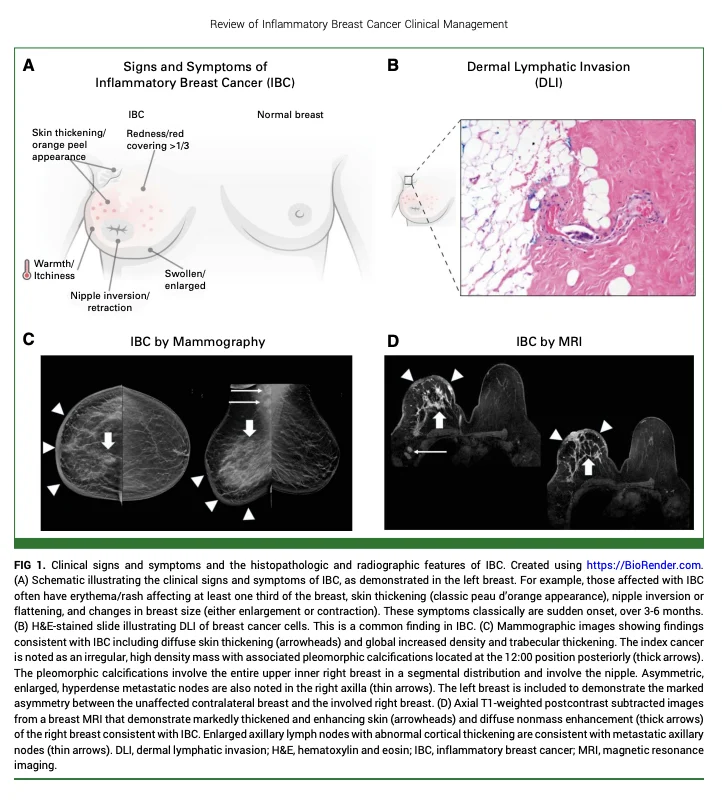
Unlike many other breast cancers, IBC frequently presents without a clearly palpable primary mass. Instead, patients develop rapidly progressive erythema, breast enlargement, edema, warmth, skin thickening, or the characteristic peau d’orange appearance.
Regional lymph node involvement is present in approximately 80%–85% of patients at diagnosis. Moreover, approximately 20%–30% present with distant metastatic disease, reflecting the aggressive natural history of IBC.
The disease also demonstrates an increased propensity for visceral and CNS involvement. Brain metastases are of particular concern in triple-negative and HER2-positive disease, although risk varies across molecular subtypes.
Historically, IBC has been associated with early recurrence even after comprehensive local and systemic treatment. Population-based analyses cited in the review report five-year OS of approximately 59%–61% in nonmetastatic IBC compared with around 87% in stage-matched noninflammatory breast cancer.
These differences underscore an important point: conventional TNM stage and receptor status do not fully capture the unfavorable clinical behavior of inflammatory disease.
Diagnosis Is Clinical: Why Dermal Lymphatic Invasion Is Not Mandatory
One of the most important practical messages concerns the diagnosis of IBC. The disease is frequently mistaken for mastitis or other inflammatory breast conditions, particularly when the patient presents with erythema and swelling but no discrete mass.
This diagnostic confusion can delay referral, biopsy, staging, and initiation of neoadjuvant treatment. Current diagnostic criteria emphasize rapid onset, generally within six months, of erythema and edema or peau d’orange involving at least one-third of the breast, together with pathological confirmation of invasive carcinoma.
The clinical presentation establishes the inflammatory phenotype, classified as T4d under the TNM system. Dermal lymphatic invasion, characterized by tumor emboli within dermal lymphatic vessels, is a characteristic histopathological finding. However, it is not present in every biopsy specimen and is not required to establish the diagnosis.
This distinction is important because a negative skin punch biopsy cannot reliably exclude IBC when the clinical presentation is otherwise characteristic. Similarly, the absence of a palpable mass does not rule out underlying invasive carcinoma.
The review reinforces the importance of integrating clinical examination, tissue pathology, and imaging rather than relying on any single diagnostic feature.
A Proposed Scoring System May Improve Diagnostic Consistency
Historically, diagnostic criteria have relied heavily on clinical judgment, leaving uncertainty when inflammatory features are incomplete or overlap with locally advanced noninflammatory breast cancer.
To address this problem, an international expert initiative proposed an IBC scoring system incorporating the timing of symptom onset, skin abnormalities, breast enlargement, nipple changes, lymphatic tumor emboli, and imaging findings.
The system assigns weighted scores to these characteristics, with greater emphasis on rapid onset and characteristic inflammatory skin changes. A total score of at least 42 indicates a definite IBC classification, while scores of 25–41 indicate a strong possibility of IBC.
Scores of 14–24 represent a weak possibility, and scores below 14 indicate that IBC is unlikely according to the proposed framework. The authors suggest that patients with nonmetastatic disease in the definite or strong-possibility categories should be managed according to IBC-specific treatment principles.
However, this scoring framework remains a proposed diagnostic refinement rather than a replacement for established clinical criteria. Further validation is needed to determine whether it improves reproducibility, reduces misclassification, or meaningfully changes patient outcomes.
Its greatest potential value may be in improving consistency across clinical practice, multidisciplinary discussions, and future IBC-specific research.
Imaging and Staging: Defining the True Extent of Disease
Imaging plays an essential role in confirming the presence of underlying malignancy, defining tumor extent, evaluating regional lymph nodes, and identifying distant metastases. Bilateral diagnostic mammography and breast and regional nodal ultrasound are recommended during the initial assessment.
Mammography may demonstrate diffuse skin thickening, increased breast density, trabecular distortion, calcifications, and abnormal axillary lymph nodes. However, conventional imaging may have limited sensitivity for identifying the primary tumor in IBC.
Breast magnetic resonance imaging (MRI) can provide more comprehensive assessment of mass and nonmass enhancement, skin involvement, chest wall edema, and regional disease extent.
MRI is particularly valuable for pretreatment mapping and evaluating response to neoadjuvant therapy, although it is not mandatory for the clinical diagnosis. Given the high rate of distant dissemination, systemic staging should be performed before definitive treatment planning.
This may include cross-sectional imaging of the chest, abdomen, and pelvis, together with bone imaging or appropriate PET-based staging.
The objective is to distinguish nonmetastatic disease requiring curative-intent trimodality therapy from stage IV IBC, in which systemic treatment generally forms the foundation of care.
Stage III IBC: Trimodality Treatment Remains the Standard
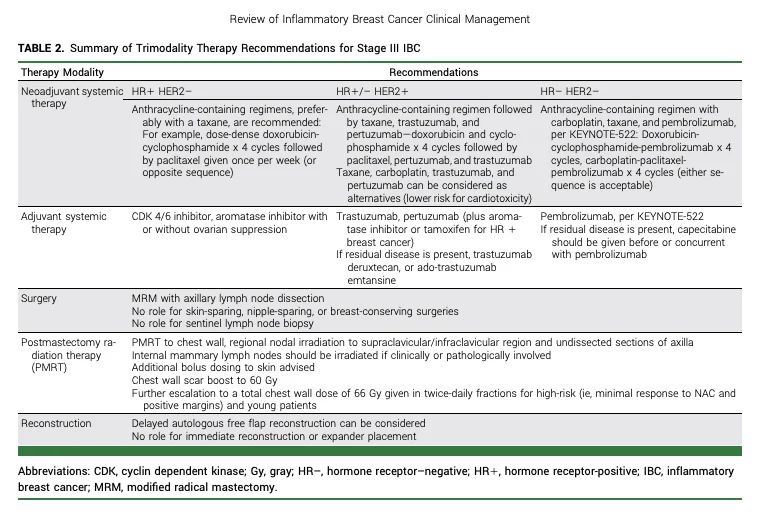
Despite major advances in systemic therapies, the central treatment strategy for nonmetastatic IBC has remained remarkably consistent. The established approach consists of neoadjuvant systemic therapy, followed by modified radical mastectomy with axillary lymph node dissection, and comprehensive postmastectomy radiotherapy.
The rationale is based on the extensive parenchymal and dermal lymphatic involvement characteristic of IBC, which creates a high risk of residual microscopic disease and locoregional recurrence. Neoadjuvant therapy addresses systemic micrometastatic disease while improving locoregional operability.
Surgery then provides definitive removal of the breast and involved regional tissues, followed by radiotherapy to reduce residual local and nodal disease. Retrospective analyses and institutional studies consistently associate completion of all three treatment components with improved outcomes. However, implementation remains challenging.
A National Cancer Database analysis cited in the review found that only 25.1% of eligible patients received all components of guideline-concordant care, emphasizing the importance of access, treatment coordination, and specialized multidisciplinary management.
These observations also reinforce the need for timely diagnosis and referral to centers experienced in treating IBC.
HR-Positive, HER2-Negative IBC: Anthracycline-Based Treatment Remains Important
For hormone receptor-positive, HER2-negative IBC, anthracycline-containing neoadjuvant chemotherapy remains a recommended approach. A commonly used regimen consists of dose-dense doxorubicin and cyclophosphamide followed by paclitaxel, although alternative anthracycline- and taxane-containing regimens may be appropriate.
The preference for anthracyclines reflects historical evidence supporting improved outcomes in IBC, while recognizing that many treatment recommendations are extrapolated from studies involving broader locally advanced breast cancer populations.
Following surgery, adjuvant endocrine therapy is indicated according to hormone receptor status and menopausal characteristics. Appropriate high-risk patients may also receive adjuvant CDK4/6 inhibition in accordance with established eligibility criteria.
However, the review does not present randomized IBC-specific evidence establishing the magnitude of benefit from adjuvant CDK4/6 inhibitors.
Consequently, the use of these agents should follow the evidence and indications established for the broader HR-positive, HER2-negative early breast cancer population.
Triple-Negative IBC: Immunotherapy Is Integrated Into Neoadjuvant Treatment
Triple-negative IBC represents a particularly aggressive clinical phenotype, often associated with early recurrence and increased metastatic risk. For stage III triple-negative IBC, the review supports a neoadjuvant approach based on the KEYNOTE-522 strategy, incorporating pembrolizumab with platinum-, taxane-, and anthracycline-containing chemotherapy.
The rationale comes from the demonstrated efficacy of pembrolizumab-based perioperative treatment in high-risk early-stage TNBC. Importantly, patients with IBC were not explicitly excluded from KEYNOTE-522, although the study was not designed to provide a dedicated, adequately powered analysis of this disease.
Following surgery, pembrolizumab is continued according to the perioperative treatment strategy. Patients with residual disease may also be considered for additional adjuvant therapy, including capecitabine, according to clinical context.
However, direct evidence defining the optimal integration or sequencing of capecitabine with pembrolizumab in IBC remains limited.
The broader implication is that immunotherapy has become an important component of treatment for eligible triple-negative IBC, but dedicated prospective trials remain necessary to establish whether the magnitude of benefit matches that observed in noninflammatory TNBC.
HER2-Positive IBC: Dual HER2 Blockade and Post-Neoadjuvant Escalation
For HER2-positive IBC, dual HER2 inhibition with trastuzumab and pertuzumab combined with chemotherapy represents a central neoadjuvant treatment strategy. Anthracycline-containing regimens followed by taxane-based dual HER2 blockade are supported by expert consensus, reflecting the aggressive biological behavior of IBC.
The combination of docetaxel, carboplatin, trastuzumab, and pertuzumab (TCHP) is another important option, particularly when avoiding anthracycline-associated cardiotoxicity is clinically desirable. However, no adequately powered IBC-specific randomized trial has established the superiority of one chemotherapy backbone over the other.
The choice of regimen therefore requires consideration of cardiac risk, comorbidities, anticipated toxicity, and institutional practice. Following surgery, adjuvant HER2-directed treatment is selected according to pathological response and overall risk.
Patients with residual invasive disease may be candidates for post-neoadjuvant escalation. The review discusses the phase III DESTINY-Breast05 findings, in which trastuzumab deruxtecan demonstrated superior three-year invasive disease-free survival compared with trastuzumab emtansine in high-risk patients with residual HER2-positive breast cancer: 92.4% versus 83.7%.
Although IBC was not excluded, these results were not generated from an IBC-specific randomized population.
The findings highlight the broader evolution of HER2-positive breast cancer treatment, while reinforcing the need to distinguish subtype-based therapeutic recommendations from evidence established specifically in inflammatory disease.
Surgery: Why De-escalation Remains Controversial
One of the most clinically important distinctions between IBC and noninflammatory breast cancer concerns surgical management. In many noninflammatory tumors, excellent responses to neoadjuvant treatment may permit breast conservation or less extensive axillary surgery.
In IBC, however, current recommendations continue to favor modified radical mastectomy with level I–II axillary lymph node dissection, even after an excellent clinical response or pCR. Breast-conserving surgery is not recommended as routine treatment because of the frequent diffuse involvement of the breast parenchyma and dermal lymphatics.
Similarly, sentinel lymph node biopsy has not been established as a reliable substitute for axillary lymph node dissection. Studies have reported concerning limitations in sentinel node identification and false-negative rates in this population.
Although small prospective studies are investigating surgical de-escalation, the current evidence is insufficient to support broad implementation. Immediate breast reconstruction is also generally discouraged because of extensive skin involvement and the need for comprehensive postoperative radiotherapy.
Delayed autologous reconstruction may be considered in selected patients after completion of treatment and multidisciplinary assessment. The distinction is essential: the broader movement toward surgical de-escalation in breast cancer should not automatically be extended to inflammatory disease.
Radiotherapy: Comprehensive Locoregional Treatment Remains Essential
Postmastectomy radiotherapy is an integral component of curative-intent treatment for stage III IBC. Recommended treatment generally encompasses the chest wall and comprehensive regional nodal areas, including supraclavicular and infraclavicular regions and appropriate portions of the axilla.
Internal mammary nodal irradiation is recommended when those nodes are clinically or pathologically involved, with individualized consideration in other circumstances. The extensive dermal lymphatic involvement characteristic of IBC provides a rationale for careful attention to skin coverage, often including the use of bolus material to increase surface dose.
Conventional fractionation and moderately hypofractionated schedules are described in contemporary breast radiotherapy guidance. IBC-specific expert recommendations also discuss chest wall boosts, including total doses around 60 Gy, with selected high-risk institutional approaches using more intensive dose escalation.
However, these dose-escalation strategies should not be regarded as universally established standards for every patient. Radiotherapy planning must balance locoregional control against potential skin, pulmonary, cardiac, and reconstructive complications.
Metastatic IBC: Systemic Therapy Remains the Foundation
Approximately 20%–30% of patients with IBC present with stage IV disease. In this setting, systemic treatment is generally selected according to the same molecular subtype and biomarker principles used for metastatic breast cancer more broadly.
Hormone receptor status, HER2 expression, genomic alterations, prior treatments, and performance status guide treatment selection. However, metastatic IBC remains a clinically distinct and particularly aggressive population, and dedicated prospective evidence is limited.
The role of surgery and radiotherapy for the primary breast tumor remains controversial. Some retrospective studies suggest improved outcomes with aggressive locoregional treatment in carefully selected patients, but these findings are susceptible to selection bias.
Randomized evidence from broader de novo metastatic breast cancer populations has not demonstrated an overall survival advantage from routine early locoregional treatment. Consequently, surgery or radiotherapy in stage IV IBC should be individualized rather than routinely recommended for survival extension.
Multidisciplinary assessment is essential, particularly when local treatment may improve symptom control or address complications.
Emerging Clinical Trials: Moving Toward IBC-Specific Evidence
The review emphasizes that one of the greatest barriers to improving outcomes is the continued underrepresentation of IBC in prospective clinical trials. Many widely adopted systemic therapies are supported by studies involving broader breast cancer populations, with relatively few patients with inflammatory disease.
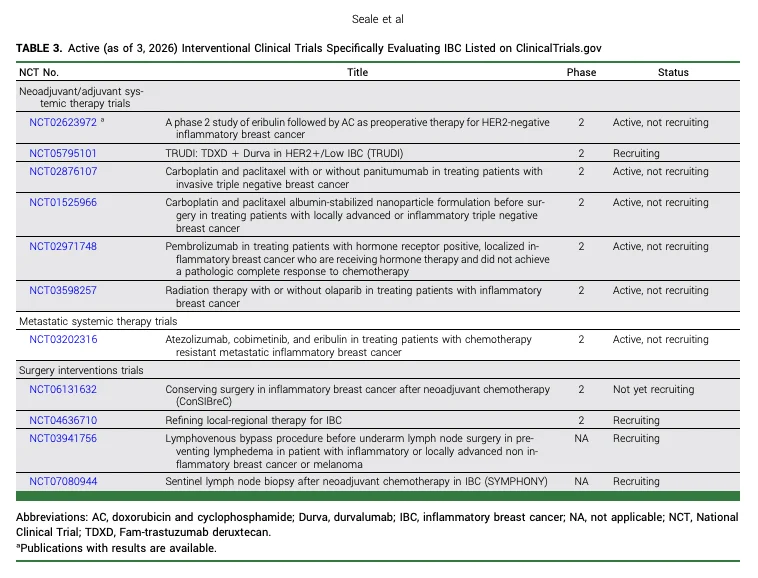
Several dedicated research programs aim to address this limitation. The phase II TRUDI study (NCT05795101) is investigating trastuzumab deruxtecan combined with durvalumab in HER2-expressing inflammatory breast cancer.
Other studies are evaluating novel immune-based combinations, strategies for improving local treatment, and selected approaches to surgical de-escalation. The ConSIBreC study (NCT06131632) is examining breast-conserving surgery after neoadjuvant therapy, while the SYMPHONY study (NCT07080944) is evaluating sentinel lymph node biopsy after preoperative chemotherapy.
These investigations are important because they may eventually determine whether carefully selected IBC patients can safely receive less extensive local treatment. Research is also addressing the increased risk of CNS involvement through studies examining brain MRI surveillance in higher-risk breast cancer populations.
The trial programs described in the review reflect their reported status during the first quarter of 2026, rather than a newly verified October 2026 recruitment assessment. Although these studies remain relatively small, they represent an important movement toward developing evidence specifically for inflammatory disease.
Limitations and Outstanding Questions
The review highlights several persistent limitations in contemporary IBC management. First, much of the treatment evidence is retrospective or extrapolated from studies that were not designed specifically for inflammatory breast cancer.
Second, diagnostic heterogeneity complicates both clinical management and research, emphasizing the need for consistent classification. Third, the absence of validated biomarkers makes it difficult to identify patients at particularly high risk of early systemic recurrence.
Fourth, although modern systemic agents have improved outcomes in breast cancer generally, the magnitude of their benefit in IBC remains inadequately characterized. Finally, surgical de-escalation, optimal radiotherapy intensification, CNS surveillance, and the selection of systemic treatment in metastatic IBC all require further prospective evaluation.
These limitations reinforce the importance of dedicated clinical trials rather than automatically transferring findings from noninflammatory disease.
OncoDaily Takeaway
Inflammatory breast cancer remains a distinct, highly aggressive form of breast malignancy in which rapid diagnosis and coordinated multimodality treatment are essential.
The 2026 JCO Oncology Practice review reinforces that IBC is primarily a clinical diagnosis. Rapidly developing erythema and edema involving at least one-third of the breast should prompt urgent evaluation, and negative dermal lymphatic findings do not exclude the disease.
For nonmetastatic IBC, neoadjuvant systemic therapy followed by modified radical mastectomy, axillary lymph node dissection, and comprehensive postmastectomy radiotherapy remains the established treatment strategy. Routine breast-conserving surgery or sentinel lymph node biopsy is not currently supported by sufficient evidence.
Modern systemic treatment has evolved considerably, incorporating immunotherapy for eligible triple-negative disease, dual HER2 blockade and post-neoadjuvant escalation for HER2-positive tumors, and endocrine therapy with selected targeted agents for hormone receptor-positive disease. However, the evidence supporting these approaches is largely derived from broader breast cancer populations.
Emerging diagnostic scoring systems and dedicated trials offer opportunities to improve classification, treatment selection, and the development of safer de-escalation strategies. Yet these approaches require prospective validation before replacing established treatment principles.
The next major advance in inflammatory breast cancer will require more than applying increasingly effective breast cancer therapies. It will require recognizing IBC earlier, ensuring access to complete guideline-concordant care, and generating prospective evidence specifically designed for its unique biology and clinical behavior.
Source
Seale KN, Van Swearingen AED, Johnson KS, Factor RE, Anders CK. Inflammatory Breast Cancer—The Evolution of Diagnosis and Modern Clinical Management. JCO Oncology Practice. Published October 20, 2026.