
HER2-positive breast cancer has undergone one of the most dramatic therapeutic transformations in oncology. A disease once associated with aggressive biology and poor outcomes is now highly curable for many patients with early-stage disease, while a substantial proportion of patients with metastatic disease survive beyond five years. That success has created a new problem.
With monoclonal antibodies, antibody-drug conjugates, tyrosine-kinase inhibitors, endocrine therapy, CDK4/6 inhibitors and increasingly effective chemotherapy combinations available, the central question is no longer simply how to intensify HER2-directed therapy. It is how to give each patient exactly as much treatment as their disease requires, and no more.
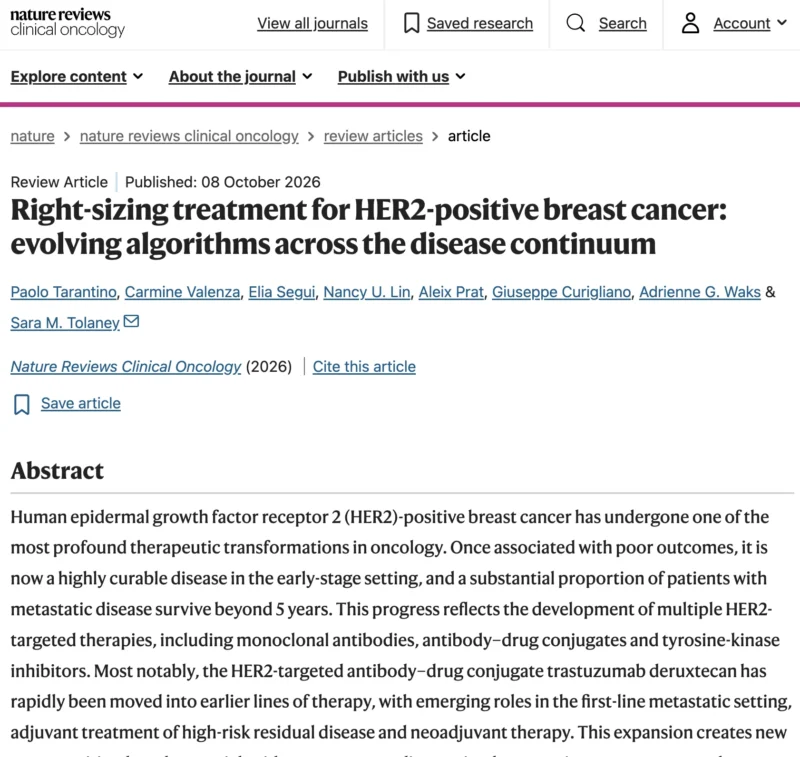
A new review by Paolo Tarantino and colleagues, published in Nature Reviews Clinical Oncology on October 8, 2026, describes this concept as “right-sizing” HER2-positive breast cancer treatment across the entire disease continuum (Tarantino et al., 2026). The framework combines disease burden, tumor biology, treatment response, toxicity and patient preference rather than applying the same degree of escalation to every HER2-positive tumor.
Early HER2-Positive Disease Is Becoming a Risk-Adapted Continuum
The review divides early HER2-positive breast cancer into very different therapeutic problems. For patients with low-risk disease, particularly small node-negative tumors, the challenge is avoiding unnecessary treatment intensity while preserving the very high probability of cure.
Long-term results from studies such as APT have established that substantially de-escalated regimens can produce excellent outcomes in selected stage I disease, while ATEMPT and newer studies continue to investigate whether treatment can be simplified further or made less toxic. The review places these approaches within a broader move away from using maximum therapy simply because a tumor is HER2-positive.
At the other end of the spectrum are patients with stage II–III disease, for whom neoadjuvant therapy remains particularly valuable because treatment response provides important prognostic information and determines post-operative therapy. Here, right-sizing becomes a two-step process: give sufficient preoperative therapy to maximize disease control, then use the pathological response to decide whether treatment can be maintained, reduced or escalated.
This response-adapted strategy is increasingly defining modern HER2-positive early breast cancer management.
Chemotherapy Itself Is Being Reconsidered
The review also highlights an important evolution in the chemotherapy backbone. Historically, increasingly intensive combinations were used in high-risk HER2-positive disease. But multiple studies have questioned whether all components contribute enough benefit to justify their toxicity.
Trials including TRAIN-2 have helped support anthracycline-free approaches in the presence of effective HER2 blockade, while more recent studies have investigated whether carboplatin is necessary for every patient and whether taxane-based dual HER2 blockade can be sufficient for selected tumors. This is an important conceptual shift.
De-escalation does not necessarily mean undertreatment. It means removing components that add toxicity without providing sufficient incremental benefit in an appropriately selected population. That distinction is central to the review’s definition of right-sized therapy.
Pathological Response Has Become a Treatment Decision Point
One of the clearest examples of precision treatment in HER2-positive breast cancer occurs after neoadjuvant therapy. Patients achieving a pathological complete response generally have a substantially more favorable prognosis than those with residual invasive disease. Conversely, residual disease identifies a group in whom additional therapeutic escalation can meaningfully alter outcome.
T-DM1 established this principle after KATHERINE, changing post-neoadjuvant management for patients with residual HER2-positive invasive disease. But that algorithm is already evolving again. The 2026 review emphasizes that trastuzumab deruxtecan is moving into the curative setting, including the post-neoadjuvant treatment of high-risk residual disease, creating new opportunities while simultaneously creating major questions regarding sequencing, duration and future retreatment (Tarantino et al., 2026).
The reference framework includes the phase III evidence evaluating T-DXd in residual HER2-positive early breast cancer as well as neoadjuvant T-DXd strategies. The implication is substantial. Residual disease may no longer represent a single treatment category. Future algorithms are likely to distinguish among different degrees and biological types of residual disease to determine how much post-neoadjuvant escalation is actually necessary.
T-DXd Is Reshaping the Entire HER2 Treatment Sequence
Perhaps no drug better illustrates the changing HER2 landscape than trastuzumab deruxtecan (T-DXd). Its development initially transformed later-line metastatic disease. It then moved earlier. Now, according to the review, T-DXd has roles emerging across:
- the first-line metastatic setting
- the post-neoadjuvant setting for high-risk residual disease
- potentially the neoadjuvant curative setting itself
This creates an unusual therapeutic problem. When a highly active drug moves earlier in the disease course, its efficacy is only part of the story. Clinicians must also ask:
- How long should it be given?
- Can it safely be stopped after deep response?
- What therapy should follow progression?
Can T-DXd be successfully reused later if the patient received it with curative intent? Does previous T-DXd exposure reduce the effectiveness of subsequent HER2-directed ADCs? These sequencing questions are now becoming as important as the efficacy of individual agents.
First-Line Metastatic HER2-Positive Disease Is No Longer a Single Algorithm
The metastatic setting is undergoing a similar transformation. Historically, trastuzumab, pertuzumab and a taxane created a clear first-line standard, generally followed by HER2-directed maintenance after chemotherapy was discontinued. That framework is becoming considerably more complex.
The review highlights the emergence of T-DXd plus pertuzumab as a first-line option while simultaneously describing new ways to intensify trastuzumab–pertuzumab maintenance with drugs such as palbociclib or tucatinib (Tarantino et al., 2026).
The references supporting this evolving landscape include DESTINY-Breast09, HER2CLIMB-05 and PATINA. Rather than one universal first-line pathway, clinicians increasingly face several competing strategies:
- an induction-and-maintenance model based on trastuzumab and pertuzumab
- maintenance intensification with another targeted agent
- continuous first-line treatment with a highly active ADC-based combination
The optimal strategy may ultimately differ according to patient characteristics rather than being settled by a single universal sequence.
Maintenance Therapy Is Becoming Active Treatment
This may be one of the most important changes in metastatic HER2-positive disease. Maintenance was traditionally considered the less intensive phase after chemotherapy. Now it can become another opportunity for treatment optimization.
The review specifically identifies palbociclib and tucatinib as examples of agents being incorporated into maintenance strategies after initial therapy. This means the clinical question after induction is increasingly not simply:
“When should chemotherapy stop?”
It is:
“What is the most appropriate biologically targeted maintenance strategy for this patient?”
For hormone receptor-positive/HER2-positive disease, endocrine biology and CDK4/6 dependence may justify one approach. For another patient, deeper HER2 blockade with a tyrosine-kinase inhibitor may be more attractive. And for patients treated from the outset with T-DXd plus pertuzumab, an entirely different question emerges: should an ADC be continued indefinitely, or can treatment eventually be de-intensified? The review identifies optimal duration as a major unresolved issue.
The CNS Must Be Part of Treatment Selection
HER2-positive metastatic breast cancer has a high propensity for brain metastases, and improvements in extracranial control mean CNS disease has become increasingly important in long-term treatment planning. As therapies move earlier, intracranial efficacy can no longer be viewed solely as a later-line consideration.
The review’s broader framework therefore supports choosing systemic therapies not only according to extracranial disease burden but also according to CNS history and future CNS risk. The expanding evidence base for tucatinib and T-DXd is particularly relevant to this problem, while modern local therapy continues to evolve alongside systemic treatment. Right-sizing therapy in metastatic disease may therefore require simultaneously asking:
- How much systemic treatment is needed?
- Which therapy has the appropriate CNS activity?
- What toxicity is acceptable for a patient who could remain on treatment for years?
HER2 Positivity Itself May Be Too Simple a Biomarker
One of the review’s most forward-looking arguments is that conventional HER2 classification might eventually be insufficient for treatment selection. Two tumors both classified as HER2-positive can have very different biology. HER2 expression can vary quantitatively. HER2 can be heterogeneous within a tumor.
Hormone receptor signaling can modify HER2 dependence. And intrinsic molecular subtype can differ substantially even within pathologically HER2-positive disease. The authors therefore highlight several emerging biomarker strategies, including: quantitative HER2 expression, intrinsic molecular subtype, functional or dynamic imaging response, and circulating tumor DNA (Tarantino et al., 2026).
The importance of these biomarkers is not merely prognostic. The real goal is to identify who can safely receive less therapy and who needs more.
HER2DX Is Moving Toward Clinical Validation
The review includes substantial attention to the HER2DX genomic assay, which integrates biological and clinicopathological information relevant to HER2-positive disease. Multiple studies have evaluated its relationship with pathological response and survival, and prospective validation efforts are underway.
Such assays could eventually help differentiate patients who appear similar by conventional stage but have very different biological risk. For example, a patient with stage II disease but highly favorable biology and rapid response could potentially become a candidate for de-escalation.
Conversely, another patient with similar anatomical stage but unfavorable molecular biology might warrant more intensive systemic treatment. That would represent a meaningful advance beyond stage-based therapy.
ctDNA Could Make Treatment Truly Dynamic
Circulating tumor DNA may be even more transformative because it can be assessed repeatedly. The review cites emerging evidence showing that ctDNA following neoadjuvant therapy can refine recurrence risk and that ultrasensitive assays are being explored for detection of minimal residual disease.
This introduces the possibility of a future treatment model in which therapy is not decided only at diagnosis or surgery. Instead:
- treatment begins
- tumor response is measured
- tDNA is reassessed
- therapy intensity changes according to whether molecular disease persists
In metastatic disease, ctDNA is also being investigated as a potential tool for identifying exceptional responders who might eventually be candidates for treatment discontinuation. That concept remains investigational, but it illustrates where right-sizing could ultimately lead.
Imaging May Also Become a Treatment Biomarker
The same principle applies to imaging. Traditional imaging determines whether a tumor has shrunk. Dynamic imaging approaches may eventually provide enough biological information to determine whether chemotherapy can be shortened or even omitted in carefully selected patients.
The review cites response-adapted studies such as PHERGain and MRI-guided approaches including TRAIN-3, in which early treatment response is used to individualize subsequent therapy. This represents another important change: response is no longer simply an endpoint. It can become a therapeutic decision tool.
Precision Oncology Now Includes De-Escalation
Precision oncology has historically been associated with finding another actionable target and adding another drug. The HER2-positive breast cancer field increasingly demonstrates that precision can work in the opposite direction.
For one patient, precision may mean:
- more HER2 blockade
- an ADC
- a TKI
- post-neoadjuvant escalation
For another, precision may mean:
- less chemotherapy
- avoiding anthracyclines
- shorter treatment
- eventually stopping systemic therapy after a sufficiently deep and durable response.
That is why “right-sizing” is a useful concept. The goal is neither escalation nor de-escalation by default. The goal is matching treatment intensity to risk and biology.
The Challenge After Success: What Comes Next?
The extraordinary success of HER2-directed therapy is itself generating the next generation of clinical questions. T-DXd is moving from late-line metastatic therapy into first-line and curative settings. Tucatinib is moving earlier.
CDK4/6 inhibition is being integrated into HER2-positive maintenance strategies. Response-adapted neoadjuvant therapy is reducing chemotherapy exposure in selected patients. And biomarkers are becoming increasingly capable of detecting differences that conventional staging cannot.
But every earlier treatment creates consequences for the next line. If T-DXd is used before surgery or after residual disease, what should be given at metastatic relapse? If it is used first line, what becomes the optimal second line? Can the same ADC be reused after a long treatment-free interval? Should patients with exceptional metastatic responses remain on HER2 therapy indefinitely?
These questions are not yet fully answered. The review emphasizes that optimal sequencing, treatment duration and retreatment remain major evidence gaps as effective therapies migrate earlier in the disease course.
The Bottom Line
The new Nature Reviews Clinical Oncology review argues that HER2-positive breast cancer has reached a stage in which therapeutic success can no longer be measured simply by how many effective drugs are available. The next advance is using those therapies more intelligently.
For early-stage disease, that means: de-intensifying treatment for low-risk tumors, optimizing neoadjuvant therapy for stage II–III disease, and escalating therapy when residual disease signals persistent risk.
For metastatic disease, it means choosing between increasingly effective first-line strategies and determining how to integrate T-DXd, trastuzumab–pertuzumab maintenance, CDK4/6 inhibition and tucatinib while preserving future treatment options.
And across both settings, biomarkers such as HER2 quantity, molecular subtype, imaging response and ctDNA may ultimately determine who needs more therapy and who can safely receive less.
HER2-positive breast cancer was once a disease in which the central challenge was finding effective treatment. In 2026, the challenge is increasingly different: not whether we can treat more but whether we can identify the right treatment intensity for each individual patient.
Reference
Tarantino, P., Valenza, C., Segui, E., Lin, N. U., Prat, A., Curigliano, G., Waks, A. G., & Tolaney, S. M. (2026). Right-sizing treatment for HER2-positive breast cancer: Evolving algorithms across the disease continuum. Nature Reviews Clinical Oncology. https://doi.org/10.1038/s41571-026-01211-5.