
The phase III HEALER trial has demonstrated a significant progression-free survival advantage with anbenitamab, a HER2-targeted bispecific antibody, combined with albumin-bound docetaxel (HB1801), compared with standard trastuzumab, pertuzumab, and docetaxel in previously untreated HER2-positive advanced breast cancer. Published in The New England Journal of Medicine, the randomized trial enrolled 885 patients across China and reported a 24-month progression-free survival rate of 58.5% with anbenitamab plus HB1801 versus 34.4% with conventional dual HER2 blockade.
The combination reduced the hazard of progression or death by 54%, with higher objective response rates but increased grade ≥3 toxicity. These findings introduce another potential first-line therapeutic strategy into an increasingly competitive HER2-positive metastatic breast cancer landscape, although overall survival data remain immature and its position relative to newer antibody–drug conjugate-based regimens remains unresolved.
The treatment of HER2-positive advanced breast cancer has undergone a profound transformation over the past two decades. The introduction of trastuzumab established HER2-directed therapy as a central component of treatment, while the subsequent addition of pertuzumab and docetaxel significantly improved outcomes and established dual HER2 blockade as a longstanding first-line standard.
The CLEOPATRA trial provided the foundation for this approach, demonstrating substantial improvements in progression-free and overall survival with trastuzumab, pertuzumab, and docetaxel (THP). However, despite the effectiveness of dual HER2 inhibition, disease progression remains inevitable for many patients, creating a continuing need for more effective and durable treatment strategies. Recent developments have further complicated the first-line treatment landscape.
The phase III DESTINY-Breast09 trial demonstrated superior progression-free survival with trastuzumab deruxtecan (T-DXd) plus pertuzumab compared with THP, establishing an important new therapeutic option.
Meanwhile, maintenance approaches incorporating CDK4/6 inhibition and continued HER2-directed therapy have expanded opportunities for selected patients with hormone receptor-positive disease. Against this rapidly evolving background, investigators have continued exploring alternative strategies capable of improving HER2 inhibition while maintaining acceptable treatment tolerability.
One approach involves bispecific antibodies designed to engage multiple HER2 epitopes within a single molecule. The phase III HEALER trial, led by Jiayu Wang, Huiping Li, Fei Xu, Tao Wu, Binghe Xu, and colleagues, evaluated anbenitamab, also known as KN026, combined with albumin-bound docetaxel (HB1801) against established THP treatment.
The findings, published online in The New England Journal of Medicine on October 24, 2026, demonstrate a substantial progression-free survival advantage for the experimental combination. The central result is a hazard ratio for disease progression or death of 0.46, corresponding to a 54% relative reduction in the hazard of progression or death compared with THP.
Anbenitamab: A Bispecific Approach to HER2 Blockade
Anbenitamab is a HER2-directed bispecific antibody designed to bind two distinct HER2 epitopes. Unlike conventional dual-antibody therapy, which combines trastuzumab and pertuzumab to inhibit HER2 signaling through complementary mechanisms, anbenitamab incorporates dual HER2 recognition within a single antibody construct.
Preclinical investigations described greater HER2-binding affinity, inhibitory activity, and receptor internalization compared with individual conventional antibodies. These properties provided a rationale for investigating whether anbenitamab could deliver more effective receptor inhibition in HER2-positive malignancies.
The antibody has also undergone clinical development in other HER2-driven tumors, including advanced gastric cancer. The chemotherapy partner, HB1801, is an albumin-bound formulation of docetaxel.
Albumin-bound formulations are intended to modify drug delivery and pharmacological characteristics, although the clinical advantages of individual formulations require prospective evaluation. Earlier studies provided evidence of antitumor activity with HB1801, supporting its further development in combination with HER2-directed therapy.
The rationale for HEALER was therefore to investigate whether combining a bispecific HER2 antibody with albumin-bound docetaxel could produce superior disease control compared with conventional trastuzumab–pertuzumab–docetaxel.
Importantly, because the experimental arm incorporated both a different HER2-directed agent and a different taxane formulation, the trial evaluated the efficacy of the complete combination rather than isolating the contribution of either component.
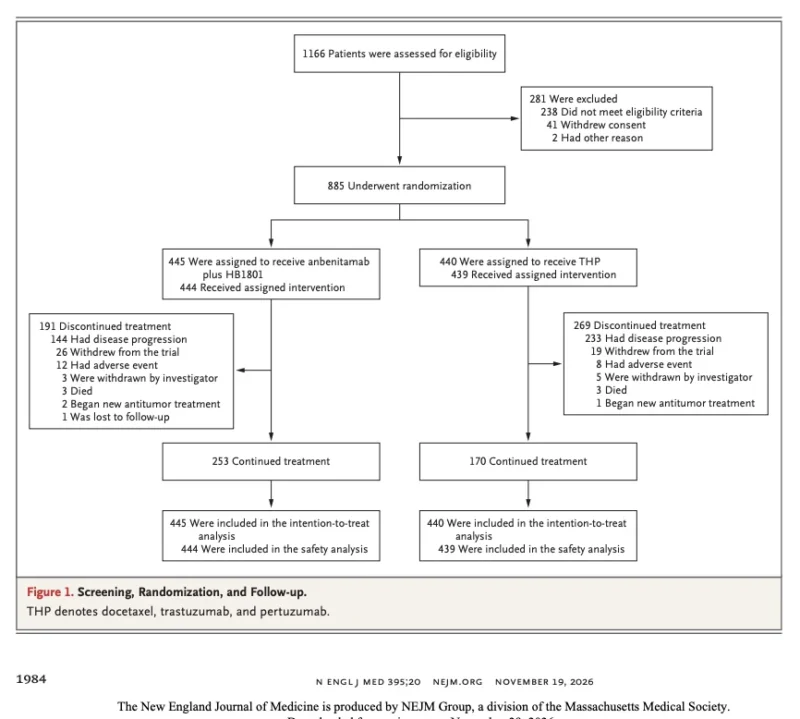
HEALER Trial Design: 885 Patients Randomized Across China
HEALER was a randomized, open-label, multicenter phase III trial conducted at 76 institutions in China. A total of 885 patients with HER2-positive unresectable locally recurrent or metastatic breast cancer were enrolled between July 2023 and April 2025. Patients were randomly assigned in a 1:1 ratio to receive anbenitamab plus HB1801 or conventional THP.
The experimental group included 445 patients, while 440 were assigned to the control group. Eligible patients had centrally confirmed HER2-positive disease, defined as immunohistochemistry (IHC) 3+ or IHC 2+ with positive in situ hybridization.
Patients were required to have ECOG performance status 0–1 and a left ventricular ejection fraction of at least 50%. Previous chemotherapy or HER2-directed treatment for recurrent or metastatic disease was not permitted, although one prior line of endocrine monotherapy was allowed.
Previous neoadjuvant or adjuvant chemotherapy and HER2-targeted treatment were permitted if disease progression occurred more than 12 months after completion. Patients in the experimental arm received anbenitamab at 30 mg/kg plus HB1801 at 100 mg/m² intravenously every three weeks.
The control group received trastuzumab, pertuzumab, and docetaxel at conventional dosing schedules, including docetaxel at 75 mg/m² every three weeks. Taxane treatment was planned for at least six cycles unless limited by progression or unacceptable toxicity.
Randomization was stratified according to previous neoadjuvant or adjuvant treatment, hormone receptor status, and the presence of visceral metastases. The primary endpoint was progression-free survival assessed by blinded independent central review according to RECIST version 1.1.
Secondary endpoints included investigator-assessed progression-free survival, objective response, duration of response, overall survival, and safety. Although the trial was open-label, blinded independent assessment of the primary endpoint helped reduce potential assessment bias.
Patient Characteristics Reflect a Broad First-Line HER2-Positive Population
The baseline characteristics were generally balanced between treatment groups. Median age was 54 years in the experimental group and 55 years in the THP group. Approximately 55% of patients had hormone receptor-positive disease, while the remainder were hormone receptor-negative.
Most participants had metastatic disease, and approximately 71% had visceral metastases. Liver involvement was present in 35.1% of patients receiving anbenitamab plus HB1801 and 41.1% receiving THP. Approximately 37% had received previous neoadjuvant or adjuvant systemic therapy.
Prior trastuzumab exposure was reported in approximately one-fifth of participants, while prior pertuzumab exposure was less common. An important feature of the study was that patients with hormone receptor-positive tumors did not receive concurrent endocrine therapy or CDK4/6 inhibitors during the trial.
Consequently, the results primarily establish the comparative efficacy of the chemotherapy-containing HER2-directed regimens rather than the effectiveness of contemporary endocrine-based maintenance strategies. The study also excluded patients with ECOG performance status ≥2, limiting direct applicability to more clinically vulnerable populations.
Progression-Free Survival: A 54% Reduction in the Hazard of Progression or Death
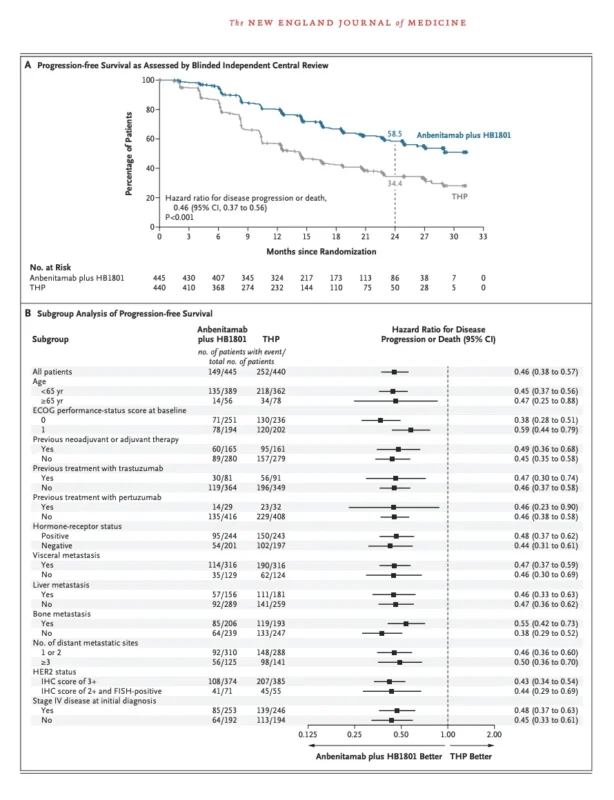
The prespecified interim analysis was performed after 401 progression or death events, with a median follow-up of 21.0 months. At the April 30, 2026 data cutoff, progression or death had occurred in 149 of 445 patients (33.5%) assigned to anbenitamab plus HB1801, compared with 252 of 440 patients (57.3%) receiving THP.
The primary endpoint demonstrated a statistically significant advantage for the experimental regimen. The hazard ratio for progression or death was 0.46 (95% CI, 0.37–0.56; P<0.001). The result crossed the prespecified efficacy boundary for the interim analysis.
The magnitude of benefit was particularly apparent in the estimated progression-free survival rates over time. At 12 months, progression-free survival was 80.2% with anbenitamab plus HB1801 compared with 56.9% with THP. At 18 months, the corresponding rates were 66.9% and 42.4%.
At 24 months, 58.5% of patients in the experimental arm remained progression-free, compared with 34.4% in the control arm. This represented an absolute difference of 24.1 percentage points at two years. Median progression-free survival was not reached in the anbenitamab group, while the THP group had a median PFS of 14.3 months.
These results demonstrate substantial improvement in disease control compared with conventional THP. However, the hazard ratio should not be interpreted as a 54% absolute reduction in progression events or as evidence of a corresponding improvement in overall survival.
The findings establish a statistically significant PFS advantage, while longer follow-up remains necessary to determine the impact on survival.
Benefit Was Observed Across Prespecified Clinical Subgroups
The progression-free survival advantage appeared generally consistent across the prespecified subgroups. Among patients with hormone receptor-positive disease, the hazard ratio for progression or death was 0.48.
Among patients with hormone receptor-negative disease, it was 0.44. The benefit was also observed in patients with visceral metastases, with a hazard ratio of 0.47. For patients with liver metastases, the hazard ratio was 0.46, while the corresponding value among those without liver involvement was 0.47.
Prior exposure to HER2-targeted therapy did not appear to eliminate the treatment advantage. Among patients who had previously received trastuzumab, the hazard ratio was 0.47. Among those with prior pertuzumab exposure, it was 0.46, although the subgroup was relatively small. These findings suggest that the efficacy of anbenitamab plus HB1801 may extend across several clinically relevant patient categories.
However, subgroup analyses should be interpreted cautiously, particularly where patient numbers were limited. The results do not establish that all subgroups derive identical benefit, nor do they provide a basis for selecting anbenitamab according to individual baseline characteristics.
Objective Response Reaches 87.6% With Anbenitamab Plus HB1801
The improvement in progression-free survival was accompanied by higher objective response rates. According to blinded independent central review, confirmed objective response was achieved in 87.6% of patients receiving anbenitamab plus HB1801, compared with 73.4% receiving THP.
The between-group difference was 14.3 percentage points, with a 95% confidence interval of 9.3–19.4 percentage points. Complete responses occurred in 3.8% and 2.3% of patients, respectively.
Partial responses accounted for most responses in both groups. The disease control rate was 98.0% with the experimental combination and 94.3% with THP. The median duration of response had not been reached in the anbenitamab group, compared with 16.6 months in the control group.
These results suggest that the experimental combination achieved both higher response frequency and more durable disease control. Nevertheless, objective response was a secondary endpoint, and no multiplicity adjustment was applied to secondary outcome analyses.
Therefore, the trial’s strongest confirmatory conclusion remains the significant improvement in the primary PFS endpoint.
Safety: Greater Efficacy Comes With More Grade ≥3 Adverse Events
The superior efficacy of anbenitamab plus HB1801 was accompanied by an increased incidence of adverse events. Grade 3 or higher adverse events occurred in 45.9% of patients receiving anbenitamab plus HB1801, compared with 34.4% receiving THP.
This represents an absolute difference of 11.5 percentage points. Hematologic adverse events were prominent. Grade ≥3 neutropenia occurred in 13.1% of patients receiving the experimental regimen compared with 8.4% in the THP group.
Grade ≥3 leukopenia occurred in 9.7% versus 5.5%, respectively. Other common adverse events included anemia, diarrhea, alopecia, peripheral edema, fatigue, and laboratory abnormalities. Diarrhea was reported in 53.2% of the experimental group compared with 40.1% of the control group.
However, grade ≥3 diarrhea occurred in only 2.3% and 1.1%, respectively. Serious adverse events occurred in 20.0% of patients receiving anbenitamab plus HB1801 and 16.2% receiving THP. Adverse events led to treatment discontinuation in 5.2% and 3.4%, respectively.
Adverse events leading to death occurred in two patients in each group. Cardiac safety is particularly relevant for therapies targeting HER2. In the anbenitamab group, left ventricular dysfunction was reported in 2.9% of patients, while decreased ejection fraction occurred in 8.1%.
Grade ≥3 events were reported in 0.5% and 1.8%, respectively. Interstitial lung disease occurred in four patients (0.9%) receiving anbenitamab plus HB1801, including one grade ≥3 event. These findings indicate that the experimental combination has an important toxicity burden despite its favorable efficacy.
Longer follow-up will be necessary to characterize delayed cardiac and pulmonary adverse events, especially as patients remain on HER2-directed therapy for extended periods.
How Does HEALER Fit Into the DESTINY-Breast09 Era?
The most important clinical question is how anbenitamab plus HB1801 should be positioned within a rapidly evolving first-line treatment landscape. For more than a decade, THP represented the principal first-line standard for HER2-positive metastatic breast cancer.
However, DESTINY-Breast09 demonstrated superior progression-free survival with trastuzumab deruxtecan plus pertuzumab compared with THP, leading to regulatory approval of this combination in the United States.
The HEALER investigators appropriately selected THP as the control regimen because the newer antibody–drug conjugate combination had not yet become an approved standard when the trial began. Both HEALER and DESTINY-Breast09 therefore demonstrate substantial improvement over the historical dual-antibody chemotherapy standard.
Nevertheless, there is no randomized head-to-head comparison between anbenitamab plus HB1801 and trastuzumab deruxtecan plus pertuzumab. Differences in patient populations, trial designs, follow-up, treatment exposure, and subsequent therapies make indirect comparison of median PFS or hazard ratios unreliable for determining which regimen is superior.
The distinct safety profiles of bispecific antibody-based treatment and antibody–drug conjugate-based treatment may also become important when evaluating future therapeutic positioning.
Anbenitamab plus HB1801 produced higher rates of hematologic toxicity and several other adverse events compared with THP, while ILD and cardiac monitoring remain relevant concerns for HER2-directed treatment.
Whether anbenitamab can offer advantages in tolerability, accessibility, cost, or treatment sequencing compared with ADC-based regimens remains to be established. The availability of multiple highly active HER2-directed strategies creates a need for additional comparative research rather than simple cross-trial ranking.
Important Questions Remain About Overall Survival and Treatment Sequencing
Despite the magnitude of the PFS advantage, several questions remain unresolved. First, overall survival data were immature at the interim analysis. Although prolonged PFS is clinically meaningful, especially when accompanied by higher and more durable response rates, an overall survival advantage has not yet been established.
Second, the study was conducted exclusively in China. This provides valuable evidence from a large regional clinical trial program but requires further evaluation before outcomes can be assumed to apply uniformly across different populations and healthcare systems.
Third, the experimental regimen combined two investigational components, preventing direct attribution of the observed benefit to the bispecific antibody, the albumin-bound taxane, or their interaction.
Fourth, the trial did not address modern maintenance strategies incorporating endocrine therapy or CDK4/6 inhibitors in hormone receptor-positive disease. Fifth, the optimal sequence of anbenitamab-based treatment and newer HER2-directed ADCs remains unknown.
These uncertainties will become increasingly important as more first-line therapies demonstrate substantial PFS advantages over THP. Future studies should clarify comparative effectiveness, long-term safety, survival outcomes, treatment sequencing, and the populations most likely to benefit from each approach.
What Changes in Clinical Practice?
HEALER provides strong phase III evidence that anbenitamab plus HB1801 is more effective than conventional THP in delaying disease progression among patients with previously untreated HER2-positive advanced breast cancer.
The magnitude of the PFS effect is clinically important, with a 24.1-percentage-point absolute difference in estimated progression-free survival at two years. The higher objective response rate further supports the antitumor activity of the combination.
However, the results should not be interpreted as establishing universal superiority over all contemporary first-line HER2-directed regimens. The absence of mature overall survival data and direct comparison with T-DXd plus pertuzumab remain important limitations.
Regulatory authorization, regional availability, financial accessibility, prior therapy, toxicity considerations, and patient preferences will all influence whether the regimen becomes a practical first-line option in different settings.
For clinicians, the findings expand the evidence supporting HER2-targeted bispecific antibodies as potentially effective alternatives to conventional dual-antibody treatment. For investigators, they reinforce the need to move beyond comparisons with historical standards and define the optimal sequence of increasingly effective HER2-directed therapies.
OncoDaily Takeaway
The phase III HEALER trial establishes anbenitamab plus albumin-bound docetaxel as a highly active first-line HER2-directed combination, demonstrating a significant progression-free survival advantage over trastuzumab, pertuzumab, and docetaxel in advanced HER2-positive breast cancer.
Among 885 randomized patients, the experimental regimen reduced the hazard of disease progression or death by 54%, with two-year progression-free survival reaching 58.5% compared with 34.4% in the control group.
The objective response rate was also higher, at 87.6% versus 73.4%, supporting the substantial antitumor activity of the bispecific antibody-based combination. However, the efficacy advantage was accompanied by a higher incidence of grade ≥3 adverse events, particularly hematologic toxicity, emphasizing the importance of evaluating treatment benefit alongside tolerability.
The findings arrive at a pivotal moment in HER2-positive metastatic breast cancer care, when trastuzumab deruxtecan plus pertuzumab has already demonstrated superior efficacy compared with THP and new maintenance strategies are further expanding treatment options.
HEALER therefore introduces an additional promising approach but does not establish how anbenitamab plus HB1801 compares directly with contemporary ADC-based first-line therapy. The trial’s exclusively Chinese population, immature overall survival data, and inability to distinguish the contributions of the individual experimental agents remain important considerations.
The central message is that HER2-directed bispecific antibodies have demonstrated substantial phase III activity in advanced breast cancer. The next challenge is determining where these combinations belong in an increasingly effective treatment sequence, with the ultimate goal of improving not only progression-free survival but also long-term survival, safety, and access to treatment.
Sources
- Wang J, Li H, Xu F, et al. Anbenitamab plus HB1801 for HER2-Positive Advanced Breast Cancer. New England Journal of Medicine. 2026;395:1981–1992. Published online October 24, 2026. DOI: 10.1056/NEJMoa2610345 Clinical Trial: HEALER — NCT05838066.
- CLEOPATRA — Pertuzumab, trastuzumab, and docetaxel for HER2-positive metastatic breast cancer.
- DESTINY-Breast09 — Trastuzumab deruxtecan plus pertuzumab versus standard first-line THP.
- PATINA — Maintenance palbociclib with HER2-directed therapy and endocrine treatment in HR-positive/HER2-positive advanced breast cancer.
- NEO-HEALER — Neoadjuvant anbenitamab plus HB1801 in HER2-positive early or locally advanced breast cancer.