
Adjuvant giredestrant (Wilserdly) was approved by the US Food and Drug Administration (FDA) on November 23, 2026, as monotherapy for adults with estrogen receptor (ER)-positive, HER2-negative, stage I, II, or III breast cancer at intermediate to high risk of recurrence. The decision came one week after giredestrant received its first approval, in combination with everolimus, for ESR1-mutated advanced disease, and a week ahead of the November 30 target action date for the adjuvant application.
With this approval, giredestrant becomes the first oral selective estrogen receptor degrader (SERD) available in the curative setting and the first new adjuvant endocrine therapy for early breast cancer in more than two decades.
“Like many Americans, I have seen breast cancer affect my own family. That experience makes the work we do at FDA deeply personal. Even as we recognize how far treatment has come for early-stage breast cancer, the Trump administration knows that patients and their families are counting on us to keep building on that progress, and that’s what we’ve done with today’s approval.”
said Acting FDA Commissioner Kyle Diamantas, J.D.

Who Is Eligible for Adjuvant Giredestrant?
The approval covers adults with early breast cancer who meet both of the following criteria:
- ER-positive, HER2-negative, stage I–III disease
- Intermediate to high risk of recurrence
Unlike the metastatic indication, the adjuvant approval does not require an ESR1 mutation. In lidERA, giredestrant was given as monotherapy in place of standard endocrine therapy for up to five years.
lidERA Trial Shows Improved Invasive Disease-Free Survival
The approval is based on the phase III lidERA Breast Cancer study (NCT04961996). This randomized, open-label, multicenter trial enrolled 4,170 patients with ER-positive, HER2-negative, stage I–III early breast cancer at intermediate to high risk of recurrence. Patients were randomized 1:1 to giredestrant (n = 2,084) or physician’s choice of standard endocrine therapy (n = 2,086), which could be tamoxifen, anastrozole, letrozole, or exemestane. Treatment continued for up to five years or until recurrence or unacceptable toxicity. The primary endpoint was invasive disease-free survival (iDFS), and overall survival (OS) was a key secondary endpoint.
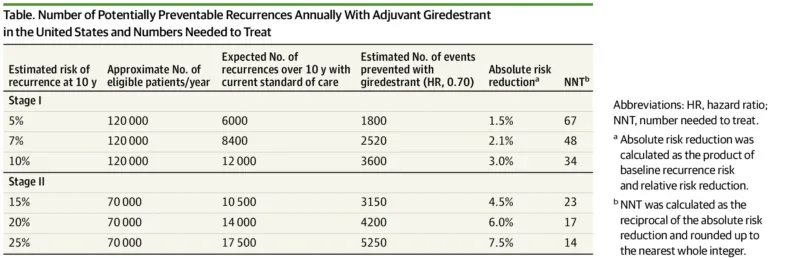
At the prespecified interim analysis in the intent-to-treat population, giredestrant reduced the risk of invasive disease recurrence or death by 30% compared with standard endocrine therapy (HR 0.70; 95% CI, 0.57–0.87; two-sided P = .0014). The 36-month iDFS rate was 92.4% (95% CI, 91.2%–93.7%) with giredestrant versus 89.6% (95% CI, 88.1%–91.0%) with standard endocrine therapy, an absolute difference of about 2.8 percentage points.
Giredestrant also reduced the risk of distant recurrence by 31% (distant recurrence-free interval HR 0.69; 95% CI, 0.54–0.89), a key secondary endpoint. OS data were not mature at the time of the analysis.
These results were first presented at the 2025 San Antonio Breast Cancer Symposium. lidERA is the first phase III trial to show a significant benefit for an oral SERD in the adjuvant setting.
Safety Profile
The most common adverse events and laboratory abnormalities, each occurring in at least 10% of patients treated with giredestrant, were:
- Adverse events: musculoskeletal pain, hot flash, fatigue, headache, nausea, bradycardia, and COVID-19
- Laboratory abnormalities: decreased lymphocyte, leukocyte, and neutrophil counts and hemoglobin; increased AST, ALT, alkaline phosphatase, triglycerides, cholesterol, creatinine, and potassium; decreased sodium and potassium; and increased or decreased calcium
In the trial, giredestrant was reported as well tolerated, with adverse events that were manageable and consistent with its known safety profile. Bradycardia has been seen across the giredestrant program, so heart rate monitoring should be considered in clinical practice. Full prescribing information, including dosing and warnings, is available in the product label.
Why This Approval Matters for Early Breast Cancer
ER-positive disease accounts for about 70% of breast cancers, and more than 90% of ER-positive cases are diagnosed at stage I–III. Despite adjuvant endocrine therapy, up to a third of patients eventually relapse. For more than 20 years, tamoxifen and aromatase inhibitors have remained the endocrine backbone of adjuvant treatment. Progress has come mainly from adding other agents, such as CDK4/6 inhibitors in higher-risk patients, rather than from a better endocrine drug.
Giredestrant is a full ER antagonist and degrader taken orally. lidERA showed that replacing standard endocrine therapy with this agent can lower the risk of recurrence across a broad intermediate- to high-risk population. Unlike intramuscular fulvestrant, an oral SERD fits the long-term, daily schedule that adjuvant therapy requires.
Several practical questions remain. The absolute iDFS benefit of 2.8% at three years is meaningful but modest, and longer follow-up will show whether it widens over time, as with earlier adjuvant endocrine trials. OS data are still pending. Clinicians will also need guidance on how giredestrant fits with adjuvant CDK4/6 inhibitors and ovarian function suppression, since lidERA tested giredestrant as monotherapy against standard endocrine therapy.
What’s Next for Giredestrant?
Giredestrant is now approved in two settings within one week. The first is in combination with everolimus for ER-positive, HER2-negative, ESR1-mutated advanced breast cancer after prior endocrine therapy, based on the phase III evERA trial. The second is as adjuvant monotherapy based on lidERA. That makes it the first SERD approved for both early and advanced ER-positive breast cancer.
The broader giredestrant program includes several more company-sponsored phase III trials across the disease continuum, including combinations with CDK4/6 inhibitors. Further follow-up from lidERA, including mature OS, subgroup analyses by risk category and menopausal status, and longer-term tolerability, will be important to define which patients benefit most from switching to a next-generation endocrine backbone.