
The efficacy advantage of trastuzumab deruxtecan over trastuzumab emtansine in high-risk HER2-positive early breast cancer does not appear to come at the cost of a substantial deterioration in overall patient-reported quality of life.
New patient-reported outcome data from the phase III DESTINY-Breast05 trial, presented at ESMO Congress 2026, showed that health-related quality of life was broadly maintained with both trastuzumab deruxtecan (T-DXd) and trastuzumab emtansine (T-DM1) in patients with residual invasive HER2-positive disease following neoadjuvant therapy.
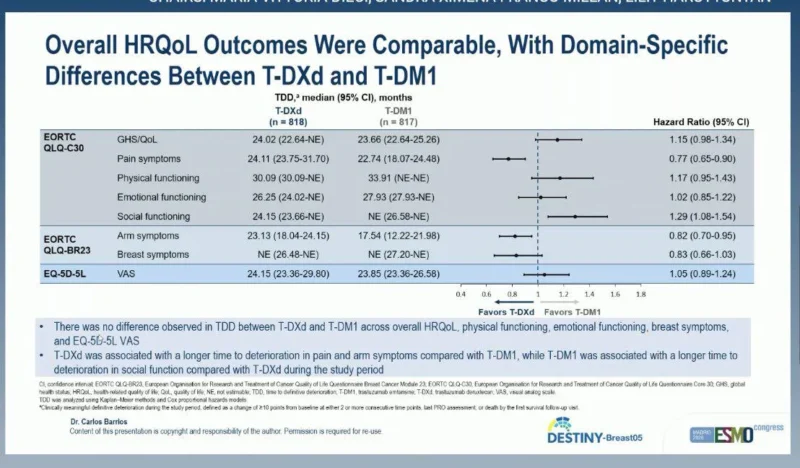
The exploratory analysis found no clear difference between treatments in time to definitive deterioration across overall global health status and quality of life, physical functioning, emotional functioning, breast symptoms, or EQ-5D-5L visual analog scale scores.
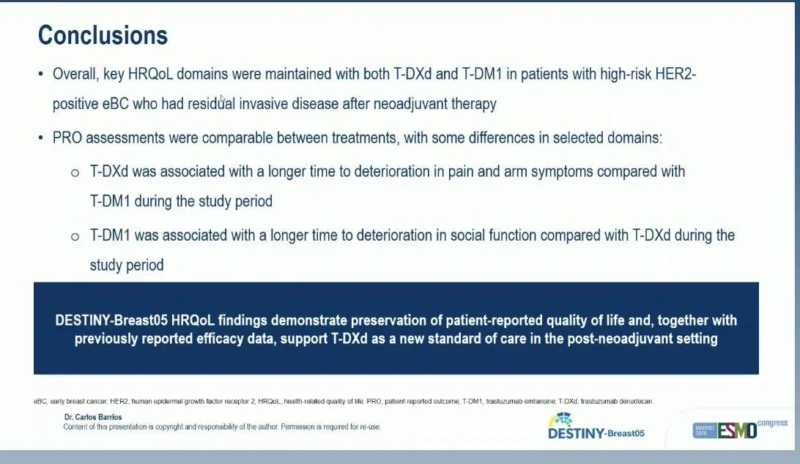
Selected domains, however, differed between treatments. T-DXd was associated with a longer time to deterioration in pain and arm symptoms, whereas T-DM1 was associated with a longer time to deterioration in social functioning.
The findings add an important patient-centered dimension to the previously reported efficacy results of DESTINY-Breast05, in which T-DXd reduced the risk of invasive disease recurrence or death by 53% compared with T-DM1.
DESTINY-Breast05 Has Already Changed the Post-Neoadjuvant Landscape
Patients with HER2-positive early breast cancer who have residual invasive disease after neoadjuvant HER2-directed therapy remain at substantially increased risk of recurrence. T-DM1 established the post-neoadjuvant standard for this population after demonstrating that treatment escalation could meaningfully reduce recurrence risk.
DESTINY-Breast05 directly challenged that standard by comparing T-DXd with T-DM1 in patients considered to have particularly high-risk residual disease. The study enrolled 1,635 patients, with 818 assigned to T-DXd and 817 to T-DM1.
At approximately 30 months of median follow-up, invasive disease recurrence or death occurred in 51 patients receiving T-DXd and 102 receiving T-DM1. Three-year invasive disease-free survival was 92.4% with T-DXd compared with 83.7% with T-DM1, corresponding to an HR of 0.47 (95% CI 0.34–0.66; P<0.001).
Three-year disease-free survival was similarly improved at 92.3% versus 83.5%, also with an HR of 0.47. These results led the FDA in May 2026 to approve T-DXd as adjuvant therapy for adults with HER2-positive early breast cancer who have residual invasive disease following neoadjuvant trastuzumab-based and taxane-based treatment.
The ESMO 2026 analysis now asks a different question: what does this greater protection against recurrence mean from the patient’s perspective during treatment?
Patient-Reported Outcomes Become Particularly Important in Curative-Intent Therapy
Quality-of-life assessment has a different importance in early breast cancer than in metastatic disease. Patients receiving post-neoadjuvant therapy may already be free of clinically detectable cancer after surgery. Treatment is being given to reduce the probability of future recurrence rather than to control measurable metastatic disease.
This raises the threshold for acceptable toxicity. A more effective therapy is clinically valuable, but the balance becomes more compelling if improved disease control can be achieved without a substantial deterioration in patients’ daily functioning and overall well-being.
DESTINY-Breast05 therefore incorporated several validated patient-reported outcome instruments, including the EORTC QLQ-C30, the breast cancer-specific EORTC QLQ-BR23, and the EQ-5D-5L visual analog scale.
The ESMO analysis evaluated time to definitive deterioration, assessing whether clinically meaningful worsening in quality-of-life domains was sustained rather than representing a temporary fluctuation during treatment.
Overall Quality of Life Was Broadly Comparable
At the July 2, 2025 data cutoff, overall health-related quality of life remained preserved with T-DXd. Median time to definitive deterioration in global health status and quality of life was 24.0 months with T-DXd and 23.7 months with T-DM1.
The HR was 1.15 (95% CI 0.98–1.34), providing no clear evidence of a treatment difference. Physical functioning was also comparable. Median time to deterioration was approximately 30.1 months with T-DXd and 33.9 months with T-DM1, with an HR of 1.17 (95% CI 0.95–1.43).
For emotional functioning, median time to deterioration was approximately 26.3 versus 27.9 months, with an HR of 1.02 (95% CI 0.85–1.22). Breast symptom deterioration also showed no clear difference between groups, with an HR of 0.83 (95% CI 0.66–1.03).
Similarly, EQ-5D-5L visual analog scale results were comparable, with an HR of 1.05 (95% CI 0.89–1.24). Taken together, these findings suggest that the substantial improvement in invasive disease-free survival observed with T-DXd was not accompanied by a clear deterioration in overall global health status or key functional domains during the study period.
T-DXd Was Favored for Pain Deterioration
One of the clearest domain-specific differences involved pain. Median time to definitive deterioration in pain was approximately 24.1 months with T-DXd compared with 22.7 months with T-DM1.
The HR was:
- 0.77 (95% CI 0.65–0.90)
Because values below 1 favored T-DXd in this analysis, this indicates a lower risk of definitive worsening in pain among patients receiving T-DXd. The finding is clinically relevant because pain can affect physical activity, sleep, treatment adherence, and overall perception of treatment burden.
Importantly, the result should not be interpreted as evidence that T-DXd actively improves pain. Rather, patients receiving T-DXd experienced definitive deterioration in this domain less frequently or later than those receiving T-DM1 during the study period.
Arm Symptoms Also Favored T-DXd
A similar pattern was observed for arm symptoms using the breast cancer-specific QLQ-BR23 instrument. Median time to definitive deterioration was 23.1 months with T-DXd compared with 17.5 months with T-DM1.
The HR was:
- 0.82 (95% CI 0.70–0.95)
Arm symptoms after breast cancer treatment may reflect a combination of surgery, lymph-node procedures, radiotherapy effects, musculoskeletal symptoms, and systemic treatment burden.
The longer time to deterioration observed with T-DXd is therefore noteworthy, although the mechanism underlying this difference cannot be established from the patient-reported outcome analysis alone.
Social Functioning Favored T-DM1
Not every domain favored T-DXd.
For social functioning, the HR was:
- 1.29 (95% CI 1.08–1.54)
indicating a longer time to definitive deterioration with T-DM1. Median time to deterioration was approximately 24.2 months with T-DXd, while it was not estimable with T-DM1 during the available follow-up period.
This finding introduces an important nuance into the overall quality-of-life interpretation. The new data should therefore not be summarized as showing uniformly better patient-reported outcomes with T-DXd.
A more accurate interpretation is that overall HRQoL was broadly comparable, with different treatments favored in selected domains. T-DXd performed better for pain and arm symptoms, whereas T-DM1 performed better for social functioning.
Patient-Reported Outcomes Do Not Replace the Safety Data
Preserved global health-related quality of life should also not be interpreted as meaning that the two drugs have equivalent toxicity profiles. DESTINY-Breast05 demonstrated important safety differences. T-DXd was associated more frequently with gastrointestinal and hematologic adverse events, including nausea, vomiting, constipation, and decreased neutrophil counts.
Interstitial lung disease remains one of its most clinically important risks. In the primary DESTINY-Breast05 analysis, adjudicated drug-related ILD occurred in approximately 9.6% of patients receiving T-DXd compared with 1.6% receiving T-DM1, and two ILD-related deaths occurred in the T-DXd arm.
These events are not contradicted by the patient-reported outcome findings. HRQoL instruments capture patients’ experiences across broad functional and symptom domains, but uncommon serious adverse events may have major clinical importance without substantially shifting average quality-of-life scores across an entire randomized population.
The two datasets should therefore be interpreted together rather than interchangeably. T-DXd provides substantially greater protection against recurrence while preserving overall HRQoL for most patients, but it also requires careful monitoring for potentially serious treatment-related toxicity.
Completion Rates Were Similar Between Treatment Arms
Interpretation of patient-reported outcomes also depends on whether questionnaires were completed consistently. PRO completion rates during treatment ranged from 58.4% to 93.3% with T-DXd and 61.2% to 92.7% with T-DM1.
The broadly similar completion rates reduce concern that major differences in questionnaire participation between treatment groups drove the findings. Nevertheless, declining questionnaire completion over prolonged follow-up remains an important limitation of most longitudinal quality-of-life analyses.
Patients who discontinue treatment, recur, become unwell, or stop completing questionnaires may differ systematically from patients who remain evaluable. For this reason, the PRO findings are best interpreted as supportive evidence rather than as an independent demonstration of superiority.
The Efficacy–Quality of Life Balance Is Clinically Important
The central clinical message from the new analysis is not that T-DXd produces better quality of life than T-DM1. The data do not support that broad conclusion. The more important finding is that the substantial efficacy advantage of T-DXd was achieved while overall health-related quality of life remained broadly comparable between treatments.
That is a meaningful distinction. T-DXd reduced the risk of invasive disease recurrence or death by more than half and improved three-year IDFS by an absolute 8.7 percentage points, yet patients did not experience a corresponding overall deterioration in global quality-of-life measures.
In curative-intent therapy, this combination of efficacy and preserved patient-reported well-being strengthens the overall benefit-risk argument.
What This Means for Post-Neoadjuvant HER2-Positive Breast Cancer
The treatment paradigm for residual HER2-positive disease has already shifted. T-DM1 was previously the defining post-neoadjuvant escalation strategy, but DESTINY-Breast05 demonstrated superior invasive disease-free survival with T-DXd in high-risk patients.
The new HRQoL analysis provides reassurance that the efficacy gain is not accompanied by a broad deterioration across global health status, physical functioning, emotional functioning, or general health perception. However, treatment decisions still require individualized discussion.
The risk of recurrence, pulmonary comorbidities, ability to undergo ILD monitoring, prior treatment tolerance, patient preferences, and expected treatment burden remain relevant.
The patient-reported outcome results strengthen the case for T-DXd, but they do not remove the need for careful toxicity surveillance.
OncoDaily Takeaway
The ESMO 2026 patient-reported outcome analysis adds an important new dimension to DESTINY-Breast05. T-DXd had already demonstrated a 53% reduction in the risk of invasive disease recurrence or death compared with T-DM1, with three-year IDFS of 92.4% versus 83.7%.
The new analysis suggests that this efficacy advantage was achieved without a clear overall deterioration in health-related quality of life. Global health status, physical functioning, emotional functioning, breast symptoms, and EQ-5D-5L scores were broadly comparable between treatments.
T-DXd was associated with a longer time to deterioration in pain and arm symptoms, while T-DM1 was favored for social functioning. These domain-specific differences reinforce the need for a nuanced interpretation rather than a simple conclusion that one therapy produces universally better patient-reported outcomes.
The safety profile also remains important. T-DXd carries a clinically meaningful risk of ILD and requires active pulmonary monitoring despite preservation of overall HRQoL.
Taken together with the primary efficacy data, however, the ESMO 2026 findings strengthen the clinical position of T-DXd in the post-neoadjuvant setting: greater protection against recurrence can be achieved while maintaining broadly comparable patient-reported quality of life during treatment.
Source
- DESTINY-Breast05, Abstract 539RO. Patient-Reported Outcomes From DESTINY-Breast05: Health-Related Quality of Life With Trastuzumab Deruxtecan Versus Trastuzumab Emtansine in Patients With High-Risk HER2-Positive Early Breast Cancer. Presented at ESMO Congress 2026.
- Primary efficacy results: Trastuzumab Deruxtecan in Residual HER2-Positive Early Breast Cancer. New England Journal of Medicine.