
Breast cancer treatment in 2026 is being shaped by two seemingly opposite trends. Systemic therapy is becoming increasingly complex, with molecular biomarkers, antibody–drug conjugates, CDK4/6 inhibitors, PARP inhibitors, immunotherapy, and next-generation endocrine therapies creating more opportunities for treatment escalation. At the same time, advances in imaging, systemic therapy, surgery, and radiation are allowing clinicians to de-escalate local treatment for carefully selected patients without compromising disease control.
A comprehensive review published in the October 2026 issue of Mayo Clinic Proceedings, captures this transition across the entire breast cancer continuum, from curative early-stage treatment to increasingly biomarker-driven metastatic sequencing (Ruddy et al., 2026). The review’s central message is not simply that more treatments are available. Breast oncology is increasingly becoming a discipline of selecting the appropriate intensity of treatment for the biology and recurrence risk of each individual cancer.
Breast Cancer Is No Longer Defined by Stage Alone
Anatomic staging remains fundamental, but breast cancer treatment now depends heavily on tumor biology. More than 75% of breast cancers are hormone receptor-positive, approximately 15–20% are HER2-positive, and 10–15% are triple-negative. The emergence of the HER2-low category has added another clinically relevant layer, identifying tumors without conventional HER2 amplification that may nevertheless respond to HER2-directed antibody–drug conjugates (Ruddy et al., 2026).
Genomics is also increasingly integrated into treatment selection. Germline testing can influence surgery, adjuvant systemic treatment, and hereditary risk management, while tumor genomic assays and molecular profiling help determine whether chemotherapy, endocrine therapy, targeted therapy, or combinations are appropriate. This evolution has made treatment personalization possible at both ends of the spectrum: escalating therapy for biologically high-risk disease while avoiding unnecessary treatment in lower-risk disease.
Surgery Is Becoming Less Extensive for Selected Patients
The shift toward personalization is perhaps most visible in breast and axillary surgery. Breast-conserving surgery followed by radiation remains oncologically equivalent to mastectomy for most appropriately selected patients. Meanwhile, the historical assumption that every patient requires progressively more extensive nodal surgery is being challenged.
The SOUND trial evaluated patients with clinically and sonographically negative axillae undergoing lumpectomy and found similar 5-year distant disease-free survival whether sentinel lymph node biopsy was performed or omitted: 97.7% versus 98.0%, respectively. The INSEMA trial produced a similar direction of evidence, supporting increasingly selective use of axillary staging in low-risk disease (Ruddy et al., 2026).
These studies do not mean sentinel node biopsy should disappear from breast cancer surgery. Rather, they illustrate how improved imaging, favorable tumor biology, systemic treatment, and modern radiation can reduce the clinical value of additional surgery in carefully selected patients.
Even more provocative research is exploring whether surgery itself could eventually be omitted in exceptional responders after neoadjuvant therapy, although this remains investigational and requires highly accurate identification of pathologic complete response.
Radiation Is Becoming Shorter and More Selective
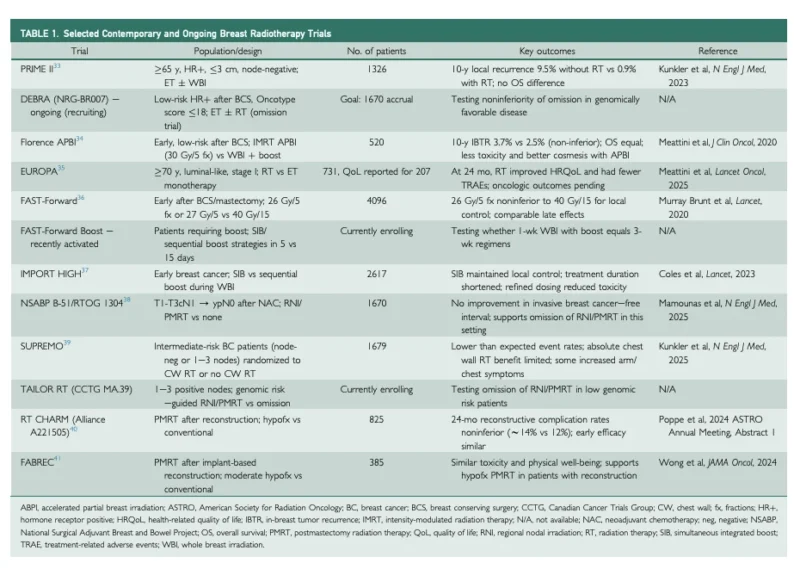
Radiotherapy is undergoing a parallel transformation. For selected patients with favorable early-stage disease, partial breast irradiation delivered over approximately five fractions provides noninferior local control compared with whole-breast irradiation, with advantages in toxicity, convenience, and treatment burden. Ultra-hypofractionated approaches have also reduced treatment duration dramatically, with FAST-Forward supporting a 1-week schedule in appropriate patients.
At the same time, clinicians are increasingly asking whether radiation can be omitted entirely in certain low-risk populations. For older women with small hormone receptor-positive tumors receiving endocrine therapy, omission of radiation increases local recurrence but does not necessarily affect overall survival. Molecular selection may further refine this approach.
The direction of travel is clear: radiation is moving away from a uniform postoperative requirement toward a risk-adapted intervention based on age, biology, anatomy, nodal status, genomic risk, and patient preference.
Postmastectomy Radiation Is Also Being Reconsidered
De-escalation extends beyond the breast itself. The NSABP B-51/RTOG 1304 trial found no improvement from regional nodal irradiation or postmastectomy radiation among patients who initially had cN1 disease but converted to ypN0 after neoadjuvant chemotherapy. The SUPREMO trial similarly demonstrated relatively limited absolute benefit from chest wall radiation in selected intermediate-risk populations with unexpectedly low recurrence rates.
These findings suggest that some patients historically considered candidates for additional regional or postmastectomy radiation may have sufficiently low residual recurrence risk to safely avoid it (Ruddy et al., 2026). The ongoing TAILOR RT programme is taking personalization further by asking whether genomic risk can help determine who truly requires regional radiation.
HR-Positive Early Breast Cancer: Endocrine Therapy Is Becoming More Sophisticated
Endocrine therapy remains the foundation of treatment for early HR-positive breast cancer. Tamoxifen, aromatase inhibitors, and ovarian function suppression remain central, but therapy increasingly extends beyond conventional estrogen deprivation.
The review highlights abemaciclib and ribociclib as established adjuvant CDK4/6 inhibitor options for patients at higher risk of recurrence. Abemaciclib is typically given for 2 years, while ribociclib is given for 3 years, with toxicity profiles influencing individual treatment decisions (Ruddy et al., 2026).
Another emerging development is the movement of oral selective estrogen receptor degraders into earlier disease. The review notes that the phase III lidERA study met its primary endpoint at a preplanned interim analysis, with giredestrant improving invasive disease-free survival compared with standard endocrine therapy. The earlier coopERA study had already shown greater suppression of Ki-67 with neoadjuvant giredestrant compared with an aromatase inhibitor (Ruddy et al., 2026).
If the long-term evidence supports these findings, the endocrine backbone of curative breast cancer treatment could itself begin to change.
Germline BRCA Status Now Determines Treatment, Not Only Risk
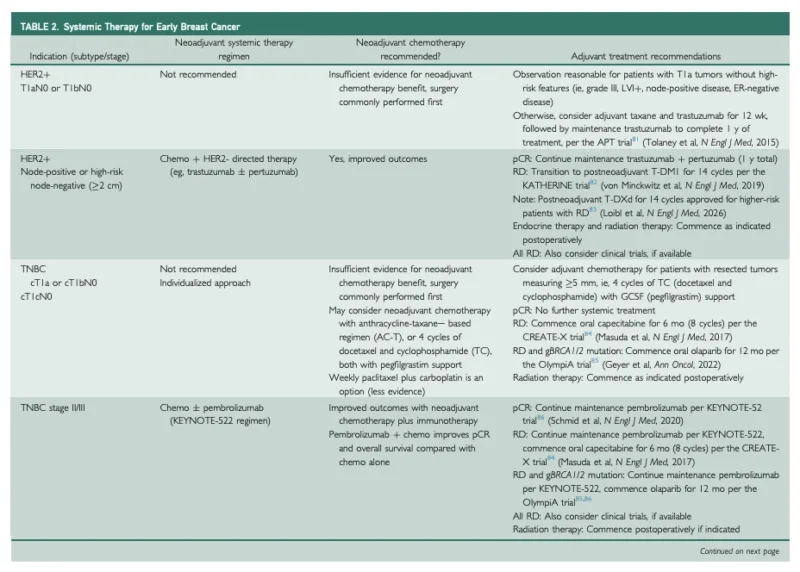
Genetic testing has also moved from risk counseling into therapeutic decision-making. For patients with high-risk HER2-negative early breast cancer and pathogenic germline BRCA1/2 variants, adjuvant olaparib for 12 months represents an important post-treatment strategy.
For patients with HR-positive disease who are also eligible for a CDK4/6 inhibitor, sequencing remains an area of limited evidence. The review notes that CDK4/6 inhibition can be considered after completion of olaparib, but robust data defining optimal sequencing remain limited. This exemplifies a recurring problem in contemporary breast oncology: effective treatments are accumulating faster than randomized trials can determine the optimal sequence between them.
HER2-Positive Early Disease Is Becoming Response-Adapted
HER2-positive early breast cancer has become one of the clearest examples of using response to neoadjuvant therapy to determine postoperative treatment. For clinically significant HER2-positive disease, particularly cT2 or larger tumors or node-positive disease, neoadjuvant chemotherapy combined with trastuzumab and pertuzumab remains an important strategy. What happens after surgery increasingly depends on whether residual invasive disease remains.
Historically, T-DM1 became the post-neoadjuvant standard following KATHERINE. The review further highlights DESTINY-Breast05, in which trastuzumab deruxtecan improved invasive disease-free survival compared with T-DM1 in higher-risk residual disease, adding another potential escalation strategy for patients whose tumors remain after preoperative HER2-directed treatment (Ruddy et al., 2026).
This is the essence of response-adapted treatment: neoadjuvant therapy does not merely shrink the tumor before surgery; it becomes a biological stress test that reveals whether postoperative therapy should be maintained, intensified, or potentially reduced.
Triple-Negative Early Breast Cancer Has Become an Immunotherapy Disease
Treatment of stage II–III triple-negative breast cancer has changed fundamentally with the incorporation of pembrolizumab. The KEYNOTE-522 strategy combines pembrolizumab with neoadjuvant chemotherapy followed by postoperative pembrolizumab. The review notes improved pathologic complete response and survival compared with chemotherapy alone, irrespective of PD-L1 status in this curative setting.
The next question is whether every patient who achieves a pCR needs the postoperative immunotherapy component. The A012103 trial is addressing this directly by randomizing patients who achieve pCR after neoadjuvant chemoimmunotherapy to observation or continued pembrolizumab. This reflects another broader shift: once an effective intensified regimen is established, the field quickly begins asking which components can safely be removed.
Metastatic HR-Positive Disease Is Increasingly Genotype-Directed
The metastatic HR-positive/HER2-negative treatment landscape has become progressively more molecular. A CDK4/6 inhibitor combined with endocrine therapy remains the typical first-line approach. The review emphasizes the consistent overall survival evidence supporting ribociclib-based therapy, while acknowledging that treatment selection must still account for toxicity, comorbidities, cost, prior therapies, and disease burden.
Once resistance develops, tumor genomic profiling increasingly guides the next therapy. For PIK3CA-mutated disease, PI3K-directed strategies can be considered. For tumors with PIK3CA, AKT1, or PTEN alterations, capivasertib can be combined with endocrine therapy. For ESR1-mutated disease, oral SERDs or newer endocrine combinations provide biomarker-specific options. For patients with germline or somatic BRCA1/2 alterations, PARP inhibition may be appropriate.
The goal is to extend endocrine- and targeted-therapy-based treatment for as long as possible before moving to chemotherapy or ADCs. When endocrine resistance eventually dominates, treatment increasingly shifts toward ADCs such as sacituzumab govitecan, datopotamab deruxtecan, and trastuzumab deruxtecan in HER2-low disease. This is transforming HR-positive metastatic breast cancer from a relatively linear endocrine-to-chemotherapy sequence into a branching algorithm driven by acquired molecular resistance.
HER2-Positive Metastatic Disease Is Becoming a Sequencing Challenge
Few breast cancer subtypes now have as many active drugs as HER2-positive metastatic disease. Historically, trastuzumab, pertuzumab, and a taxane formed the dominant first-line backbone, followed by sequential HER2-directed therapies.
The 2026 review describes a rapidly changing environment in which maintenance strategies are becoming more active. It highlights the PATINA study, where adding palbociclib to anti-HER2 maintenance plus endocrine therapy substantially prolonged PFS in HR-positive/HER2-positive disease, and HER2CLIMB-05, in which adding tucatinib to trastuzumab and pertuzumab improved PFS by approximately 9 months.
At the same time, the review notes that DESTINY-Breast09 moved trastuzumab deruxtecan plus pertuzumab into the first-line conversation after producing substantially longer PFS than the historical THP strategy. This creates a new problem that did not exist a few years ago. If T-DXd moves into first-line therapy, what should follow it? Where should tucatinib be placed? How should brain metastases influence the sequence? And which patients may remain on maintenance HER2 blockade for years without ever needing another line?
Both T-DXd and tucatinib have clinically important CNS activity, a crucial consideration given the high incidence of brain metastases in HER2-positive metastatic breast cancer (Ruddy et al., 2026). The challenge in HER2-positive disease is therefore increasingly not a lack of active drugs but how to sequence multiple highly effective ones.
Triple-Negative Metastatic Disease Is Moving Toward Earlier ADC Use
Metastatic TNBC remains a high-risk disease, but the therapeutic framework is also changing rapidly. KEYNOTE-355 established pembrolizumab plus chemotherapy for PD-L1-positive disease, with median OS of 23.0 months versus 16.1 months in the CPS ≥10 population. Sacituzumab govitecan subsequently demonstrated substantial survival benefit in later-line disease in ASCENT, with median OS of 11.8 versus 6.9 months compared with standard chemotherapy.
The 2026 review describes ADCs moving even earlier. ASCENT-04 reported improved PFS with first-line sacituzumab govitecan plus pembrolizumab compared with chemotherapy plus pembrolizumab in PD-L1-positive metastatic TNBC, while ASCENT-03 was positive in PD-L1-negative disease. The review also highlights datopotamab deruxtecan as another emerging first-line ADC strategy.
The implication is substantial. Metastatic TNBC may be moving from a model in which ADCs are reserved for treatment after conventional chemotherapy toward one in which ADC therapy becomes part of the initial metastatic strategy.
HER2-Low Has Changed the Meaning of “HER2-Negative”
The emergence of HER2-low disease has also changed one of the most basic classifications in breast oncology. Historically, tumors were clinically treated as either HER2-positive or HER2-negative. HER2-targeted ADCs have demonstrated that this binary model is incomplete.
The review estimates that approximately 55% of breast cancers may fall into the HER2-low category, including substantial proportions of both HR-positive and triple-negative disease. HER2 expression in these tumors may not function as a dominant oncogenic driver, but it can act as a sufficiently abundant surface target to deliver a highly potent ADC payload.
That principle is changing how biomarkers are interpreted. A biomarker does not necessarily need to be the cause of the cancer to be therapeutically useful. Sometimes it only needs to provide the drug with an address.
De-Escalation and Escalation Are Happening at the Same Time
Perhaps the most interesting theme of the Mayo Clinic review is that modern breast cancer therapy is simultaneously moving in two directions. In early-stage disease, treatment is increasingly being de-escalated where recurrence risk is sufficiently low: less axillary surgery, shorter radiation, selective radiation omission, and more precise decisions about chemotherapy.
In biologically high-risk disease, treatment is being escalated: CDK4/6 inhibition, PARP inhibition, immunotherapy, ADCs, targeted maintenance, and post-neoadjuvant strategies selected according to residual disease. These are not contradictory trends. They are both consequences of better risk assessment. The goal is no longer to give the maximum amount of treatment that a patient can tolerate. The goal is to give exactly as much treatment as the disease requires.
The Next Challenge Is Sequencing
As the number of available therapies grows, sequencing has become one of the major unresolved problems in breast oncology. Many active drugs have never been compared directly with one another. Patients may now receive several endocrine-targeted combinations, multiple HER2-directed therapies, PARP inhibitors, checkpoint inhibitors, and more than one ADC over the course of their disease.
Cross-resistance between ADC payloads, optimal timing of molecular testing, management of brain metastases, mechanisms of endocrine resistance, duration of maintenance therapy, and selection of therapies after progression will increasingly determine outcomes.
Ruddy and colleagues identify the need for stronger predictive biomarkers and better post-progression sequencing strategies as central unmet needs in metastatic breast cancer.
Precision Oncology Still Depends on Access
The scientific sophistication of breast cancer care continues to increase, but the review also highlights a persistent global contradiction. Countries with lower breast cancer incidence can have substantially higher mortality because patients present with more advanced disease and have less access to optimal diagnosis and treatment.
The clinical relevance of a new ADC, genomic assay, oral SERD, or highly conformal radiation technique depends on whether patients can access it. As breast oncology becomes increasingly personalized, equitable implementation will therefore be just as important as therapeutic innovation.
The Bottom Line
Breast cancer treatment in 2026 is no longer moving toward a single universal standard. It is moving toward multiple biologically defined treatment pathways. For low-risk early disease, the direction is toward less surgery, shorter and more selective radiation, and avoidance of unnecessary systemic therapy. For high-risk early disease, treatment is becoming increasingly response-adapted, with CDK4/6 inhibition, olaparib, immunotherapy, and ADCs used to reduce residual recurrence risk.
In metastatic disease, therapy is increasingly selected according to ESR1, PIK3CA, AKT1, PTEN, BRCA1/2, HER2 expression, PD-L1 status, prior treatments, CNS involvement, and mechanisms of resistance. The review by Ruddy and colleagues summarizes a field in which personalization is no longer limited to choosing a drug.
It increasingly determines whether to operate, how much to irradiate, when to escalate, when to de-escalate, and what should come next after resistance develops (Ruddy et al., 2026). The defining question in modern breast oncology may therefore no longer be: What is the standard treatment for breast cancer?
It is increasingly: What is the right treatment intensity, sequence, and duration for this particular breast cancer, and this particular patient?
Reference
- Ruddy, K. J., Idossa, D., Black, D. M., Corbin, K. S., Cathcart-Rake, E., & O’Sullivan, C. C. (2026). Treatment of breast cancer. Mayo Clinic Proceedings, 101(10), 1788–1817. https://doi.org/10.1016/j.mayocp.2026.07.019.