
Every October, the world turns pink for Breast Cancer Awareness Month. The pink ribbon has become one of the most recognizable symbols in global health, but the value of this month extends far beyond visibility. Awareness matters only when it leads to action: recognizing breast changes, seeking medical attention without delay, receiving a timely diagnosis, accessing appropriate treatment, and ensuring that every patient has an equitable opportunity for survival.
For Breast Cancer Awareness Month 2026, the World Health Organization highlights the theme “Every story is unique, every journey matters.” The message reflects an increasingly important principle in breast cancer care: there is no single breast cancer experience. Tumor biology, stage at diagnosis, age, access to diagnostics and treatment, socioeconomic circumstances, family support, fertility concerns, treatment toxicity, survivorship, and recurrence risk can make each patient’s journey profoundly different (WHO, 2026).
Yet behind those individual stories is a global challenge of enormous scale.
Breast Cancer Remains a Major Global Health Challenge
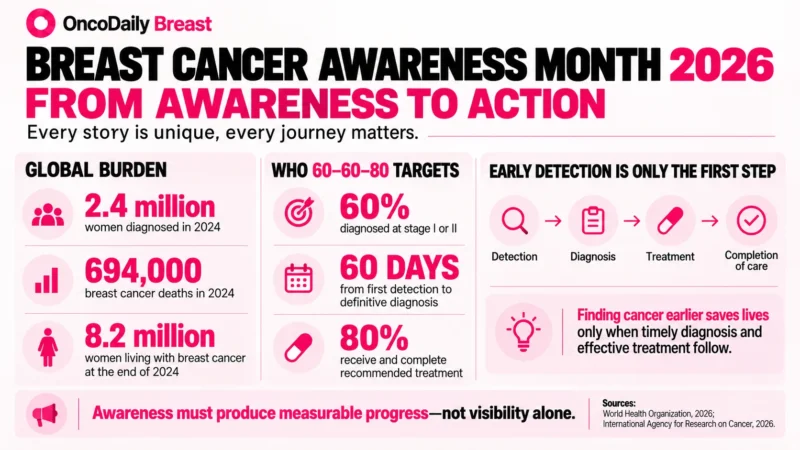
Breast cancer remains the most commonly diagnosed cancer among women worldwide. According to the latest estimates highlighted by WHO, approximately 2.4 million women were diagnosed with breast cancer in 2024, around 694,000 women died from the disease, and approximately 8.2 million women were living with breast cancer at the end of that year (WHO, 2026).
The International Agency for Research on Cancer similarly estimates that almost 2.5 million people developed breast cancer and nearly 700,000 died from it in 2024, making breast cancer by far the most common cancer among women and the leading cause of cancer death among women globally (IARC, 2026).
These numbers also illustrate why awareness cannot be restricted to one month. For millions of women, breast cancer is not an October campaign. It is a diagnosis, months or years of treatment, uncertainty about recurrence, long-term adverse effects, changes in fertility or body image, financial consequences, and the challenge of returning to everyday life after treatment.
Early Diagnosis Still Matters
Modern breast oncology is advancing rapidly. Endocrine therapies, HER2-directed agents, CDK4/6 inhibitors, PARP inhibitors, immunotherapy, antibody–drug conjugates, molecular testing, and increasingly individualized treatment strategies continue to improve outcomes. But none of these advances eliminates the importance of detecting breast cancer early.
Treatment is generally more effective when disease is diagnosed before it has spread to distant organs. Early detection can also allow less extensive local and systemic therapy for some patients. WHO’s Global Breast Cancer Initiative therefore focuses on three interconnected goals: health promotion and early detection, timely diagnosis, and comprehensive breast cancer management.
The initiative has established the 60–60–80 targets: 60% of invasive breast cancers should be diagnosed at stage I or II. Patients should receive a definitive diagnosis within 60 days of first detection or presentation to a health facility.
At least 80% of people diagnosed with breast cancer should receive and complete the recommended treatment (WHO, 2026). These targets recognize an essential reality: detecting a breast abnormality earlier achieves little if pathology takes months, staging is inaccessible, or effective treatment cannot subsequently be delivered.
Knowing the Signs Is Different From Living in Fear
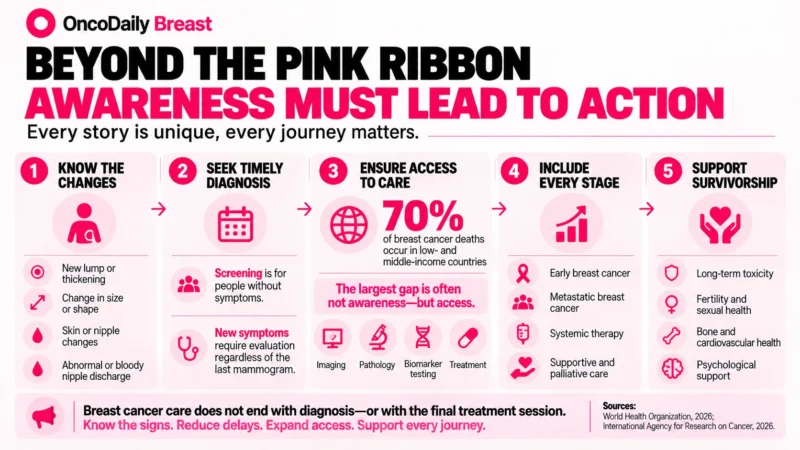
Breast awareness does not mean constantly searching for cancer. It means being familiar with one’s breasts and seeking medical assessment when a persistent or unusual change appears. WHO highlights several signs that warrant attention, including a new breast lump or thickening, a change in breast size or shape, alterations of the breast skin or nipple, and abnormal or bloody nipple discharge (WHO, 2026).
Many breast changes are benign. Nevertheless, a new or persistent abnormality should not be ignored simply because it is painless or because there is no family history of breast cancer. In fact, family history is only one component of risk.
WHO estimates that approximately 80% of breast cancers occur in women without a specific risk factor other than being female and increasing age. Most women diagnosed with breast cancer do not have a known family history of the disease (WHO, 2026). That makes population-wide awareness essential.
Screening and Symptom Awareness Are Not the Same Thing
Breast cancer screening and early diagnosis are sometimes discussed as though they were interchangeable, but they address different situations. Screening aims to detect cancer in people without symptoms, generally through organized mammography programmes for populations in whom benefits have been demonstrated. Early diagnosis means recognizing symptoms promptly and ensuring that a person with a suspicious finding reaches appropriate diagnostic services without unnecessary delay.
Both matter.
A woman participating regularly in mammographic screening should still seek assessment if she develops a new breast symptom between screening examinations. Conversely, awareness campaigns should not imply that self-examination alone is a substitute for evidence-based organized screening where such programmes are recommended and available.
Breast Cancer Awareness Month should therefore encourage informed participation in appropriate screening while also emphasizing that symptoms require evaluation regardless of the date of the last mammogram.
The Largest Gap Is Often Not Knowledge, but Access
One of the most important messages of Breast Cancer Awareness Month 2026 is that breast cancer outcomes remain profoundly unequal. WHO reports that approximately 70% of breast cancer deaths occur in low- and middle-income countries, where barriers to early detection, timely diagnosis, pathology, surgery, radiotherapy, systemic therapy, and continuity of care remain substantially greater (WHO, 2026). This changes how awareness should be discussed.
Telling people to “get checked” is insufficient if diagnostic imaging is inaccessible. Promoting screening has limited value if abnormal findings cannot be biopsied promptly. Diagnosing breast cancer early is not enough when essential surgery, radiotherapy, systemic treatment, or supportive care cannot be delivered.
The modern goal of breast cancer advocacy must therefore extend from awareness to access. That means strengthening diagnostic pathways, pathology infrastructure, treatment availability, multidisciplinary care, patient navigation, and survivorship services, not simply distributing information.
Prevention Also Deserves a Place in the Conversation
Not every breast cancer can be prevented, and awareness messaging should never imply that a patient caused her cancer. Nevertheless, some risk factors are modifiable. IARC identifies alcohol consumption and obesity among established causes of breast cancer and estimates that these two factors were responsible for more than 250,000 breast cancer cases worldwide in 2022 (IARC, 2026).
Physical activity, maintenance of a healthy body weight, and reduction or avoidance of alcohol can therefore form part of broader breast cancer prevention strategies.
But prevention messaging must remain balanced. Even people who follow healthy lifestyles can develop breast cancer, while many patients have no identifiable modifiable risk factor. The purpose of discussing risk is to support informed health choices, not to assign responsibility after diagnosis.
Breast Cancer Is Not One Disease
Awareness campaigns often refer to “breast cancer” as though it were a single condition. Modern oncology tells a very different story.
Hormone receptor-positive/HER2-negative breast cancer behaves differently from HER2-positive disease. Triple-negative breast cancer represents another clinically and biologically distinct group. Within these categories are additional molecular subtypes and genomic alterations that can influence prognosis and treatment.
Stage also changes everything.
A person with a small node-negative tumor faces very different treatment decisions from someone with inflammatory breast cancer, residual disease after neoadjuvant therapy, or metastatic disease involving the liver, lung, bone, or brain.
That is why the WHO 2026 theme “Every story is unique, every journey matters” fits the current era of breast oncology particularly well. Всемирная организация здравоохранения Precision oncology increasingly recognizes that treatment should be tailored to both tumor biology and the individual living with the disease.
Awareness Must Include Metastatic Breast Cancer
Breast Cancer Awareness Month should also include people living with metastatic breast cancer. For these patients, awareness does not primarily mean earlier diagnosis. It means access to effective treatment, molecular testing when appropriate, symptom control, supportive and palliative care, participation in clinical trials, psychological support, and recognition that living with metastatic disease can involve years of sequential therapy.
Scientific progress has substantially expanded the treatment options available across several metastatic breast cancer subtypes. Yet metastatic breast cancer remains responsible for the overwhelming majority of breast cancer deaths. A meaningful awareness campaign should therefore acknowledge both sides of breast oncology: the possibility of cure in early disease and the continuing need for better treatments for patients whose cancer has become metastatic.
Survivorship Is Part of Breast Cancer Care
Better treatment means more people are living longer after breast cancer. That success creates another responsibility. Survivorship may include management of endocrine therapy symptoms, premature menopause, cardiovascular and bone health, lymphedema, cognitive concerns, fertility, sexual health, body image, anxiety about recurrence, employment and financial consequences, and the long-term toxicities of cancer treatment.
The end of chemotherapy or radiotherapy is therefore not necessarily the end of cancer care. Breast Cancer Awareness Month should recognize survivors not simply as people who have finished treatment, but as individuals who may continue to need structured medical and psychosocial support for years afterward.
From Pink Ribbons to Measurable Progress
Awareness campaigns have played an important role in bringing breast cancer into public conversation. The next challenge is to ensure that awareness produces measurable outcomes.
Success should ultimately mean:
- more cancers diagnosed at an earlier stage
- shorter delays between suspicious findings and diagnosis
- rapid access to appropriate multidisciplinary treatment
- greater participation in evidence-based screening
- broader access to biomarker and genetic testing when clinically indicated
- better support during and after treatment
- smaller survival gaps between countries and communities
This is the transition Breast Cancer Awareness Month needs, from visibility to implementation.
The Bottom Line
October is Breast Cancer Awareness Month, but the message for 2026 should extend beyond wearing pink. Breast cancer affected approximately 2.4 million women worldwide in 2024 and caused around 694,000 deaths.
Scientific advances continue to transform treatment, yet survival still depends heavily on when cancer is diagnosed, how quickly the diagnosis is established, whether appropriate treatment is available, and whether patients can complete that treatment.
Awareness therefore needs to lead to action.
- Know the changes that should prompt medical assessment
- Participate in appropriate screening when recommended
- Reduce delays between detection and diagnosis
- Ensure access to modern pathology and biomarker testing
- Deliver evidence-based treatment without unnecessary interruption
- Support patients through treatment, survivorship, and metastatic disease
- Work toward breast cancer care in which geography and income no longer determine the chance of survival
In 2026, the goal should not simply be a more visible Breast Cancer Awareness Month.
It should be a more actionable one.
References
- World Health Organization. (2026). Breast Cancer Awareness Month 2026: Every story is unique, every journey matters. World Health Organization. Всемирная организация здравоохранения
- International Agency for Research on Cancer. (2026, October 1). IARC marks Breast Cancer Awareness Month 2026. World Health Organization. IARC