
Catherine Alix-Panabières, Visiting Professor at University of Hamburg, shared on LinkedIn:
“Today is World Pancreatic Cancer Day.
Pancreatic cancer remains one of the most aggressive cancers, mostly because it is detected too late. Changing that means catching it at its very first steps.
At the Liquid Biopsy LCCRH Lab – Laboratoire Cellules Circulantes Rares Humaines,Liquid Biopsy LCCRH Lab – Laboratoire Cellules Circulantes Rares Humaines, CHU de Montpellier, we are strongly committed, nationally and internationally, to projects that will shape tomorrow’s very early detection of this disease:
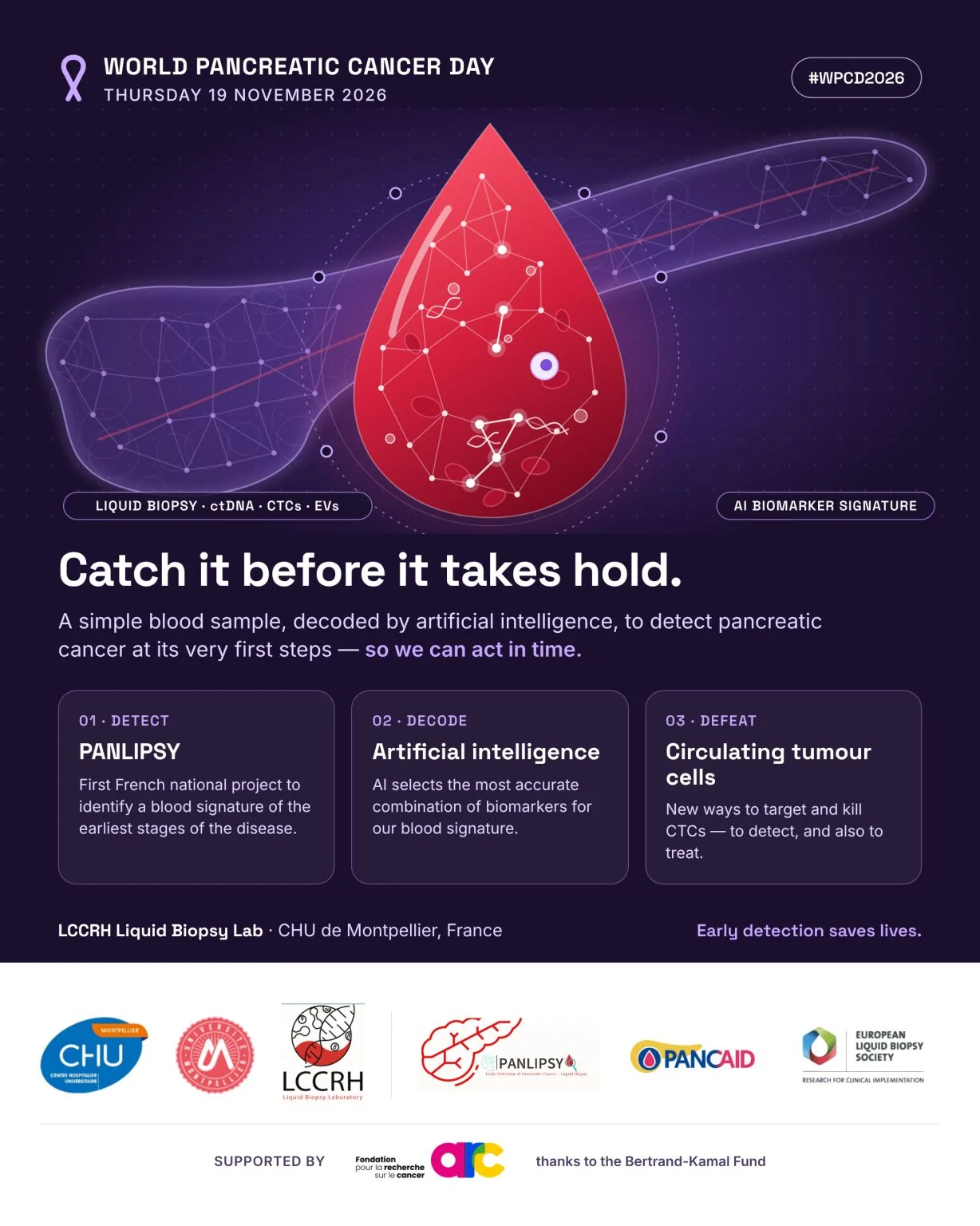
PANLIPSY: the first French national project aiming to identify a blood signature that reveals the very beginning of pancreatic cancer development, so that we can act in time.
This signature combines different types of circulating biomarkers, such as circulating tumour DNA , circulating tumour cells , extracellular vesicles and proteins but also circulating immunes cells (CICs), circulating microbiota.
I have the privilege of coordinating it in France. A big thank you to all collaborators!
- Artificial intelligence (AI) is central to PANLIPSY. No single biomarker is enough: AI helps us integrate these multiple signals and select the most accurate combination to build our blood signature.
- Targeting circulating tumour cells (CTCs): in parallel, we are working to identify new ways to kill CTCs. The goal is to detect the disease, and also to treat it.
PANCAID: a complementary international project with similar goals coordinated by Klaus Pantel, Matthias Löhr.
A heartfelt thank you to the the ARC Foundation for Cancer Research for its trust and its support of this highly innovative and promising project, made possible by the Bertrand-Kamal Fund. My deepest gratitude goes to Samir and Annick, BEKA’s parents, for their kindness and their strength. We will fight it one day.
Early detection saves lives. Let’s keep pushing.”
You can also read:
World Pancreatic Cancer Day 2026: From Silent Symptoms to the Urgent Need for Earlier Diagnosis