





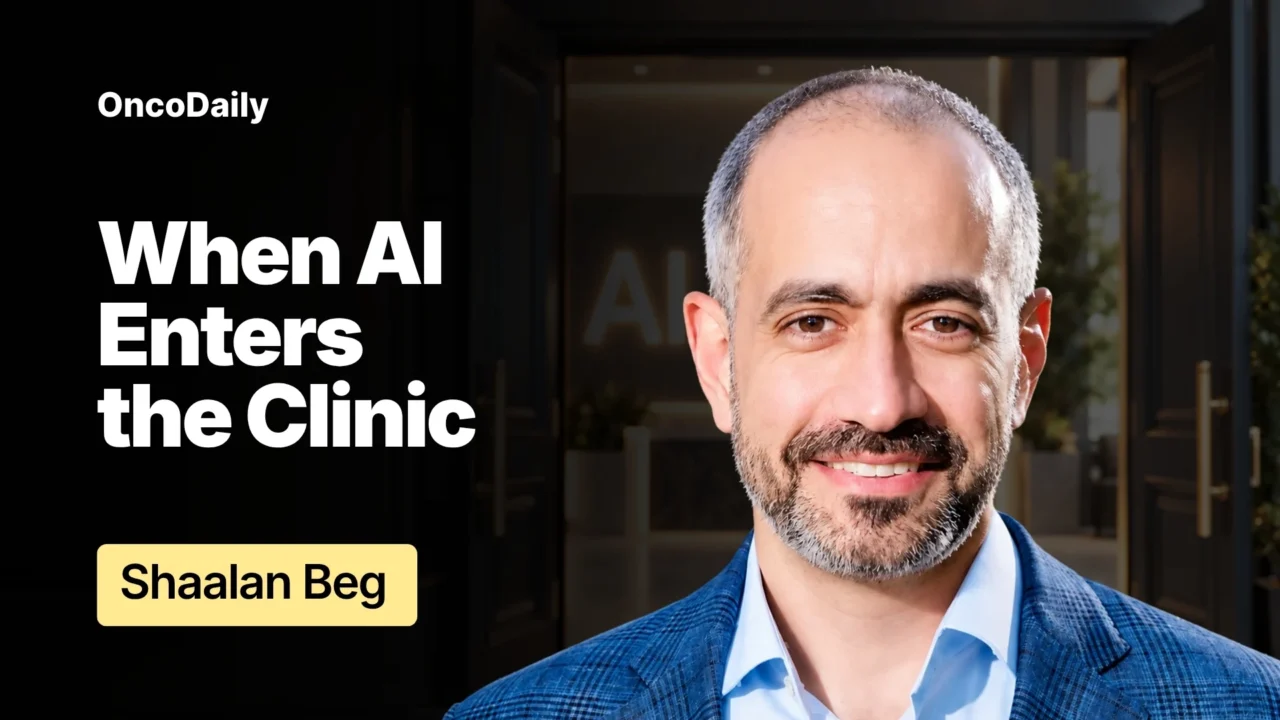
For Shaalan Beg, the future of AI in oncology is not an autonomous machine replacing physicians. It is a focused clinical assistant – tested, governed, and accountable – helping patients reach better care and clinical trials.
Artificial intelligence has entered medicine with the vocabulary of revolution.
It will diagnose faster. Read everything. Find every trial. Eliminate paperwork. Reduce burnout. Perhaps, one day, it will even think like the best physician in the room.
Shaalan Beg is more careful.
That caution does not come from distance. Dr. Beg stands at the intersection where the promises of artificial intelligence are being tested against the realities of cancer care. He is a practicing gastrointestinal medical oncologist, a former adviser at the National Cancer Institute, a leader in digital clinical research, and now Chief Medical Officer for Oncology at ConcertAI.
He understands the clinic. He understands clinical trials. He understands the systems that must connect them.
The Doers
When I asked him to explain agentic AI in the simplest possible way, he did not describe an all-knowing machine.
He described a worker with one job.
“I view agentic AI solutions as doers of specific tasks,” he said. “They have been trained based on the knowledge that we have around a specific use case, around a specific problem.”
In a hospital, when a patient develops a kidney problem, the treating team calls a nephrologist. When cancer is suspected, it calls an oncologist. Each specialist enters with a particular body of knowledge, answers a defined question, and contributes to the patient’s care.
Shaalan sees AI agents in much the same way.
“We pull in agents that are trained with specific expertise for the problem that we’re looking to solve,” he explained. “There are guardrails in place and expertise that’s built into those agents, similar to how, when we call in a consultant or a specialist, we pull in that specific expertise.”
The future, in other words, may not belong to one enormous medical intelligence.
It may belong to thousands of narrowly trained ones.
Expertise Behind the Machine
Anyone can now create an AI agent.
It might organize a family calendar, coordinate school pickups, prepare a grocery list, or summarize a folder of documents. The same large language models available to physicians are available to almost everyone.
But building an agent that is convenient is not the same as building one that is safe enough for cancer care.
“When we translate that into clinical care or clinical research,” Shaalan Beg said, “you need to have a team that is obsessed with a specific use case – how to make that use case better, more relevant for the physician, relevant for the patient, relevant for the clinic, relevant for the healthcare system.”
Articles and public information are not enough.
A clinical tool must be tested. Its limits must be understood. Developers need to know when it performs well, when it performs poorly, and when it may break.
The real difference between one medical AI tool and another, Beg argues, is not simply the sophistication of the language model. It is the quality of the expertise and data behind it.
“What they don’t have access to is proprietary data,” he said. “In healthcare, those data are locked in electronic medical records, in claims data, in clinical trials data, and, of course, in the minds of experts who over the years have honed clinical skills.”
That final source may be the most difficult to capture.
Medicine has always recognized the extraordinary clinician, the physician who sees something others miss, asks one more question, notices a pattern, or understands that a guideline does not completely fit the person sitting in front of them.
AI is forcing medicine to define what that expertise actually is.
“If someone is a proficient clinician, a clinician extraordinaire, we’re actually having to think about what are those steps – what is that chain of thought – that an extraordinary clinician has in their mind that an average clinician doesn’t, with the same knowledge,” Shaalan said. “And how can we codify that and bring it into the tools that are being developed?”
This is where the separation will occur.
Not between one chatbot and another.
Between tools trained on general information and tools built on deep clinical understanding.
An Algorithm Does Not Travel Like a Drug
Shaalan Beg offers a simple comparison.
If a person in the mountains of Nepal takes acetaminophen for a headache, the medicine should work in essentially the same way as it would in a tertiary hospital in Boston.
An AI tool is different.
“You have one AI tool that’s been developed, and its implementation – its effectiveness – is highly, highly dependent on the environment that it’s implemented in,” he said.
A tool that works for one physician may fail another. A model designed in one health system may struggle in another country. The available data, clinical workflow, patient population, language, infrastructure, and local practice patterns can all change its performance.
This is one of the most important distinctions in the entire AI discussion.
A drug travels.
An algorithm arrives carrying the assumptions of the place where it was built.
When Experts Disagree
That is also why hallucinations remain so dangerous.
In oncology, even human experts may interpret the same evidence differently. There may be no universal answer – only competing judgments, each defended by respected clinicians.
So how can an oncologist trust an AI recommendation?
Shaalan Beg’s answer is not that hallucinations will simply disappear. It is that developers must choose the problems carefully.
“We really have to pick the use cases carefully,” he said. “For us to think this solution – or AI – is going to solve all of these problems is very unfounded.”
That is also why validation matters as much as the algorithm itself. A system is only as credible as the data behind it, and the guardrails that catch it when it’s wrong.
In oncology, that quality assurance cannot be optional. It has to sit underneath the tool before it ever touches a clinical decision.
The most credible future is not one in which AI suddenly solves medicine.
It is one in which expert systems address individual problems, one by one.
Lane Assist
Shaalan again turns to an analogy.
When people hear AI in medicine, they often imagine a fully autonomous vehicle: a machine that picks up the patient, chooses the route, and reaches the destination without human involvement.
“I don’t think that is a use case which will apply broadly across medicine,” he said. “I’m thinking more about a lane-assist mechanism that allows the care of the patient to be nudged and prodded along so that it stays within the lane.”
It is a powerful image.
AI may warn that something has been missed. It may identify a patient who should be tested, flag a possible trial, detect a deviation, or bring forward evidence at the right moment.
But it should not pretend the road is empty.
And the question of responsibility remains unresolved.
The phrase most often used is “physician in the loop.” Beg sees another meaning hidden inside it.
“When we talk about the physician being in the loop,” he said, “we’re actually saying that we want the physician on the hook for anything that’s going to go wrong.”
Who is responsible when an AI tool fails – the developer, the hospital, the physician, or all three?
Medicine has not yet answered.
The Trial Gap
The greatest promise may be found where Beg has spent much of his career: between clinical care and clinical research.
Oncology is unusual because the best available treatment for a patient may exist inside a clinical trial. Yet fewer than 5% of patients enroll in trials, while roughly one-third of studies fail to recruit enough participants.
The science is moving quickly.
The system is not.
“We’re in, in my opinion, the most exciting time for drug development in oncology,” Beg said. “And the clinical world is not able to keep up with the innovation and the new medicines that are coming in.”
AI can help at several stages.
It can identify patients who may qualify for a study, including those treated outside major academic centers. It can pre-screen records, compare eligibility criteria, support recruitment, and help determine whether a patient is truly eligible.
After enrollment, it can support data collection, detect protocol deviations, and help trials run more consistently.
It can also help ensure that patients receive the best already-approved therapy.
Dr. Beg imagines a learning system: patients gain access to appropriate treatments, their outcomes return to the system, and future decisions improve.
The need is growing because oncology categories are constantly changing. Patients once considered ineligible for a HER2-directed treatment, for example, may now qualify for newer drugs. New mechanisms bring new toxicities, new testing requirements, and new definitions of who may benefit.
“We have to rethink how we’re finding those patients,” he said. “And AI has a role to play – or is playing a role – in all of those elements.”
The objective is not technological elegance.
It is access.
The right patient. The right treatment. The right trial. At the right time.
The Hardest Part
Yet the biggest obstacle is not necessarily the algorithm. It is implementation.
Hospitals and cancer centers must evaluate security, privacy, patient safety, regulatory compliance, workflow, institutional risk, and reputation before introducing a new tool.
Those concerns are legitimate, but the process can be slow, expensive, and fragmented.
“The major challenges around healthcare AI are around implementation,” Shaalan Beg said.
That surprised him.
A model can perform impressively in development and still fail when introduced into a real clinic. Data may remain trapped inside electronic medical records. The tool may not fit the local workflow. Physicians may not trust it. Staff may not know how to use it. Patients may respond differently than expected.
Shaalan also sees promise in patient-facing tools that allow people to download and question their own medical records, potentially creating useful applications that do not depend entirely on a hospital opening its systems.
This is why artificial intelligence cannot simply be installed.
It must be integrated.
The Burnout Promise
Physicians have heard promises of technological rescue before.
Electronic medical records were supposed to make their lives easier. Instead, many clinicians began seeing fewer patients while spending more time documenting care.
That history explains the skepticism surrounding AI.
“Physicians were promised that they would have less work to do when electronic medical records were being implemented 15 years ago,” Dr. Beg said. “But in reality, people are now seeing fewer patients in one clinic day than they did before, and they’re feeling more exhausted.”
The clearest current example is ambient listening: an AI system listens to the conversation between a physician and patient, then drafts the clinical note.
The promise is compelling.
Instead of completing documentation at home – during dinner, late at night, or while watching television – the physician could reclaim what has become known as “pajama time.”
But the results, Shaalan said, are inconsistent.
“In some cases, we’re seeing hours per week being returned to clinicians. In others, we’re seeing no difference,” he said. “In some instances, we’re seeing the acceptance rate being high. In others, we’re seeing that after a couple of weeks people are stopping using these tools.”
The lesson is not necessarily that the technology failed.
It may have solved the wrong problem.
Perhaps the physician did not need only a drafted note. Perhaps orders needed to be pre-populated. Perhaps the tool required too much correction. Perhaps the system was introduced without enough training or adaptation.
“This is a change-management issue,” he said.
The physicians who become enthusiastic users are often those who invested time in setting up the tool and adapting the environment around it.
“We should not expect them to be plug and play,” he said. “Some of them may be plug and play, but some of them are going to require buy-in from practices and individual physicians.”
AI may reduce burnout.
It may also create more alerts, more corrections, and more work.
The difference will be determined by implementation.
Start With the Problem
For cancer centers preparing an AI strategy, Beg’s advice begins with restraint.
Do not start with the question: Where can we use AI?
Start with: What problem are we trying to solve?
“We interact the best with organizations that have a very well-defined problem and are looking for solutions for a defined problem,” he said.
A clear clinical champion matters.
So does governance.
Some institutions may choose the best individual tool for every task. Others may prefer an enterprise platform – a kind of Microsoft Office suite for AI – so that implementation, security, and support are handled once.
Neither model is automatically right.
But a cancer center must decide intentionally.
Governance also cannot belong only to technologists or only to clinicians.
A technically rigorous committee without subject-matter expertise may approve a tool no oncologist uses. A group led only by clinicians may select a useful product without adequately addressing security, integration, or system-wide risk.
The answer is likely a hybrid structure – one capable not only of selecting tools, but also of deciding which should continue and which should be retired.
Tomorrow Morning
At the end of our conversation, I asked Shaalan for one practical way an oncologist could begin using AI the next morning.
He did not recommend a complex clinical system.
He recommended a better way to read.
“You said oncologist, but I’m going to imagine this oncologist is also a person, also has a family, also has hobbies, and also has likes and dislikes,” he said.
His suggestion was NotebookLM, a tool he uses to collect articles and papers and convert them into audio overviews.
“A lot of us have all these articles that we see, and we’re like, ‘I’ll read this one later,’ and then you never can really get back to that article again,” he said.
The tool allows him to build his own reading list and turn it into a customized podcast.
“Being able to design what I want my podcasters to talk about has been great,” he said. “It’s really changed how I interact with articles and topics.”
It is a modest beginning.
Perhaps that is the point.
The safest path into artificial intelligence may not begin by asking it to make a treatment decision.
It may begin by asking it to help us learn.
Interview by Gevorg Tamamyan, Editor-in-Chief of OncoDaily and World Health Voices