Jordan Johnson, Founder and Principal at Bridge Oncology and Legal Data Expert, shared on LinkedIn:
“OpenAI Is Moving Inside the Medical Record. Oncology Will Reveal Whether That Is Enough
OpenAI has made its clearest statement yet about where it intends to compete in healthcare: inside the clinical workflow, with access to the medical record, rather than as another application sitting beside it.
On September 1, OpenAI announced that healthcare organizations can connect Epic environments directly to ChatGPT for Healthcare. Authorized clinicians can ask ChatGPT to review appointment notes, laboratory results, medications, specialist documentation, referrals, and unresolved issues. The product can operate in two configurations: clinicians can bring Epic data into ChatGPT, or health systems can embed ChatGPT within the Epic interface. UCSF Health is serving as a pilot partner. OpenAI also introduced a Healthcare Public Data plugin connecting users to nine official sources, including PubMed, ClinicalTrials.gov, DailyMed, RxNorm, and CMS Coverage. OpenAI’s announcement makes the direction unmistakable: the company does not want ChatGPT to be merely a place where clinicians ask general medical questions. It wants ChatGPT to reason over the patient’s actual clinical context.
That distinction is particularly important in oncology.
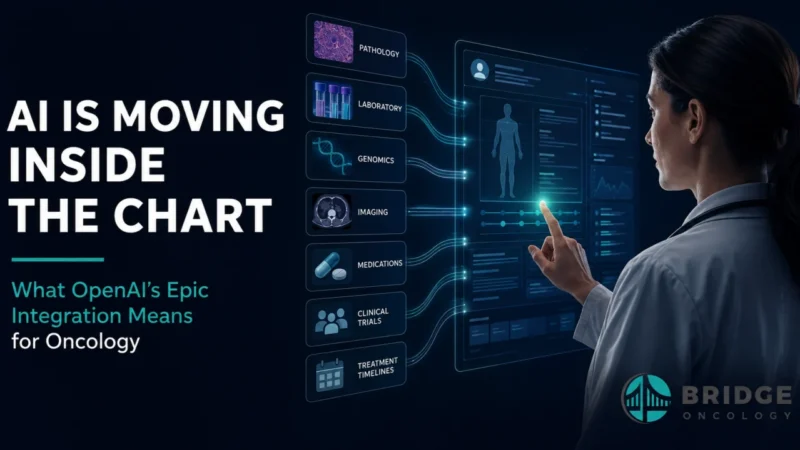
Cancer care may be the ultimate test of whether EHR-connected artificial intelligence can become clinically meaningful. An oncology record is not a single note or diagnosis. It is a longitudinal narrative distributed across pathology, molecular testing, diagnostic imaging, staging, surgery, radiation therapy, systemic therapy, pharmacy, genetics, laboratory results, supportive care, hospitalizations, specialist recommendations, and patient-reported symptoms. The information is often incomplete, duplicative, contradictory, or buried in documents created by different organizations.
An AI system that can reliably reconstruct that narrative could save clinicians significant time. Before an oncology consultation, it could identify the original diagnosis, stage, biomarker profile, prior therapies, treatment response, toxicities, dose modifications, relevant comorbidities, and unresolved recommendations. It could prepare a concise timeline for a tumor board, surface a medication change that affects treatment, or identify that a recommended follow-up study was never completed.
That is a much more consequential use of AI than simply drafting a clinic note.
The Safety Number Requires Context
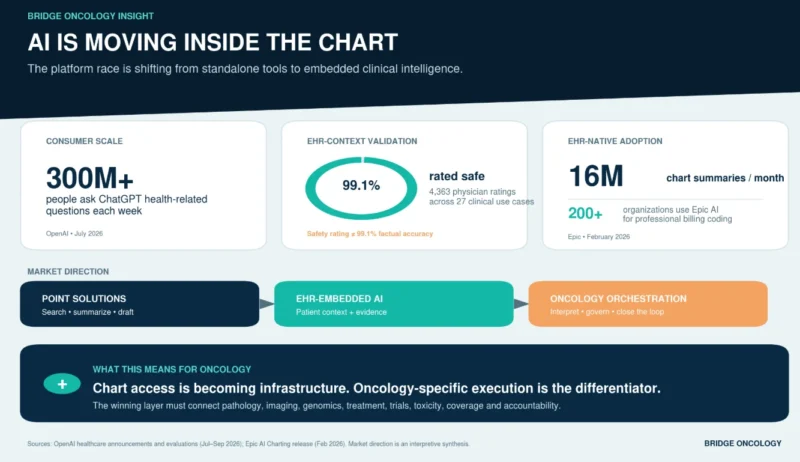
OpenAI reports that physicians evaluated responses across 27 EHR-related use cases, including pre-visit review, clinical timelines, medication review, and handoff summaries. Across 4,363 ratings, 99.1% of responses were rated as safe. In a separate evaluation involving connected public datasets, more than 93% of responses for each of five tested sources received an accuracy rating of ‘good’ or better.
Those results are encouraging, but they should not be misinterpreted. A 99.1% safety rating is not the same as 99.1% factual accuracy, complete clinical recall, or improved patient outcomes. It also does not establish how the system performs when the underlying chart is wrong, incomplete, copied forward, or internally inconsistent. Oncology organizations will need to evaluate not only whether an answer appears safe, but whether the system consistently identifies the information that materially changes treatment.
Missing an old antihypertensive medication is different from missing prior anthracycline exposure, a radiation dose to an adjacent field, a germline mutation, a previous immune-related adverse event, or a pathology amendment that changes the diagnosis.
The oncology standard cannot simply be, ‘Did the AI produce a reasonable summary?’ It must be, ‘Did it preserve every fact necessary to make the next decision safely?’
Read-Only Is a Strategic Boundary
The Epic connection is currently read-only. According to OpenAI’s product documentation, access follows the clinician’s existing Epic and patient-chart permissions. The system can retrieve authorized information, but it cannot modify the record. OpenAI’s Healthcare documentation confirms that administrative configuration, Epic authentication, and existing access controls remain part of the deployment.
Read-only access should not be viewed merely as a product deficiency. It creates a deliberate boundary between interpretation and execution. ChatGPT can summarize, compare, and prepare information without independently changing the legal medical record, placing an order, modifying a treatment plan, or initiating a clinical transaction.
That boundary matters in oncology. There is an enormous difference between identifying that a patient may be eligible for a trial and enrolling the patient; between recognizing a possible toxicity and changing treatment; between locating a coverage policy and representing that a service is authorized; or between drafting an order and signing it.
FDA guidance similarly distinguishes among different forms of clinical decision-support software and emphasizes the ability of healthcare professionals to independently review the basis for a recommendation. Some decision-support functions may fall outside medical-device regulation, while others remain subject to FDA oversight. The FDA’s current clinical decision-support guidance underscores why provenance, explainability, intended use, and the level of automation become increasingly important as AI moves closer to treatment decisions.
Read-only, therefore, is not the destination – but neither should health systems assume that write-back is inevitable or automatically desirable. Moving from summarizing information to executing clinical actions will require much stronger governance, validation, auditability, and authority controls.
Clinical-Trial Matching May Be an Early Oncology Breakthrough
The connection between the patient record and ClinicalTrials.gov may prove especially valuable. Trial matching remains labor-intensive because eligibility criteria must be compared against stage, histology, biomarkers, performance status, organ function, prior treatments, treatment intervals, comorbidities, and numerous exclusion criteria.
The federal USCDI+ Cancer initiative has identified the same opportunity. Its clinical-trial matching work calls for tools that extract relevant EHR data, compare it with protocol criteria, and generate a list of potential matches. It also recognizes the current barriers: inconsistent implementation, incomplete eligibility data, fragmented systems, and continued reliance on manual processes. NCI’s USCDI+ Cancer materials specifically identify tumor characteristics, cancer stage, laboratory values, medications, comorbidities, radiation therapy, and health-status assessments as relevant data classes.
This is precisely where an EHR-connected reasoning platform could create value. It may not determine final eligibility, but it could reduce hundreds of possible studies to a smaller set requiring human review. For community oncology programs without large research departments, that could help expand access to trials beyond major academic centers.
The same model could eventually support detection of immune-related adverse events, treatment-surveillance gaps, oral therapy adherence issues, and patterns of emergency department utilization. However, those uses require more than chart access. They require time-sensitive workflows, defined escalation pathways, and clear ownership of the response.
Coverage Information Is Valuable – but It Is Not Authorization
Connecting clinical context with CMS Coverage also creates operational possibilities. The Medicare Coverage Database contains national and local coverage determinations that can be searched by procedure, diagnosis, code, and jurisdiction. CMS also maintains an API providing access to national and local coverage data. CMS describes the Coverage API as a way for developers to access Medicare coverage information programmatically.
For oncology, ChatGPT could potentially help clinicians and revenue-cycle teams locate relevant Medicare policies, compare documentation with stated requirements, prepare prior-authorization materials, and identify missing information before treatment begins.
But coverage intelligence must not be confused with a coverage decision. Medicare policies are only one part of the payer environment. Commercial medical policies, delegated utilization-management vendors, plan-specific rules, coding edits, network provisions, and authorization requirements can all produce different answers. A technically covered service can still be denied because authorization was not obtained, documentation was incomplete, the wrong code was submitted, or the patient’s specific plan applied a different rule.
This is one example of why oncology-specific operating knowledge still matters. Access to CMS Coverage is useful. Converting that information into a clean authorization, compliant claim, and defensible payment is an entirely different workflow.
OpenAI Is Entering a Crowded EHR-AI Market
OpenAI is not the first company to understand the importance of being embedded in the EHR. Epic released AI Charting in February 2026 as a built-in feature that listens during encounters, drafts notes, and queues orders for clinician review. Epic also reports that its chart-summarization capability is already used millions of times each month. Epic’s announcement demonstrates how aggressively the EHR vendor is converting AI from an external product into a native feature.
Microsoft is pursuing the same workflow through Dragon Copilot, which combines ambient documentation, medical-information retrieval, and task automation. Microsoft reports that the underlying DAX capabilities have supported millions of patient conversations across hundreds of healthcare organizations. Microsoft’s product announcement shows that OpenAI is entering an established contest for clinical attention, workflow position, and enterprise trust.
The claim that OpenAI alone occupies both the patient and clinician sides of healthcare is probably too broad. Epic has both clinician-facing and patient-facing AI capabilities, and Microsoft is also expanding across professional and consumer health experiences. OpenAI’s potential advantage is its extraordinary consumer reach and the possibility of a familiar reasoning interface following the patient and clinician across multiple sources. OpenAI says more than 300 million people now use ChatGPT for health-related questions each week. Health in ChatGPT gives the company a scale of consumer engagement that traditional clinical vendors may find difficult to reproduce.
The strategic question is whether those two environments will remain separate governed experiences or eventually become part of a permissioned, continuous information loop between patients and their care teams.
Oncology Point Solutions Now Face a Higher Standard
This announcement does not mean specialized oncology AI companies are obsolete. It means ‘specialized’ must now mean substantially more than placing a general language model behind an oncology-branded interface.
A sustainable oncology platform will need to understand disease-specific pathways, treatment intent, staging, biomarkers, lines of therapy, radiation dose and fractionation, regimen schedules, toxicity grading, clinical-trial criteria, payer rules, and the operational dependencies that determine whether care actually happens. It must integrate with existing work queues, oncology information systems, imaging, pharmacy, authorization, revenue cycle, and patient-monitoring workflows. Most importantly, it must demonstrate measurable improvement in outcomes, safety, access, staff capacity, or total cost of care.
A point solution that merely summarizes, drafts, or searches will be increasingly vulnerable because those functions are becoming features of larger platforms. A specialized company that owns a high-value workflow, supplies oncology-specific intelligence, closes the loop, and accepts accountability for performance will remain valuable.
That is the real signal in OpenAI’s announcement. The market is shifting from isolated AI tools to integrated intelligence layers. But oncology will expose the limits of that strategy faster than almost any other specialty.
The chart contains the information. It does not contain the entire care model.
OpenAI is moving closer to where clinical decisions are made. The next test is whether it can help oncology organizations connect those decisions to action without weakening clinical authority, patient safety, or accountability. The future will not belong simply to the AI that gets inside the chart. It will belong to the systems that can understand the full oncology journey, operate within its safeguards, and reliably help the care team complete the next right action.”
This also can be interesting:
ChatGPT Health: OpenAI Introduces a Dedicated Space for Health and Wellness Conversations