





Paclitaxel: Understanding Its Mechanism, Dosing, and Clinical Role in Cancer
Key takeaways
- Paclitaxel is a taxane chemotherapy that stabilizes microtubules and prevents normal mitotic spindle function.
- It is FDA-approved for breast cancer, ovarian cancer, NSCLC, and AIDS-related Kaposi sarcoma.
- Common treatment schedules include 175 mg/m² IV every three weeks and 80 mg/m² IV weekly, depending on the regimen.
- Conventional paclitaxel requires premedication with corticosteroids and antihistamines.
- Administration requires an in-line filter ≤0.22 microns and appropriate non-PVC equipment.
- Major toxicities include myelosuppression, peripheral neuropathy, alopecia, myalgia, and hypersensitivity.
- - Paclitaxel remains an important component of platinum-based chemotherapy and selected immunotherapy-containing regimens.
Paclitaxel (Taxol) is a taxane chemotherapy and microtubule inhibitor widely used in the treatment of breast cancer, ovarian cancer, non-small cell lung cancer (NSCLC), and other solid tumors. Unlike chemotherapy agents that primarily damage DNA, paclitaxel stabilizes microtubules and prevents their normal disassembly, interfering with mitosis and ultimately promoting cancer-cell death.
Paclitaxel is an important component of modern combination chemotherapy, frequently administered with carboplatin, cisplatin, or other anticancer agents. Its continued clinical relevance also extends to immunotherapy-containing regimens, including the February 2026 FDA approval of pembrolizumab with paclitaxel, with or without bevacizumab, for selected patients with platinum-resistant ovarian cancer. U.S. Food and Drug Administration
This article aims to review paclitaxel’s mechanism of action, dose, administration, clinical uses, clinical-trial findings, pharmacokinetics, safety profile, and current clinical role.
This article focuses on conventional solvent-based paclitaxel injection, not albumin-bound paclitaxel (nab-paclitaxel/Abraxane), which has different dosing, administration, and premedication requirements.
Key Facts
- Generic name: Paclitaxel
- Brand name: Taxol
- Drug class: Taxane; microtubule-stabilizing chemotherapy
- Route: Intravenous infusion
- Initial FDA approval: December 29, 1992
- FDA-approved indications: Ovarian cancer, breast cancer, NSCLC, and AIDS-related Kaposi sarcoma
- Common three-weekly dose: 175 mg/m² IV
- Common weekly dose: 80 mg/m² IV
- Infusion duration: Usually 1–3 hours, depending on the regimen; some labeled regimens use 24 hours
- Available concentration: 6 mg/mL
- Major mechanism: Microtubule stabilization and inhibition of mitosis
- Major toxicities: Myelosuppression, peripheral neuropathy, hypersensitivity, alopecia, and myalgia
- Important monitoring: CBC, liver function, peripheral neuropathy, and infusion reactions
- Premedication: Required for conventional solvent-based paclitaxel
- In-line filter: Required; microporous membrane ≤0.22 microns
- Key caution: Paclitaxel formulations must not be substituted dose-for-dose.
What Is Paclitaxel?
Paclitaxel is a taxane antineoplastic agent that interferes with microtubule dynamics during cell division.
It was originally isolated from the Pacific yew tree, Taxus brevifolia, and is now produced through semisynthetic manufacturing processes.
Microtubules are essential components of the cellular cytoskeleton. They are particularly important during mitosis, when chromosomes must be separated accurately between two daughter cells.
Paclitaxel binds to β-tubulin within microtubules and prevents their normal depolymerization.
This disrupts mitotic spindle function and prevents malignant cells from completing normal cell division.
Paclitaxel has demonstrated broad antitumor activity and has become an established chemotherapy backbone across several solid tumors.
What Is the Mechanism of Action of Paclitaxel?
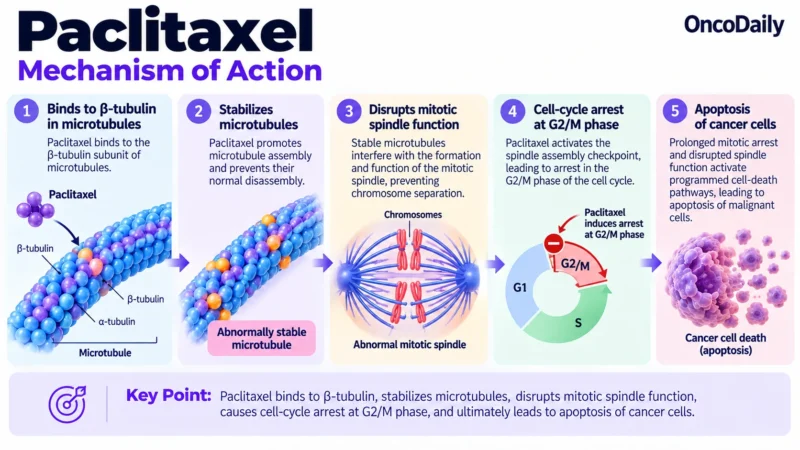
Paclitaxel produces cytotoxic effects through several interconnected mechanisms.
1. Binding to β-Tubulin
Paclitaxel binds to β-tubulin within microtubules.
Microtubules normally undergo continuous polymerization and depolymerization, allowing them to reorganize during mitosis.
2. Microtubule Stabilization
Paclitaxel promotes microtubule assembly and prevents their normal disassembly.
This produces abnormally stable microtubules that cannot undergo the dynamic changes required for cell division.
3. Mitotic Spindle Disruption
Stable microtubules interfere with the formation and function of the mitotic spindle.
Chromosomes cannot separate normally during mitosis.
4. Cell-Cycle Arrest
Paclitaxel activates the spindle assembly checkpoint and commonly produces arrest during the G2/M phase of the cell cycle.
Prolonged mitotic arrest prevents malignant cells from completing normal division.
5. Apoptosis
Disrupted mitosis and prolonged cellular stress can activate programmed cell-death pathways.
The mechanism can be summarized as:
Paclitaxel → β-tubulin binding → microtubule stabilization → impaired mitotic spindle function → mitotic arrest → apoptosis.
Unlike vinca alkaloids, which inhibit microtubule assembly, paclitaxel primarily prevents microtubule disassembly.
Watch more: Paclitaxel: Mechanism of Action
What Is the Dose of Paclitaxel?
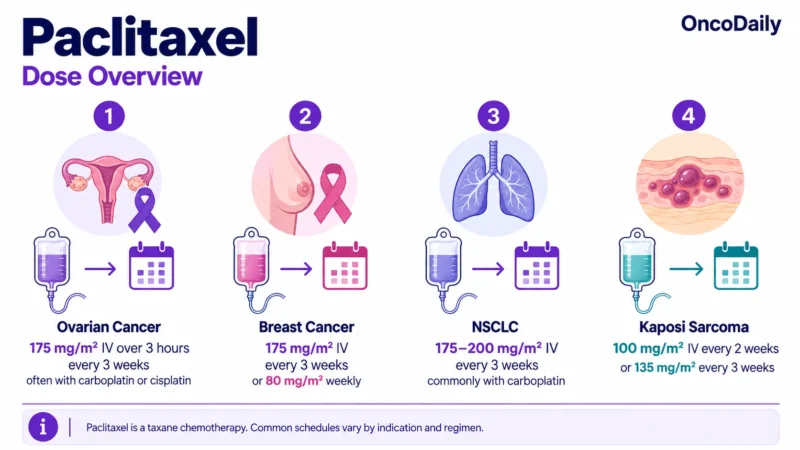
Paclitaxel dosing depends on the cancer type, treatment setting, and combination regimen.
Ovarian Cancer
The FDA-labeled first-line regimens include:
175 mg/m² IV over 3 hours every 3 weeks, followed by cisplatin 75 mg/m².
An alternative historical regimen uses:
135 mg/m² IV over 24 hours every 3 weeks, followed by cisplatin 75 mg/m².
In contemporary practice, paclitaxel is frequently combined with carboplatin.
A commonly used regimen is:
Paclitaxel 175 mg/m² IV on Day 1 + carboplatin AUC 5–6 on Day 1, repeated every 21 days.
Breast Cancer
For adjuvant treatment of node-positive breast cancer, the FDA-labeled regimen is:
175 mg/m² IV over 3 hours every 3 weeks for 4 cycles, following doxorubicin-containing combination chemotherapy.
An alternative commonly used adjuvant schedule is:
80 mg/m² IV weekly for 12 weeks.
Weekly paclitaxel has also been incorporated into neoadjuvant and metastatic breast-cancer treatment protocols.
Non-Small Cell Lung Cancer
The historical FDA-labeled first-line regimen is:
135 mg/m² IV over 24 hours every 3 weeks, followed by cisplatin 75 mg/m².
Contemporary regimens frequently use paclitaxel 175–200 mg/m² over approximately three hours with carboplatin, sometimes combined with immunotherapy.
AIDS-Related Kaposi Sarcoma
Recommended regimens include:
135 mg/m² IV over 3 hours every 3 weeks
or:
100 mg/m² IV over 3 hours every 2 weeks.
These dosing schedules are described in the US prescribing information and should not be considered interchangeable across cancer types.
How Is Paclitaxel Administered?
Paclitaxel is administered by intravenous infusion.
The commercially available conventional formulation contains:
6 mg/mL
Available presentations include:
- 30 mg/5 mL
- 100 mg/16.7 mL
- 300 mg/50 mL.
Preparation and Dilution
Paclitaxel must be diluted before administration.
Compatible solutions include:
- 0.9% sodium chloride
- 5% dextrose
- 5% dextrose with 0.9% sodium chloride
- 5% dextrose in Ringer’s injection.
The recommended final concentration is:
0.3–1.2 mg/mL
The diluted preparation is physically and chemically stable for up to 27 hours at approximately 25°C under the conditions described in the US prescribing information.
Administration Equipment
Conventional paclitaxel contains polyoxyl 35 castor oil, historically known as Cremophor EL.
This formulation can extract the plasticizer DEHP from certain PVC administration materials.
Therefore, the prescribing information recommends:
- Glass, polypropylene, or polyolefin containers
- Non-PVC administration equipment
- Polyethylene-lined administration sets.
Paclitaxel should not be administered as an undiluted rapid IV bolus.
Does Paclitaxel Require an In-Line Filter?
Yes. Conventional solvent-based paclitaxel requires an in-line filter.
The US prescribing information specifies a microporous membrane:
≤0.22 microns
This requirement is formulation-specific and should not automatically be applied to albumin-bound paclitaxel.
Does Paclitaxel Require Premedication?
Yes. Premedication is an essential part of conventional paclitaxel administration.
The drug can cause severe hypersensitivity reactions, including anaphylaxis.
The historical FDA-labeled premedication regimen includes:
Corticosteroid
Dexamethasone:
20 mg orally approximately 12 and 6 hours before paclitaxel.
H1 Antihistamine
Diphenhydramine:
50 mg IV approximately 30–60 minutes before paclitaxel.
H2 Antagonist
The historical label describes cimetidine or ranitidine.
Contemporary institutional protocols may substitute another H2 antagonist, such as famotidine, or use modified premedication schedules.
Premedication may be reduced after uneventful infusions according to institutional policies, but this should not be assumed for every patient.
Are Dose Reductions Used?
Yes.
Dose reduction or treatment interruption may be necessary for:
- Severe neutropenia
- Peripheral neuropathy
- Severe hypersensitivity
- Significant hepatic impairment
- Other clinically important toxicity.
Hematologic Toxicity
For patients with solid tumors, the US label recommends delaying subsequent cycles until:
ANC ≥1,500/mm³
and:
Platelets ≥100,000/mm³
For severe neutropenia lasting at least seven days, a 20% dose reduction is recommended for subsequent cycles.
Peripheral Neuropathy
Severe peripheral neuropathy generally requires a 20% reduction in subsequent doses under the US label.
Severe Hypersensitivity
Patients who develop severe hypersensitivity reactions require immediate discontinuation.
The US prescribing information advises against rechallenge after a severe reaction.
What Is the Pharmacokinetic Profile of Paclitaxel?
Paclitaxel demonstrates extensive tissue distribution and predominantly nonrenal elimination.
Distribution
Paclitaxel is approximately:
89–98% protein bound.
Its apparent steady-state volume of distribution following a 24-hour infusion ranges from approximately 227 to 688 L/m².
Metabolism
Paclitaxel is metabolized primarily in the liver.
The principal enzyme involved is:
CYP2C8
CYP3A4 also contributes to the formation of minor metabolites.
Elimination
Paclitaxel is eliminated predominantly through nonrenal pathways.
Approximately 1.3–12.6% of the administered dose is recovered unchanged in urine.
Half-Life
The elimination half-life depends on the administered dose and infusion duration.
In clinical pharmacokinetic studies, mean terminal half-lives ranged from approximately:
13–53 hours
across the evaluated 3-hour and 24-hour infusion schedules.
Does Paclitaxel Require Renal or Hepatic Dose Adjustment?
Renal Impairment
Paclitaxel undergoes predominantly hepatic metabolism and nonrenal clearance.
The US label does not establish a standard creatinine-clearance-based dose-reduction schedule.
Treatment should be individualized in patients with substantial renal dysfunction, particularly when paclitaxel is combined with platinum chemotherapy.
Hepatic Impairment
Hepatic function is an important determinant of paclitaxel exposure and toxicity.
For a three-hour infusion, the US label provides the following initial-dose recommendations when transaminases are below 10 times the upper limit of normal:
- Bilirubin ≤1.25 × ULN: 175 mg/m²
- Bilirubin 1.26–2 × ULN: 135 mg/m²
- Bilirubin 2.01–5 × ULN: 90 mg/m²
- Bilirubin >5 × ULN: Paclitaxel is not recommended.
Paclitaxel is also not recommended under this schedule when transaminases are at least 10 times the upper limit of normal.
These recommendations apply specifically to the labeled three-hour regimen and should not be automatically transferred to weekly dosing protocols.
What Are the Clinical Uses of Paclitaxel?
Breast Cancer
Paclitaxel is widely used in early-stage and metastatic breast cancer.
Clinical applications include:
- Adjuvant chemotherapy
- Neoadjuvant chemotherapy
- Metastatic breast cancer
- Combination treatment for triple-negative breast cancer
- Selected HER2-positive treatment protocols.
Ovarian Cancer
Paclitaxel is a major component of platinum-based chemotherapy for ovarian cancer.
Carboplatin plus paclitaxel is an established treatment backbone in newly diagnosed advanced ovarian cancer.
Paclitaxel also has activity in recurrent disease, including selected platinum-resistant settings.
Carboplatin is one of the most frequently combined chemotherapy agents with paclitaxel in ovarian cancer. Learn more about carboplatin and its role in cancer treatment on OncoDaily.
Non-Small Cell Lung Cancer
Paclitaxel is used in selected NSCLC chemotherapy regimens.
It is commonly combined with carboplatin and may be incorporated into immunotherapy-containing treatment approaches.
Endometrial Cancer
Paclitaxel plus carboplatin is an important chemotherapy backbone for advanced and recurrent endometrial cancer.
The combination may also be administered with immunotherapy in selected patients.
Cervical Cancer
Paclitaxel has a role in recurrent, persistent, or metastatic cervical cancer, frequently combined with platinum chemotherapy and other systemic agents.
Other Clinical Uses
Paclitaxel is also used in selected treatment protocols for:
- Head and neck cancers
- Esophageal cancer
- Gastric cancer
- Anal cancer
- AIDS-related Kaposi sarcoma.
The precise indication and combination regimen depend on disease-specific recommendations.
What Did Paclitaxel Clinical Trials Show?
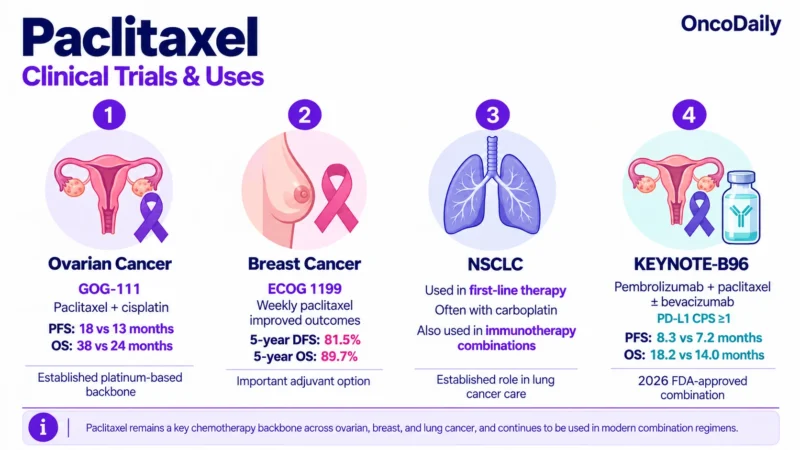
GOG-111: Paclitaxel in Advanced Ovarian Cancer
The randomized phase III GOG-111 trial compared paclitaxel plus cisplatin with cyclophosphamide plus cisplatin in patients with advanced ovarian cancer and residual disease larger than 1 cm after surgery.
Among 386 eligible patients:
Median progression-free survival:
- Paclitaxel + cisplatin: 18 months
- Cyclophosphamide + cisplatin: 13 months.
Median overall survival:
- Paclitaxel + cisplatin: 38 months
- Cyclophosphamide + cisplatin: 24 months.
Among patients with measurable disease, response rates were 73% versus 60%.
This trial helped establish the role of paclitaxel-containing platinum chemotherapy in advanced ovarian cancer.
ECOG 1199: Weekly Paclitaxel in Breast Cancer
The phase III ECOG 1199 trial evaluated different taxane schedules after anthracycline-based chemotherapy in women with early-stage breast cancer.
The study enrolled 4,950 women with node-positive or high-risk node-negative breast cancer.
Patients received doxorubicin and cyclophosphamide before being randomized to one of four taxane treatment schedules.
Five-year disease-free survival:
- Weekly paclitaxel: 81.5%
- Paclitaxel every three weeks: 76.9%.
Five-year overall survival:
- Weekly paclitaxel: 89.7%
- Paclitaxel every three weeks: 86.5%.
These findings helped establish weekly paclitaxel as an important adjuvant treatment option.
KEYNOTE-B96: Paclitaxel With Pembrolizumab in Ovarian Cancer
KEYNOTE-B96 evaluated pembrolizumab plus paclitaxel, with or without bevacizumab, in patients with platinum-resistant epithelial ovarian, fallopian tube, or primary peritoneal cancer.
The randomized trial enrolled 643 patients.
Among 466 patients with PD-L1 CPS ≥1:
Median progression-free survival:
- Pembrolizumab combination: 8.3 months
- Control: 7.2 months.
Median overall survival:
- Pembrolizumab combination: 18.2 months
- Control: 14.0 months.
These findings supported the FDA approval of pembrolizumab plus paclitaxel, with or without bevacizumab, for the specified PD-L1-positive population on February 10, 2026.
This is an approval of the pembrolizumab-containing combination; it does not change the independent labeled indications for conventional paclitaxel. U.S. Food and Drug Administration
Is Paclitaxel FDA Approved?
Yes.
Paclitaxel received its initial FDA approval on December 29, 1992, for ovarian cancer.
The current US labeling includes:
- First-line ovarian cancer in combination with cisplatin
- Subsequent therapy for advanced ovarian cancer
- Adjuvant treatment of node-positive breast cancer
- Metastatic breast cancer after failure of initial chemotherapy or early relapse after adjuvant therapy
- First-line NSCLC in combination with cisplatin
- Second-line AIDS-related Kaposi sarcoma.
The development of paclitaxel has had a substantial influence on modern chemotherapy, particularly in breast and ovarian cancer.
What Is the Current Clinical Role of Paclitaxel?
Paclitaxel remains an established chemotherapy backbone in modern oncology.
Its role extends beyond conventional cytotoxic treatment through combinations with targeted therapy and immunotherapy.
In breast cancer, paclitaxel is used across several early-stage and metastatic treatment strategies.
In ovarian cancer, carboplatin plus paclitaxel remains an important platinum-based regimen.
In NSCLC, paclitaxel-containing chemotherapy may be combined with immunotherapy according to histology, disease characteristics, and treatment indications.
The February 2026 approval of pembrolizumab with paclitaxel, with or without bevacizumab, provides an additional example of paclitaxel’s continued relevance in emerging combination strategies. U.S. Food and Drug Administration
What Are the Major Side Effects of Paclitaxel?
Paclitaxel can cause substantial hematologic and nonhematologic toxicity.
Common adverse effects include:
- Neutropenia
- Anemia
- Thrombocytopenia
- Peripheral neuropathy
- Alopecia
- Myalgia and arthralgia
- Nausea and vomiting
- Diarrhea
- Mucositis
- Hypersensitivity reactions
- Fatigue
- Infections.
In the US prescribing information’s pooled analysis of 812 patients with ovarian or breast cancer receiving single-agent paclitaxel, alopecia occurred in 87%, peripheral neuropathy in 60%, and myalgia or arthralgia in 60%.
These frequencies reflect historical studies with different doses and infusion schedules and should not be interpreted as universal risks for every contemporary regimen.
Myelosuppression
Myelosuppression, particularly neutropenia, is a major dose-limiting toxicity of paclitaxel.
Hematologic abnormalities include:
- Neutropenia
- Leukopenia
- Anemia
- Thrombocytopenia.
In the pooled single-agent clinical studies, neutropenia below 2,000/mm³ occurred in approximately 90% of patients.
Severe neutropenia increases the risk of infection, sepsis, and treatment delays.
Peripheral Neuropathy
Peripheral neuropathy is one of the most clinically important cumulative toxicities of paclitaxel.
Symptoms may include:
- Numbness
- Tingling
- Burning sensations
- Sensory loss
- Difficulty with fine motor activities.
Neuropathy is generally dose-dependent and may become more prominent with repeated treatment.
Severe neuropathy may require dose reduction or discontinuation.
Some patients experience persistent symptoms after completing chemotherapy.
Hypersensitivity Reactions
Conventional paclitaxel can cause acute hypersensitivity reactions.
Potential manifestations include:
- Flushing
- Rash
- Dyspnea
- Bronchospasm
- Hypotension
- Angioedema
- Anaphylaxis.
Severe hypersensitivity reactions occurred in approximately 2–4% of patients in clinical trials.
These reactions can occur despite premedication and may be fatal.
Alopecia
Hair loss is very common with paclitaxel.
In the pooled single-agent safety analysis, alopecia occurred in approximately:
87% of patients.
Hair loss generally develops during the first several weeks of treatment.
Myalgia and Arthralgia
Paclitaxel frequently causes muscle and joint pain.
These symptoms may begin within several days after administration.
In pooled clinical studies, myalgia or arthralgia occurred in approximately:
60% of patients.
Gastrointestinal Toxicity
Common gastrointestinal side effects include:
- Nausea
- Vomiting
- Diarrhea
- Mucositis.
In pooled single-agent studies, nausea and vomiting occurred in 52%, diarrhea in 38%, and mucositis in 31%.
Infections
Paclitaxel-associated neutropenia increases susceptibility to bacterial, viral, and fungal infections.
Severe complications include pneumonia, bacteremia, sepsis, and septic shock.
Cardiac Toxicity
Paclitaxel can cause transient cardiovascular abnormalities, including:
- Bradycardia
- Hypotension
- Hypertension
- Conduction abnormalities.
Severe conduction abnormalities are uncommon but may require treatment interruption or cardiac monitoring.
Extravasation
Paclitaxel is an irritant with vesicant potential.
Extravasation may cause pain, swelling, erythema, and local tissue injury.
The infusion site should be monitored throughout administration.
Hepatotoxicity
Paclitaxel may cause elevated liver enzymes and bilirubin.
Patients with pre-existing hepatic impairment may have increased drug exposure and a higher risk of severe myelosuppression.
Pregnancy and Reproductive Toxicity
Paclitaxel can cause fetal harm.
Effective contraception and fertility counseling should be addressed according to the specific product’s prescribing information and the patient’s treatment circumstances.
What Monitoring Is Required?
Monitoring should include:
- CBC with differential
- Platelet count
- Liver function
- Peripheral neuropathy assessment
- Blood pressure and heart rate
- Assessment for hypersensitivity reactions
- Assessment for infection
- IV infusion-site monitoring
- Evaluation for gastrointestinal toxicity
- Treatment tolerance and cumulative neurotoxicity.
Particular attention should be given to hypersensitivity during the initial infusions and peripheral neuropathy during subsequent treatment cycles.