






Marco Donia, Professor at University of Copenhagen (Københavns Universitet), shared a post on LinkedIn by Yago Garitaonaindia, Translational Research Fellow at CCIT-DK – National Center for Cancer Immune Therapy of Denmark, adding:
“Congratulations to Yago Garitaonaindia (first and corresponding author) and our team from CCIT-DK – National Center for Cancer Immune Therapy of Denmark.
Simple but important idea: across 15,199 patients and 41 phase 3 trials, acquired resistance to immunotherapy correlates to the strength of the response, not the tumor type.
How deep the response goes may matter more than the cancer type – response-guided follow-up across cancers may be the way to go.”
Quoting Yago Garitaonaindia’s post:
“Acquired resistance to immunotherapy is tumour agnostic: tracks the strength of the resposnse, not the cancer of origin.
How often do responders to checkpoint inhibitors eventually relapse, and what predicts it? We reconstructed individual patient data from 41 phase III trials across 11 tumour typesker
key findings:
- 15,199 patients. Pan-cancer acquired resistance (ARI) was 38.5% (95% CI, 36.2-40.7) at 1 year and 73.5% (71.6-75.4) at 3 years.
- It ranged widely by tumour, from 25.4% in dMMR colorectal cancer to 83.1% in squamous esophageal carcinoma.
- That variation was explained by response depth. Higher CR and PR rates tracked with less acquired resistance (CR ρ -0.63, P=.044; PR ρ -0.66, P=.031), higher SD rates with more (ρ +0.68, P=.025). The associations held after adjusting for tumour type.
- Scaled to global incidence, more than 1 million patients per year may develop acquired resistance after initially benefiting from immunotherapy.
take home:
The strength of the antitumour response, not tumour histology, appears to set the long-term risk of resistance.
Clinical Complications:
Argues for response-guided follow-up across tumours: patients in CR may carry low risk, while PR or SD with residual burden may warrant closer follow-up or intensification. Hypothesis-generating, not practice-changing.
Open Questions:
These are trial-level, ecological correlations from digitized PFS and DOR curves. Patient-level confirmation is needed.
n.b. A nationwide patient-level study (EJC, Rikke Andersen and Mette Syberg Jespersen et al., last author Marco Donia) reached a similar conclusion with a Danish nationwide real-world data study
Grateful to my co-authors, and Sociedad Española de Oncología Médica (SEOM) and Fundación Alfonso Martín Escudero for supporting this work.”
Title: Acquired Resistance to Immune Checkpoint Inhibitors Across Tumor Types: A Reconstructed Individual Patient Data Analysis
Authors: Yago Garitaonaindia, Rikke Andersen, Mario Presti, Marco Donia
Read the full article on JNCCN.

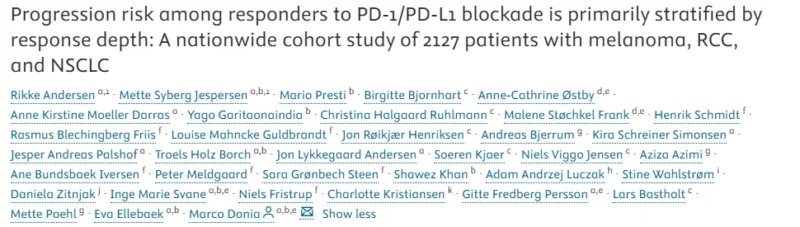
Title: Progression risk among responders to PD-1/PD-L1 blockade is primarily stratified by response depth: A nationwide cohort study of 2127 patients with melanoma, RCC, and NSCLC
Authors: Rikke Andersen, Mette Syberg Jespersen, Mario Presti, Birgitte Bjørnhrt, Anne-Cathrine Østby, Anne Kirstine Moeller Darras, Yago Garitaonaindia, Christina Halgaard Ruhlmann, Malene Støchkel Frank, Henrik Schmidt, Rasmus Blechingberg Friis, Louise Mahncke Guldbrandt, Jon Røikjær Henriksen, Andreas Bjerrum, Kira Schreiner Simonsen, Jesper Andreas Palshof, Troels Holz Borch, Jon Lykkegaard Andersen, Søren Kjær, Niels Viggo Jensen, Aziza Azimi, Ane Bundsbaek Iversen, Peter Meldgaard, Sara Grønbech Steen, Shawez Khan, Adam Andrzej Luczak, Stine Wahlstrøm, Daniela Zitnjak, Inge Marie Svane, Niels Fristrup, Charlotte Kristiansen, Gitte Fredberg Persson, Lars Bastholm, Mette Poehl, Eva Ellebaek, Marco Donia
Read the full article on European Journal of Cancer.
Other articles featuring Marco Donia on OncoDaily.