Xenofon Vakalis, Radiation Oncologist at Medical Center of Athens, shared on LinkedIn:
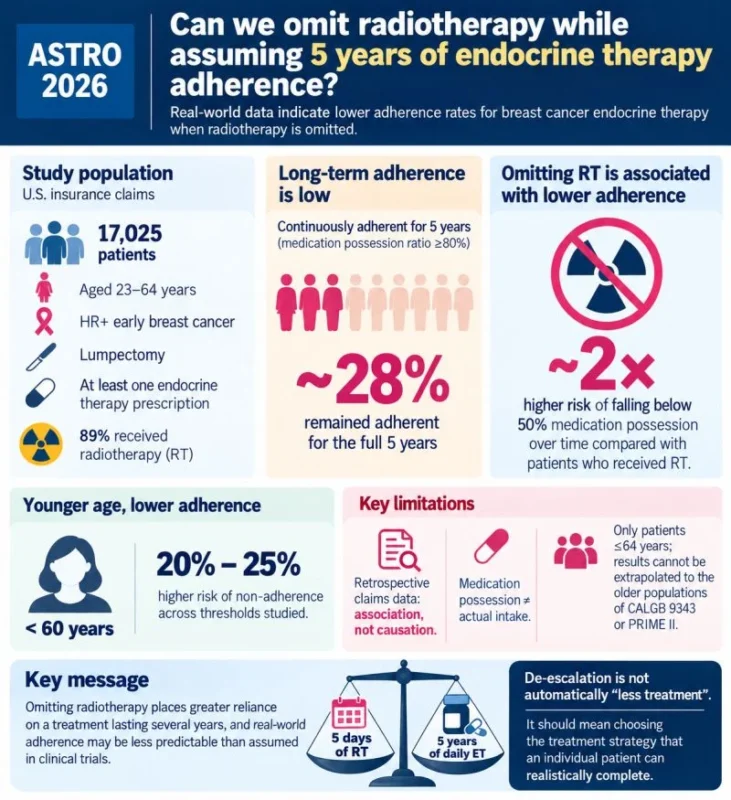
“ASTRO 2026: Can we omit radiotherapy while assuming 5 years of endocrine therapy adherence?
Treatment de-escalation in early HR+ breast cancer is an important step forward. Trials such as CALGB 9343 and PRIME II showed that, in carefully selected older women, radiotherapy (RT) after breast-conserving surgery may be omitted without compromising overall survival – although at the cost of increased local recurrence.
But there is a crucial assumption: long-term adherence to endocrine therapy (ET). New real-world data presented at ASTRO 2026 challenge how reliable that assumption may be.
Among 17,025 patients aged 23-64 with HR+ early breast cancer treated with lumpectomy, only ~28% remained continuously adherent at the ≥80% threshold throughout 5 years. Annual adherence appeared much higher (59-75%), highlighting how treatment gaps accumulate over time.
Importantly, patients who did not receive RT were more likely to have substantial ET non-adherence and were approximately twice as likely to fall below the 50% medication-possession threshold.
But interpretation requires caution. This was a retrospective claims-based analysis showing association, not causation. Medication possession does not prove medication intake, and differences between RT and no-RT populations may reflect patient selection, healthcare access, treatment preferences, or follow-up.
Another major limitation: patients were ≤64 years old, whereas the strongest evidence supporting RT omission comes primarily from older populations. These findings therefore cannot simply be extrapolated to the CALGB 9343 or PRIME II populations.
The message is not that RT improves endocrine therapy adherence. That was not demonstrated. The more important point is that omitting RT places greater reliance on a treatment lasting several years – and real-world adherence may be considerably less predictable than assumed in clinical trials.
This becomes particularly relevant in the era of effective 5-fraction breast RT. The discussion is no longer simply: ‘Radiotherapy or no radiotherapy?’
It may also be: 5 days of RT vs greater reliance on 5 years of daily medication adherence.
De-escalation should not automatically mean ‘less treatment.’ It should mean choosing the treatment strategy that an individual patient can realistically complete. The study should therefore not be interpreted as an argument that ‘everyone needs RT,’ but as a reminder that RT-omission strategies rely on long-term patient behavior that cannot be taken for granted in the real world.
Real-World Data Indicate Lower Adherence Rates for Breast Cancer Endocrine Therapy When Radiation Therapy Is Omitted – The ASCO Post.”
You can also read: ESTRO Breast Radiotherapy Target Volumes Prospectively Validated in DBCG Skagen Trial 1.