Wafik El-Deiry, Former Associate Dean for Oncologic Sciences and Founding Director of the Cancer Center at Brown University, shared on X:
“Mapping Big Data’s Linkage Challenges for 2026
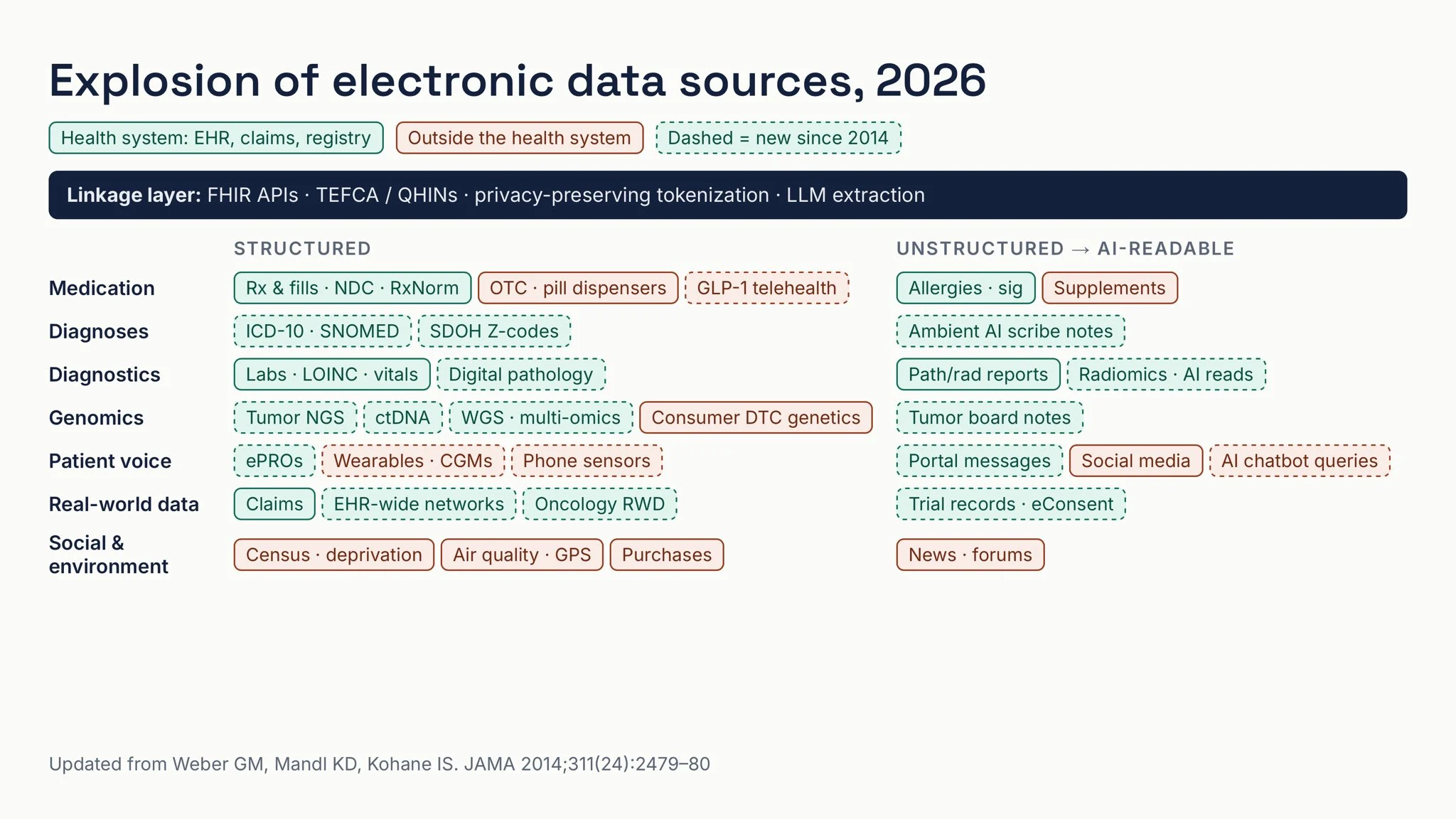
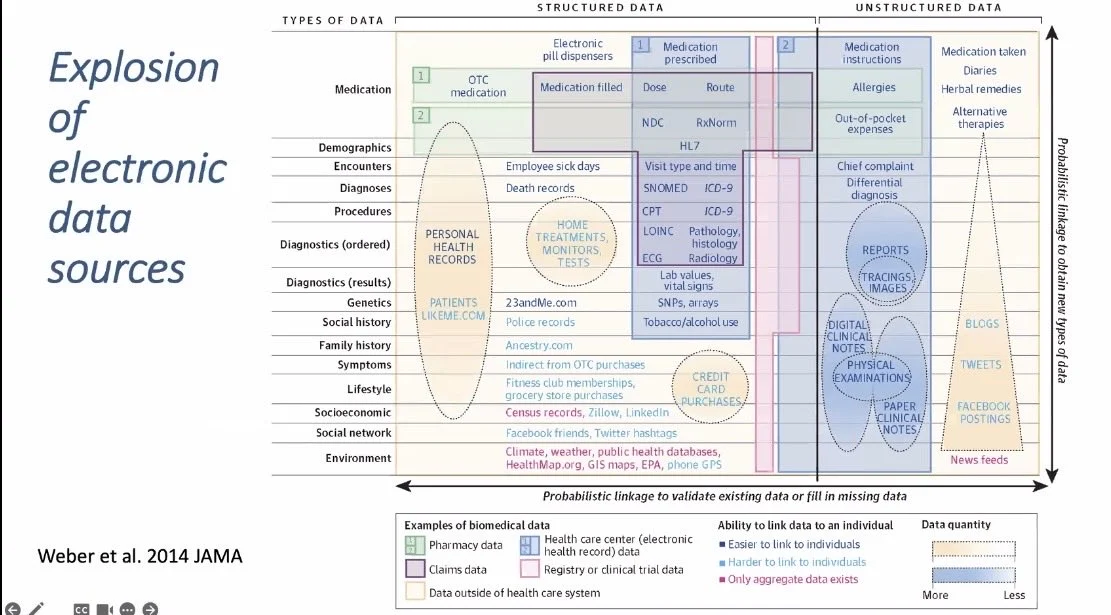
In my Business Analytics Class last night in a lecture by Professor Chris Harle that is part of the IU Kelley School of Business Physician MBA Program, we learned a bit about electronic data sources from Griffin Weber, Kenneth Mandl and Isaac Kohane ‘Finding the Missing Link for Big Biomedical Data’ JAMA, 2014 (Published Online: June 25, 2014: 2014;311;(24):2479-2480. doi:10.1001/jama.2014.4228). I asked my Claude AI Assistant to prepare a brief summary of what changed between 2014 – 2026.
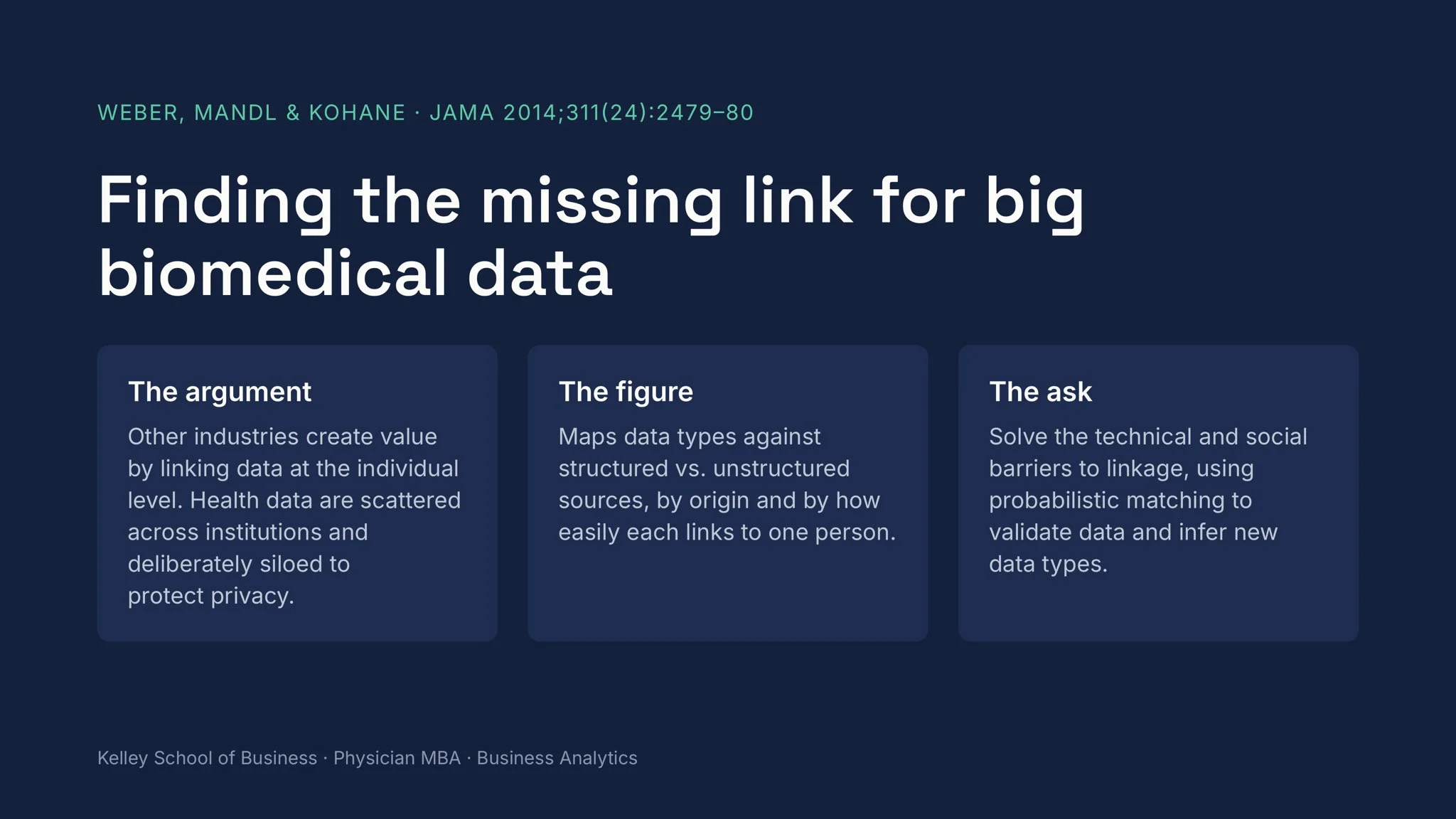
Here is the output along with 3 slides plus the original image from Weber et al.
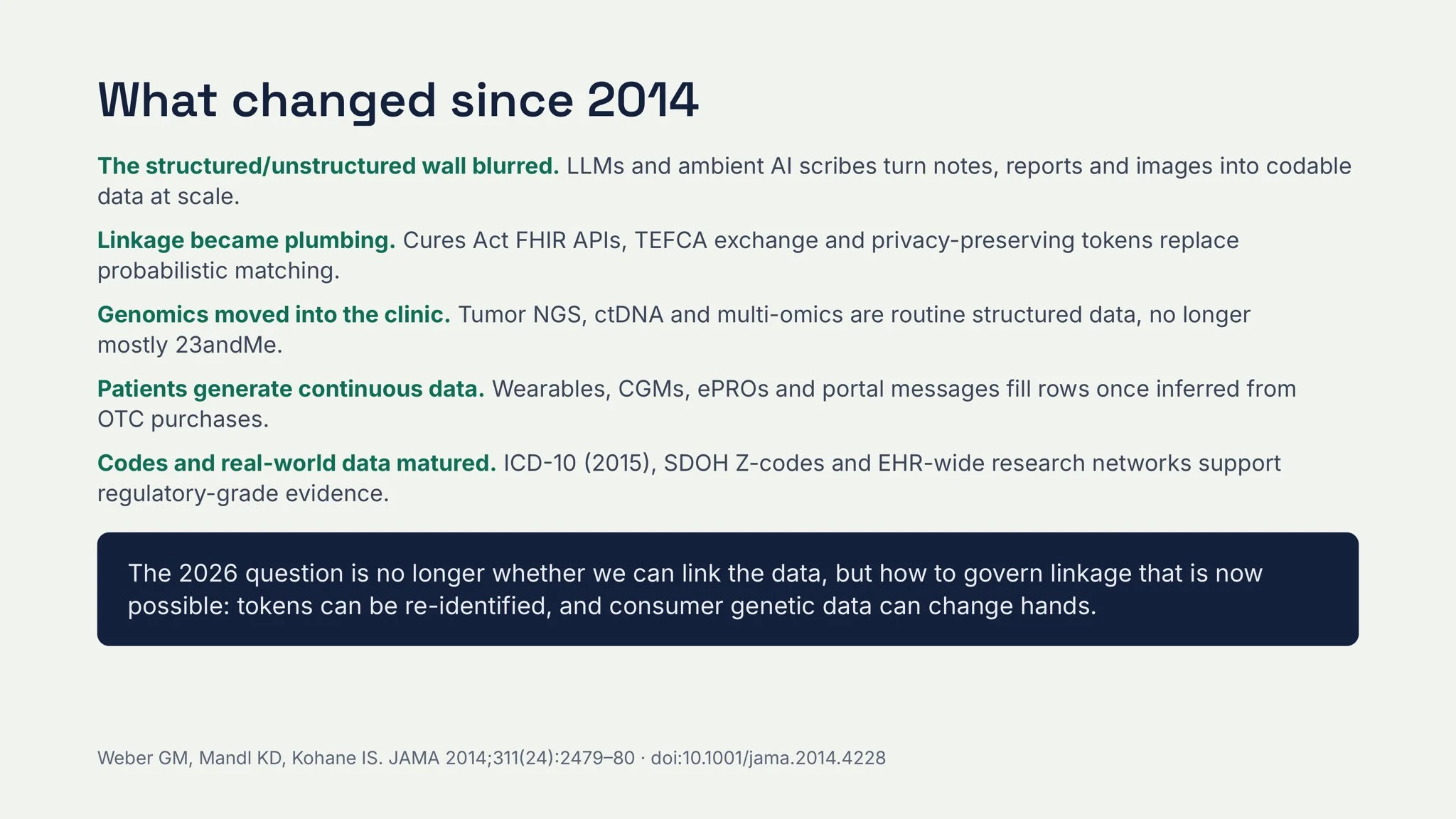
The five biggest changes since 2014:
- The structured/unstructured line has blurred. In 2014, notes, images and reports sat on the far side of a wall; large language models and ambient AI scribes now turn free text into codable data at scale. The right-hand column is now ‘AI-readable,’ not ‘out of reach.’
- Linkage became plumbing, not probability. Weber’s figure relied on probabilistic matching. Today, Cures Act–mandated FHIR APIs, the TEFCA national exchange network, and privacy-preserving tokenization link records across EHRs, claims, labs and registries without exchanging names.
- Genomics moved from SNP arrays to the clinic. Tumor NGS, ctDNA and multi-omics are now routine structured EHR data. In 2014, the genetics row was mostly 23andMe.
- Patients generate continuous data. Wearables, CGMs, ePROs and portal messages have filled the ‘symptoms’ and ‘lifestyle’ rows. In 2014, the figure could only infer those from OTC purchases.
- Codes and real-world data matured. The US switched from ICD-9 to ICD-10 in 2015. SDOH Z-codes, EHR-wide research networks and oncology real-world data platforms now support regulatory-grade evidence.
The privacy concern Weber raised has grown along with the data. Tokenized records can still be re-identified, and 23andMe’s 2025 bankruptcy and sale showed that consumer data can change hands. The main question in 2026 is how to govern the linkage that is now possible, not how to make it possible.
My review of this information is that it is accurate and useful and I approve it as teaching, not medical advice or a recommendation for anything.”
Other posts featuring Wafik El-Deiry on OncoDaily.