


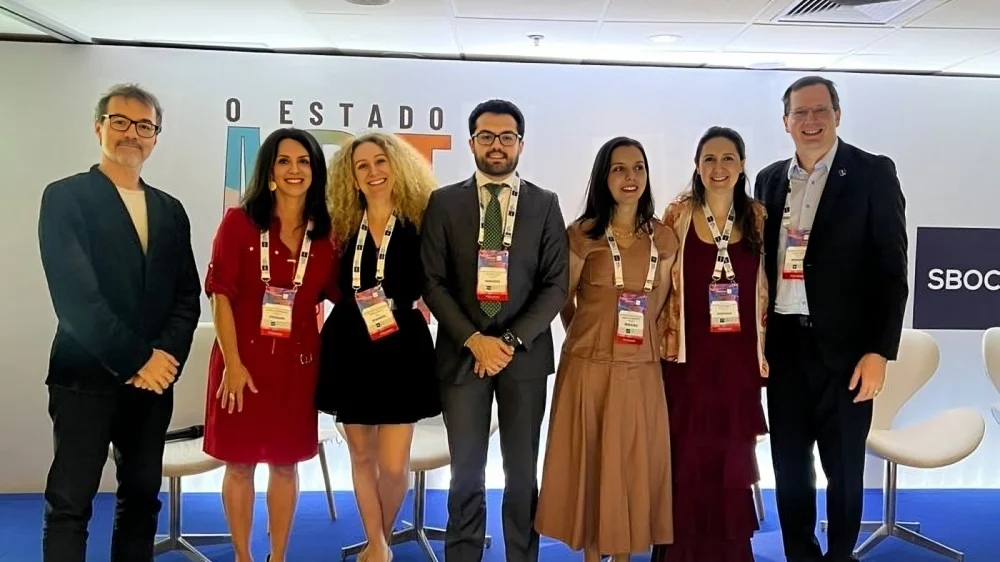
Teresa Amaral, Medical Oncologist at the University Hospital Tübingen, shared on LinkedIn:
“It was a pleasure to join this session at the Brazilian Society of Clinical Oncology – SBOC congress last week with Rachel Riechelmann and Fabrice Andre, Andre Deeke Sasse, Laura Testa, Alvaro Lopes de Almeida and Arinilda Campos Bragagnoli.
We had a great discussion during the joint Session ESMO/SBOC | Value Assessment and Health Technology Adoption, where I had the chance to discuss the value and the shortcomings of the ESMO MCBS scale.
The discussions were very interesting, including the Brazilian adaptation of the ESMO MCBS scale and what other countries can learn from it.
If you want to learn more about the ESMO MCBS, check it out online: ESMO-Magnitude of Clinical Benefit Scale.
Thank you so much for the kind invitation!
Looking forward to future collaborations.”
About the ESMO-MCBS
The ESMO-MCBS was created to promote the scientific integrity of ESMO and enable oncologists to critically evaluate the clinical benefit of cancer therapies reported in clinical trials.
It provides a structured approach that reduces bias in data interpretation, avoids hype, and ensures evaluations are grounded in evidence.
By adhering to ethical standards of accountability for reasonableness, fairness and transparency, the scale supports cancer planning, value-based priority setting, and informed resource allocation.
Introduced in 2015 for solid tumours and expanded in 2023 to include haematological malignancies through collaboration with the European Hematology Association (EHA), the ESMO-MCBS is a dynamic tool that evolves alongside the rapidly changing treatment and regulatory landscape.
The ESMO-MCBS was revised in 2017, and in 2025 following extensive peer review and feedback from clinicians, patients, researchers, and industry representatives.
The ESMO-MCBS is integrated into ESMO Clinical Practice Guidelines and the Pan-Asian Adapted Guidelines, helping to provide patients with the best care options and setting the highest standards for cancer care, and widely adopted by health technology assessment (HTA) bodies worldwide.
It serves as a cornerstone for rational, equitable cancer care, helping clinicians explain treatment benefits to patients and guiding policymakers in reimbursement decisions.