






Talha Badar, Hematology/Oncology Specialist at Mayo Clinic, shared on X:
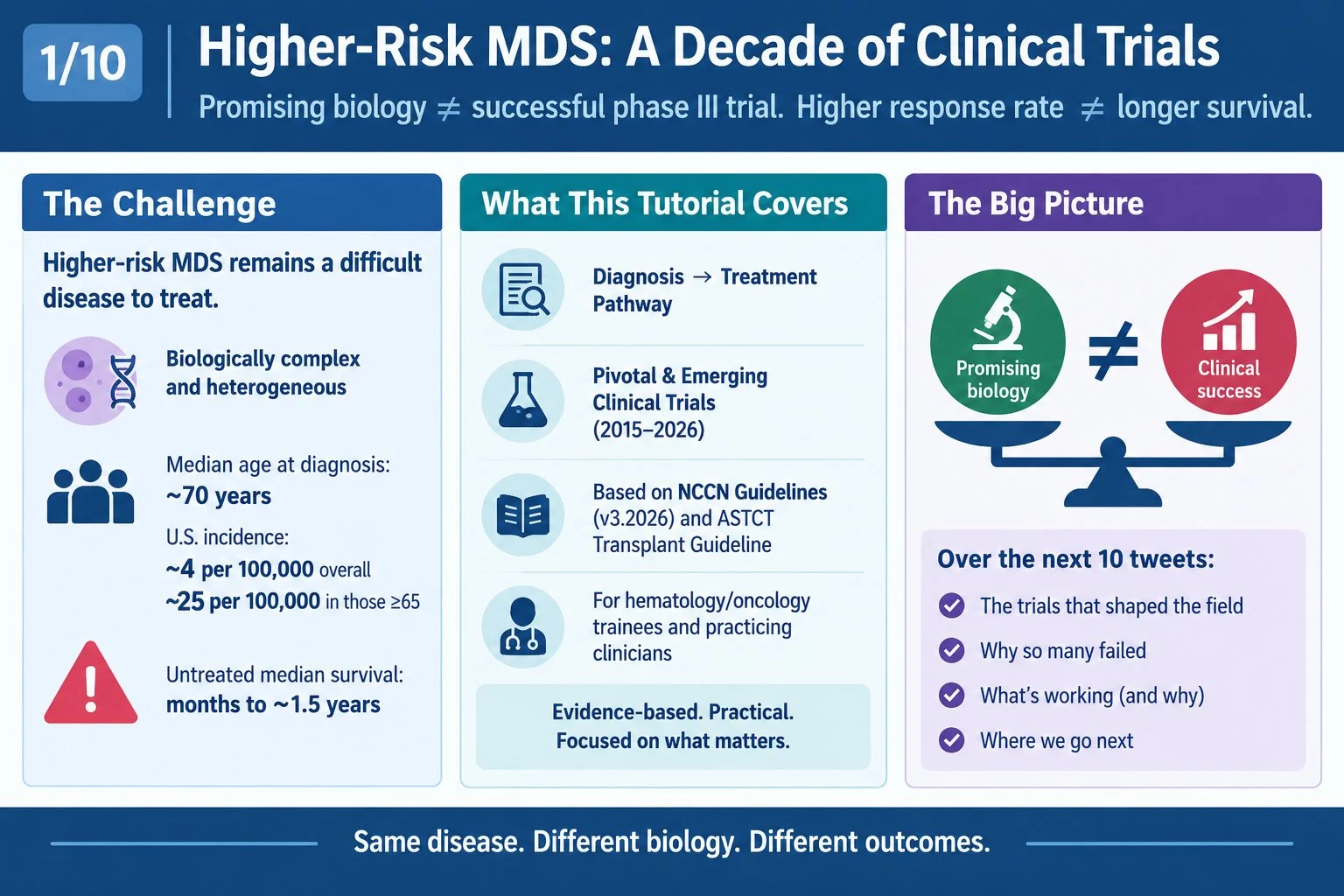
“Higher-risk MDS: A decade of clinical trials
The last decade in HR-MDS has taught us a humbling lesson:
- Promising biology ≠ successful phase III trial.
- Higher response rate ≠ longer survival.
Here is the trials that shaped the field, why so many failed, and where we go next.
THE FOUNDATION: HMA
AZA-001 established azacitidine as the reference standard:
- Median OS: 24.5 vs 15 months
- HR 0.58 • CR/PR: 29% vs 12%
- Time to leukemic progression/death: 21 vs 13 months
Decitabine produced responses but no significant OS benefit.
Nearly two decades later, the HMA backbone remains remarkably difficult to improve upon.
VENETOCLAX: RESPONSE ≠ SURVIVAL
Early AZA + venetoclax studies generated impressive responses.
Then came phase III VERONA:
- ORR: ~76% vs 57%
- Median OS: 22.2 vs 21.7 months
- No significant OS improvement
One of the defining lessons of the decade:
In HR-MDS, a higher response rate does not necessarily translate into longer survival.
TP53 CHANGES EVERYTHING
TP53-mutated MDS is not one disease.
Allelic state matters. Multi-hit/biallelic TP53 is associated with:
- Complex cytogenetics
- Treatment resistance
- High relapse risk
- Poor outcomes with HMA, chemotherapy and even HCT
This matters for both treatment AND trial design.
Pooling this biology with TP53-WT disease can obscure treatment effects.
THE HR-MDS ‘TRIAL GRAVEYARD’
The list is longer than most realize:
- Magrolimab → ENHANCE: no CR/OS benefit; more severe/fatal AEs
- Eprenetapopt + AZA: phase III failed to significantly improve CR; no OS benefit
- Sabatolimab → STIMULUS-MDS1/2: randomized studies failed primary endpoints
- Tamibarotene → SELECT-MDS-1: biomarker-selected RARA+ population, but no significant CR benefit
- Pevonedistat → PANTHER: encouraging phase II signal failed phase III confirmation
- Venetoclax → VERONA: substantially higher ORR, but no OS improvement
- Vorinostat + AZA → SWOG S1117: ORR 27% vs 38% with AZA alone; no survival benefit
- Entinostat + AZA → E1905: no improvement in hematologic normalization; evidence of pharmacodynamic antagonism
- Pracinostat + AZA: failed CR endpoint, with more grade ≥3 toxicity/discontinuation
- Vorinostat after AZA failure: unsuccessful GFM add-on strategy
- Rigosertib → ONTIME: post-HMA failure OS 8.2 vs 5.9 months; P=.33
- Checkpoint inhibitors: PD-1/PD-L1/CTLA-4 approaches have shown unsatisfactory efficacy; none approved for MDS
WHY DID SO MANY FAIL?
- Early single-arm studies may overestimate benefit
- CR/ORR does not reliably predict OS
- Added toxicity can offset efficacy
- Some combinations may be biologically antagonistic
- HR-MDS is molecularly heterogeneous
- TP53 disease can dominate outcomes
- Mixing MDS, CMML and AML can dilute signals
- Biomarker enrichment ≠ therapeutic dependence
- Phase II signals often fail rigorous phase III validation
The lesson: a compelling target and a higher response rate are not enough.
Better biology. Better patient selection. Better endpoints.
PRECISION THERAPY: A SUCCESS STORY
IDH-mutated MDS shows that targeted therapy can work.
Ivosidenib: FDA-approved for R/R IDH1-mutated MDS. AG120-C-001:
- CR+PR 39%, all responses were CR
- Responses could be durable
Enasidenib: active in IDH2-mutated MDS and NCCN-listed in the R/R setting.
Small molecular subsets, but important proof of principle:
Molecular selection can identify patients who benefit from targeted therapy.
WHERE NEXT?
Perhaps the future is not another AZA combination for every patient with HR-MDS.
One example: emavusertib, an IRAK4/FLT3 inhibitor.
In TakeAim, marrow CR was reported in 57% of 7 HR-MDS patients with splicing-factor mutations, with minimal activity otherwise.
Very early data and far from definitive. But conceptually important: Move from risk-defined trials to biology-defined trials.
A DECADE OF HR-MDS TRIALS
One picture summarizes the story.
AZA-001 → BMT CTN 1102 → SWOG S1117 → ONTIME → PANTHER → STIMULUS → ENHANCE → SELECT-MDS-1 → VERONA → targeted approaches.
For every negative trial, ask:
- Was the target wrong?
- Was the population wrong?
- Was toxicity the problem?
- Or was the endpoint wrong?
The field has generated many responses. Far fewer interventions have generated survival gains.
THE TAKE-HOME
A decade of HR-MDS trials has changed how we should think about drug development:
- HMA remains a remarkably durable backbone.
- Assess transplant eligibility early.
- CR/ORR ≠ OS.
- Molecular biology matters.
- Multi-hit TP53 disease deserves dedicated strategies/trials.
- Post-HMA failure remains a major unmet need.
- A biologically rational drug can still fail if we test it in the wrong population, with the wrong endpoint, or at the cost of excess toxicity.
Perhaps the next major advance will come not from adding another drug to azacitidine for everyone, but from matching the right therapy to the right biology. Clinical trials remain essential.”
Other posts featuring Talha Badar on OncoDaily.