






Svetlana Nikic, Founder at Precision Oncology Consulting, shared on LinkedIn:
“This week’s most significant developments concerned European market access. They suggest that companies are planning for diagnostic access in Europe earlier, rather than waiting until after a US launch, while regulatory timelines are changing.
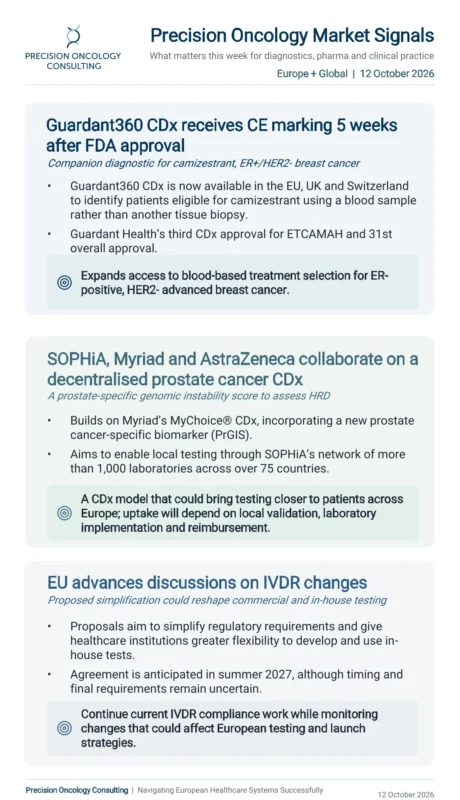
Guardant360 CDx Receives European Approval in 5 weeks.
Guardant360 CDx by Guardant Health is now available to clinicians in the EU, UK and Switzerland to identify patients with ER-positive, HER2-negative advanced breast cancer who may be eligible for AstraZeneca’s camizestrant (ETCAMAH), using a blood sample rather than another tissue biopsy. The CE mark, announced on 8 October, follows FDA accelerated approval on 4 September and an earlier approval in Japan. From a European market access perspective, the timing is encouraging: in this case, the European milestone came just over a month after the US approval. The next question is how quickly this translates into funded testing and access for patients.
Sophia Genetics, Myriad Genetics and AstraZeneca team up to build a decentralised companion diagnostic for prostate cancer
The collaboration builds on Myriad’s MyChoice CDx, already used as a CDx in ovarian cancer. It will incorporate a prostate cancer-specific genomic instability score (PrGIS), a novel biomarker designed to assess chromosomal instability associated with homologous recombination deficiency (HRD). The aim is to make testing available through Sophia’s network of more than 1,000 connected laboratories across over 75 countries, allowing testing closer to patients. For Europe, this is a relevant approach given the differences in testing infrastructure and access across healthcare systems. Its impact will depend on local validation, laboratory implementation and reimbursement. PrGIS data co-authored with AstraZeneca are expected to be presented at ESMO 2026.
IVDR revision: what could change for oncology diagnostics?
The EU is progressing discussions on changes to IVDR, with agreement anticipated in summer 2027. The proposals aim to simplify regulatory requirements and give healthcare institutions greater flexibility to develop and use in-house tests. For oncology diagnostics, this could affect both the cost of bringing commercial tests to market and the role of hospital-developed assays in routine care. The balance between improving access and maintaining consistent quality remains under discussion. The timing and final requirements are still uncertain.
Follow me and Precision Oncology Consulting to stay informed on the latest updates in precision oncology!”
Other articles featuring Svetlana Nikic on OncoDaily.