






Svetlana Nikic, Founder of Precision Oncology Consulting, shared a post by European Coalition for Comprehensive Genomic Profiling (ECGP) on LinkedIn, adding:
“How is negative CGP-result communicated? Is it simply a technical performance issue or the evaluated sample is truely negative for that alteration?
False negative on the other hand might represent a missed actionable alteration, a treatment opportunity that is never identified, and a patient who may never receive the therapy most appropriate for their tumour biology.
A clear, harmonised definition is therefore fundamental to ensuring that CGP delivers consistent clinical value and that this value can be meaningfully assessed and translated into access.
This is precisely why ECGP is working with scientific societies towards greater alignment on what CGP should mean in practice.”
Quoting ECGP’s post:
“Two tests can both be labelled ‘comprehensive genomic profiling’ while delivering materially different clinical results.
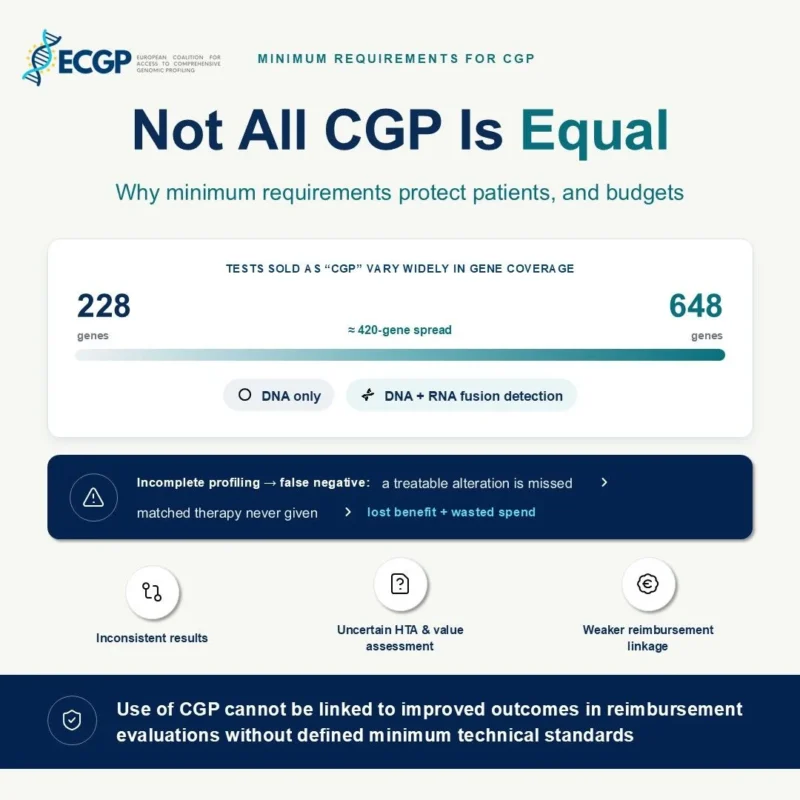
CGP is not a uniform technology. Assays named ‘CGP’ vary widely in gene coverage, inclusion of RNA-based fusion detection, analytical sensitivity, and the breadth of biomarkers assessed. Tests on the market today range from roughly 228 to 648 genes, some interrogating DNA only and others adding RNA analysis.
That heterogeneity is not only at the technical level. It has direct consequences on the clinical decisions:
- Incomplete profiling produces false negatives
- A false negative means a treatable alteration is missed, and the matched therapy is never given
- Besides the direct clinical consequences, inconsistent reporting and nomenclature make HTA and value assessment harder
- Reimbursement cannot be linked to measurable benefit without minimum standards
For payers this is a critical inefficiency: diagnostic investment does not reliably convert into better outcomes, weakening the value proposition of precision oncology.
This is why harmonisation matters. Minimum requirements for genomic coverage, key biomarker classes including RNA fusions, analytical performance and transparent reporting would enable consistent care and robust economic evaluation.
ECGP is working with several scientific societies to address exactly this need and define the minimum technical requirements for comprehensive genomic profiling tests.”
Other articles featuring Svetlana Nikic on OncoDaily.