





Susanna Fletcher Greer, Chief Scientific Officer at The V Foundation, shared on LinkedIn:
“One of my favorite parts of the V Foundation Wine Celebration – The V Foundation for Cancer Research is Conversations for a Cure.
This curated scientific symposium is a chance for our supporters to sit down with the cancer researchers whose grants they make possible, not just to hear about discoveries, but to ask questions, understand the challenges, and see firsthand how research moves from an idea to a breakthrough. It’s breathtaking. I love it. Introducing V Foundation grantees to the donors who fund their research is good medicine for all: inspiring messages of hope in a sea of hard work and harsh realities, for researchers and cancer patients alike.
One of our featured grantee speakers, Dr. Robert Canter and team at the University of California, Davis just published an important new study in the Journal for ImmunoTherapy of Cancer. The Canter team’s work focuses on bone and soft tissue sarcomas, rare cancers that have historically been difficult to treat with immunotherapy.
Our immune system includes specialized cells called natural killer (NK) cells. Think of NK cells as some of the body’s first responders, constantly on the lookout for invaders, including cancer. Researchers have long believed that blocking a protein called TIGIT could help NK cells become even better cancer fighters. But despite that promise, the results in patients have been disappointing.
Rather than asking whether an NK therapy worked, Dr. Canter’s team asked a different question: What if the therapy wasn’t failing because of the drug, but because of where it was being delivered?
Their research uncovered something remarkable. The same NK cells behave very differently depending on where they are. In the bloodstream, they’re active and ready to attack. But once they enter the tumor, they become worn down and lose much of their ability to fight cancer. (Kind of like how I feel after a long week of meetings!)
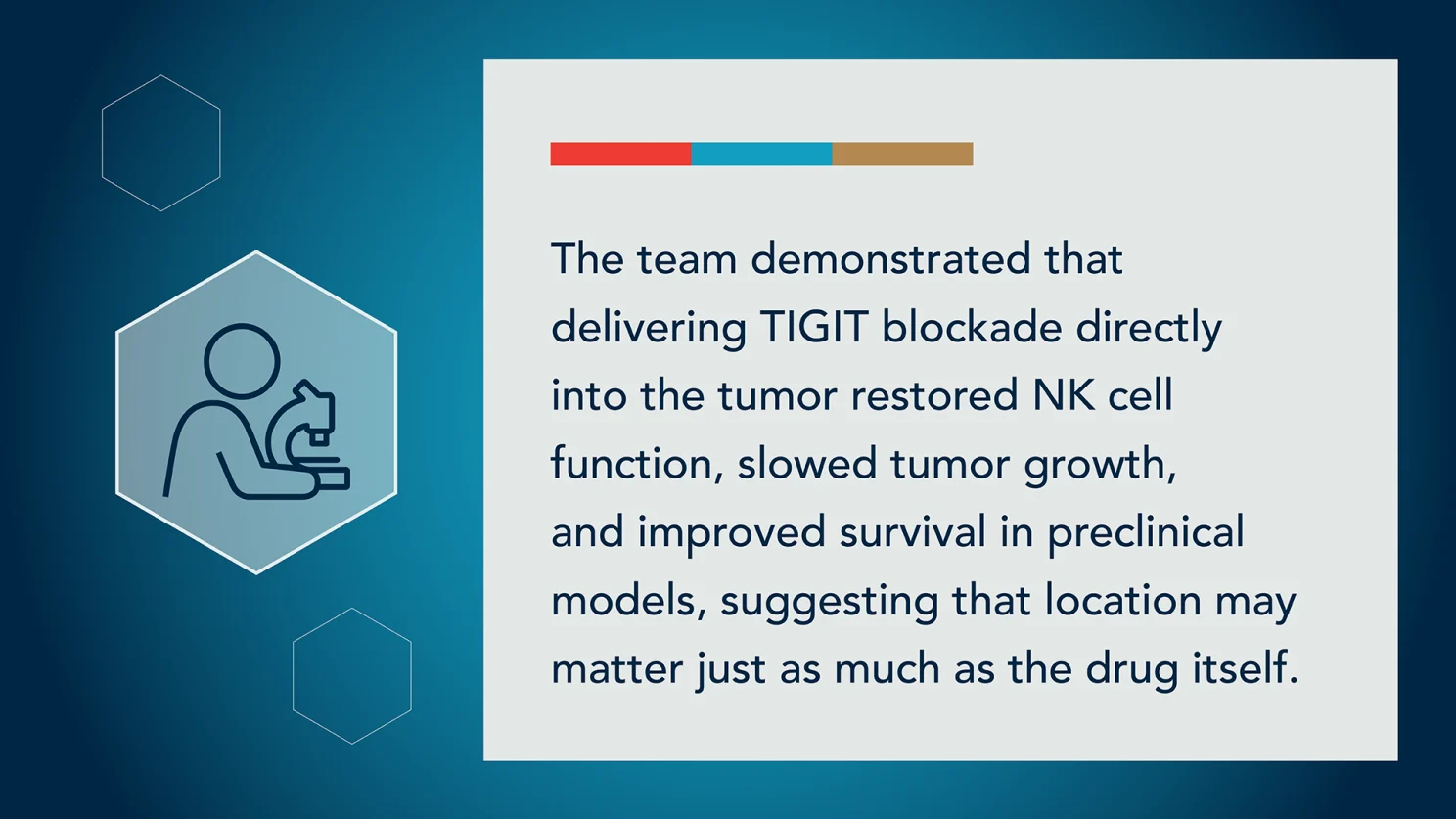
Instead of abandoning their approach, the Canter team changed strategy. By delivering the TIGIT-blocking therapy directly into the tumor, they were able to reawaken these exhausted immune cells. In preclinical studies, that slowed tumor growth and improved survival. I like this study because it’s a powerful reminder that sometimes the breakthrough isn’t discovering a new drug, it’s discovering a better way to use one.
This is exactly the kind of research the V Foundation is uniquely positioned to support. It challenges assumptions. It asks bold questions. And it has the potential to open entirely new treatment strategies for patients with sarcoma, and perhaps many other cancers.
At the V Foundation, we fund the ideas that change what’s possible. Long before a new treatment reaches patients, there is a scientist willing to ask a different question, and a community of supporters willing to believe in that question before anyone knows the answer.
And that’s what Conversations for a Cure is all about.
Our guests won’t simply hear about cancer research; they’ll meet the people driving it forward. They’ll learn why breakthroughs rarely happen in a straight line, why setbacks often lead to better questions, and why philanthropy gives scientists the freedom to pursue innovative ideas that traditional funding may overlook.
Every conversation has the potential to spark a new partnership. Every partnership helps accelerate discovery. And every discovery brings us one step closer to changing what is possible for patients and their families.
I can’t wait to welcome our Wine Celebration guests this week and introduce them to remarkable investigators like Dr. Canter. His work is a wonderful reminder that breakthroughs often begin with a single question, and with people willing to invest in finding the answer.
Find the Canter lab at Robert J. Canter, M.D. for UC Davis Health and read their newest paper at Intratumoral TIGIT blockade augments antitumor responses and bypasses increased functionality of peripheral TIGIT+ NK cells in mouse and human models of bone and soft tissue sarcoma | Journal for ImmunoTherapy of Cancer.
And, if you’re in Napa this week, reach out; I’d love to chat.”
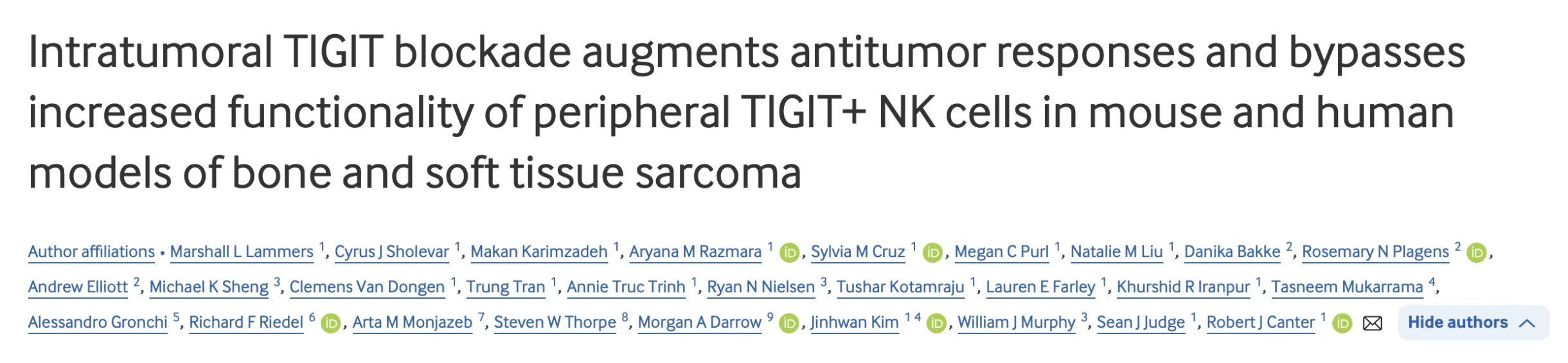
Title: Intratumoral TIGIT blockade augments antitumor responses and bypasses increased functionality of peripheral TIGIT+ NK cells in mouse and human models of bone and soft tissue sarcoma
Authors: Marshall Lammers, Cyrus Sholevar, Makan Karimzadeh, Aryana Razmara, Sylvia Cruz, Megan Purl, Natalie Liu, Danika Bakke, Rosemary Plagens, Andrew Elliott, Michael Sheng, Clemens Van Dongen, Trung Tran, Annie Truc Trinh, Ryan Nielsen, Tushar Kotamraju, Lauren Farley, Khurshid Iranpur, Tasneem Mukarrama, Alessandro Gronchi, Richard Riedel, Arta Monjazeb, Steven Thorpe, Morgan Darrow, Jinhwan Kim, William Murphy, Sean Judge, Robert Canter
Read the Full Article on Journal for ImmunoTherapy of Cancer
Other posts featuring Susanna Fletcher Greer on OncoDaily.