






Stephanie Otto, Exercise Oncologist and Senior Scientist at University Hospital Ulm, shared on LinkedIn:
“Exercise as Cancer Medicine
7,000 steps a day. A 37% lower risk of dying from colon cancer. Muscle strength that nearly halves mortality risk in advanced cancer patients.
This isn’t wellness marketing – it’s what randomized trials and large-scale studies published in 2025 actually show about exercise and cancer.
For years we’ve said ‘exercise helps.’ Now we have RCT-level proof (NEJM, ASCO 2025), precise dose-response data, and confirmed molecular mechanisms behind it.
I break down the 2025 evidence – the challenge trial, step-count thresholds, fitness/survival data, and the biology behind it – in my latest article.”

Exercise as Cancer Medicine: What evidence shows
Exercise as Cancer Medicine: What evidence shows
For decades, physical activity has been framed as a ‘nice to have’ in cancer prevention – sensible advice alongside not smoking and eating vegetables. That framing is now outdated. Evidence published in 2024 and 2025 has moved exercise from correlational lifestyle advice to a mechanistically understood, dose-responsive, and now randomized-trial-validated intervention in oncology.
Here is what the current state of the art tells us – and why it matters for how we counsel patients, design prevention programs, and think about cancer care.
Step count, not intensity, predicts cancer risk
A major 2025 analysis drawing on UK Biobank-style cohort data involving tens of thousands of adults found that daily step count is a stronger predictor of cancer risk than exercise intensity. The dose-response curve is clear: compared to 5,000 steps per day, 7,000 steps reduces cancer risk by 11%, and 9,000 steps reduces it by 16%, with benefits plateauing beyond that point. Even more compelling, a separate 2025 study found that 7,000 steps per day was associated with a 37% lower cancer mortality rate compared to just 2,000 steps daily.
This reframes public health messaging. The long-standing WHO target of 150 minutes of moderate activity per week remains valid, but a step-count target is more intuitive, more trackable via wearables, and doesn’t require structured “exercise sessions” to achieve meaningful risk reduction. Walking to work, taking stairs, or a daily errand-based walk now count as measurable cancer-risk-reducing behavior.
The first randomized trial proof in cancer survivors
Until recently, nearly all evidence linking exercise to better cancer outcomes came from observational studies – useful, but always vulnerable to the criticism that healthier people simply exercise more, rather than exercise making people healthier. That changed with the CHALLENGE trial, presented at ASCO 2025 and published in the New England Journal of Medicine.
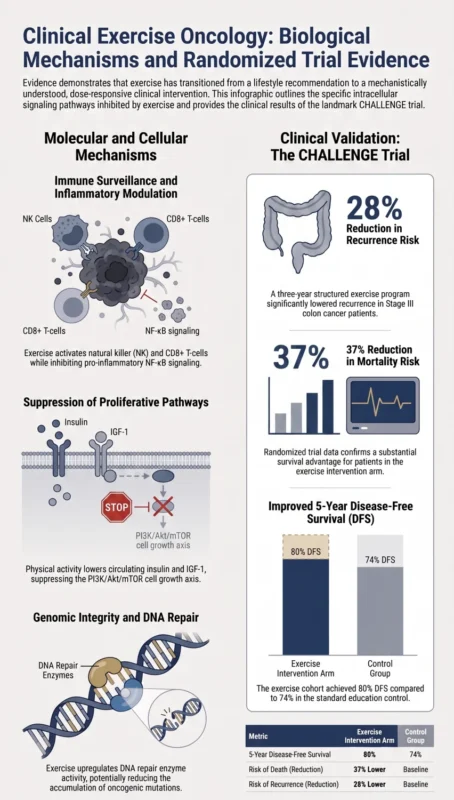
The trial followed 889 patients with stage III colon cancer after surgery and adjuvant chemotherapy. Half were randomized to a structured, three-year exercise program; the other half received standard health education. The results: a 28% reduction in risk of cancer recurrence or new cancer, and a 37% reduction in risk of death, in the exercise group. Five-year disease-free survival was 80% in the exercise arm versus 74% in the control arm. Any form of aerobic activity – not a specific regimen – produced these benefits.
This is the first high-quality randomized controlled trial to demonstrate that a structured exercise intervention can meaningfully alter cancer outcomes, placing it on similar evidentiary footing to a pharmacological intervention.
Muscle strength and fitness predict survival, not just risk
A 2025 systematic review and meta-analysis published in the British Journal of Sports Medicine pooled data from 42 studies and nearly 47,000 cancer patients. High muscle strength and cardiorespiratory fitness were associated with a 31–46% reduction in all-cause mortality, with the strongest protective effect observed in patients with advanced-stage disease. For lung and gastrointestinal cancers specifically, fitness was linked to a 19–41% mortality reduction.
This matters clinically because it shifts the conversation beyond “does the patient exercise” to “how strong and fit is the patient” – suggesting resistance training and cardiorespiratory conditioning deserve dedicated attention in survivorship care, not just general activity encouragement.
Mechanisms: from hypothesis to biological confirmation
Older reviews described exercise’s anticancer effects as biologically plausible but not fully elucidated. That has changed. Current mechanistic reviews confirm that exercise:
- Inhibits NF-κB inflammatory signaling, reducing chronic low-grade inflammation linked to tumorigenesis
- Activates natural killer cells and CD8+ T-cells, enhancing immune surveillance of malignant cells
- Lowers circulating insulin and IGF-1 levels, reducing growth signaling implicated in hormone-sensitive cancers
- Suppresses the PI3K/Akt/mTOR pathway, a key driver of uncontrolled cell proliferation
- Upregulates DNA repair enzyme activity, potentially reducing mutation accumulation
A particularly striking 2025 study found that a single bout of exercise releases circulating factors into the bloodstream capable of slowing breast cancer cell growth in laboratory models – direct cellular evidence that even acute exercise has anticancer biological activity, not just cumulative lifestyle benefit.
The numbers, by cancer type
Current evidence synthesis shows regular physical activity reduces the risk of colorectal, breast, lung, bladder, and gastric cancers by 10–20%. In patients already diagnosed with cancer, regular exercise is associated with a 40–50% improvement in cancer-specific survival, with the strongest effects seen in breast, colorectal, and prostate cancer.
What this means in practice
The clinical and public health implications are significant:
- Step-count targets (7,000–9,000/day) are a more actionable, trackable public health message than generalized “be more active” advice
- Structured exercise programs post-diagnosis should be considered a component of standard survivorship care, not an optional adjunct
- Resistance training and fitness conditioning deserve equal emphasis alongside aerobic activity, given their independent association with survival
- The mechanistic evidence base is now strong enough to support exercise prescription with the same confidence as other evidence-based interventions
We are moving from “exercise is probably good for cancer patients” to “exercise is a quantifiable, mechanistically explained, randomized-trial-validated intervention.” The next frontier is translating this evidence into systematic clinical implementation – ensuring every cancer patient, not just the motivated few, has access to structured exercise oncology support.”
Other articles about Colon Cancer on OncoDaily.