






Solomon Rotimi, Vice President (West Africa), AORTIC at AFRICAN ORGANIZATION FOR RESEARCH AND TRAINING IN CANCER AORTIC INC, shared on LinkedIn:
“I’m pleased to share our newly published paper in Cancer Control.
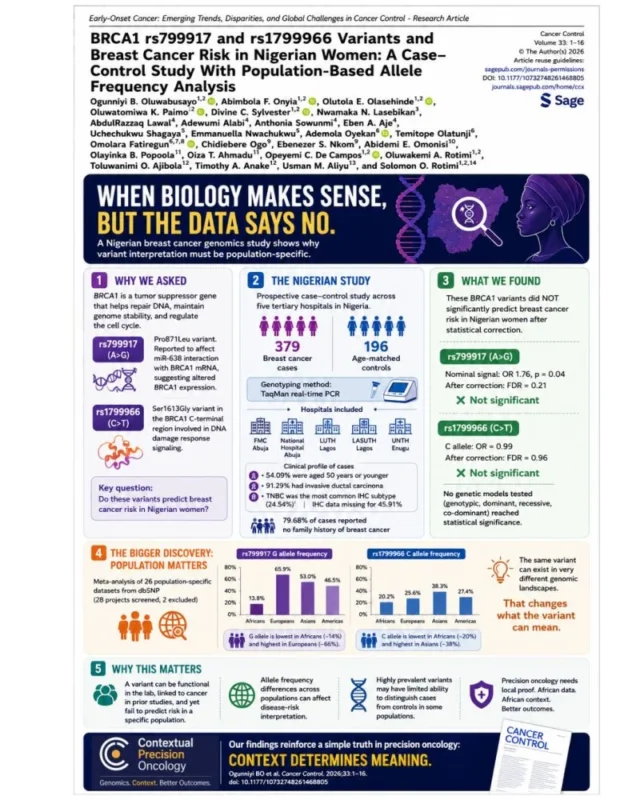
This study reflects our group’s commitment to advancing cancer genomics in African populations by asking a simple but important question: Do variants reported to increase cancer risk elsewhere actually predict breast cancer risk in our population?
That question matters because evidence is contextual.
We studied Nigerian women with breast cancer and age-matched controls, examining two common BRCA1 variants.
The findings were instructive. Although both variants have been linked to cancer in previous studies and have plausible biological mechanisms, neither was associated with breast cancer risk among Nigerian women.
This is more than a negative finding. It’s a reminder that function does not necessarily equal pathogenicity. This means that a variant may alter protein function in the laboratory, appear compelling in earlier studies, and still fail to predict disease risk in a specific population.
History offers a useful analogy. For centuries, maps placed Europe at the center of the world. The maps were internally consistent, but they reflected the perspective of their makers rather than an objective reality.
Genomic knowledge will continue to suffer from the same limitation without askign contextual research questions as we did in this study.
Many pathogenicity models are built largely from European-ancestry populations. They are valuable maps, but they are not the territory.
Our findings reinforce a fundamental principle of precision oncology:
The pathogenicity of a variant can be population-specific. If precision medicine is to benefit everyone, African populations must be represented not only as participants but also as sources of evidence. That requires local cohorts, local validation, and biological context. Without context, even good biology can lead us to the wrong conclusions.”
Title: BRCA1 rs799917 and rs1799966 Variants and Breast Cancer Risk in Nigerian Women: A Case-Control Study With Population-Based Allele Frequency Analysis
Authors: Ogunniyi B. Oluwabusayo, Abimbola F. Onyia, Olutola E. Olasehinde, Oluwatomiwa K. Paimo, Divine C. Sylvester, Nwamaka N. Lasebikan, AbdulRazzaq Lawal, Adewumi Alabi, Anthonia Sowunmi, Eben A. Aje, Uchechukwu Shagaya, Emmanuella Nwachukwu, Ademola Oyekan, Temitope Olatunji, Omolara Fatiregun, Chidiebere Ogo, Ebenezer S. Nkom, Abidemi E. Omonisi, Olayinka B. Popoola, Oiza T. Ahmadu, Opeyemi C. De Campos, Oluwakemi A. Rotimi, Toluwanimi O. Ajibola, Timothy A. Anake, Usman M. Aliyu, Solomon O. Rotimi
Other articles about Breast Cancer on OncoDaily.