Shrinidhi Nathany, Consultant Molecular Hematology and Oncology at Fortis Memorial Research Institute, India, shared a post on LinkedIn:
“The WHO has quietly made one of the most important advances in cancer genetics.
For decades, hereditary cancer syndromes have largely been organized by organ system or individual genes. Lynch syndrome belonged to gastrointestinal pathology. BRCA belonged to breast and ovarian cancer. Li-Fraumeni syndrome was taught separately. While clinically useful, this approach often overlooked the shared biology connecting these disorders.
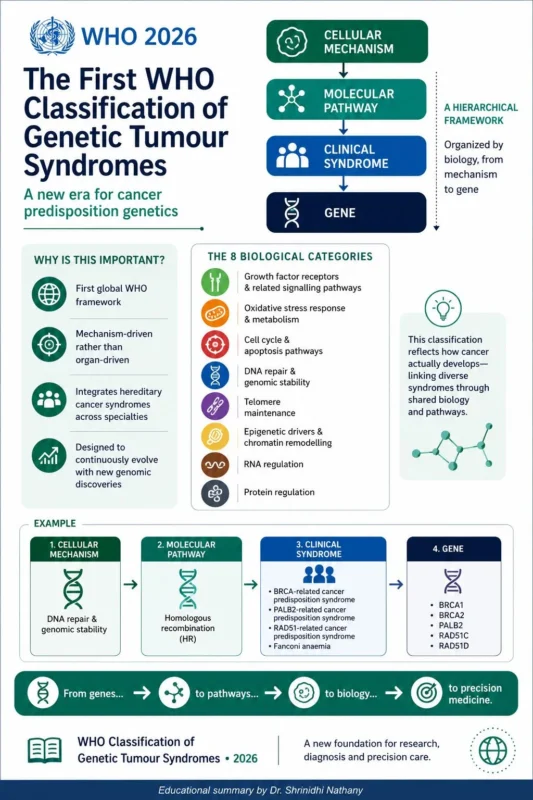
The newly released WHO Classification of Genetic Tumour Syndromes (2026) changes that paradigm.
For the first time, tumour predisposition syndromes are organized using a hierarchical biological framework:
Cellular mechanism – Molecular pathway – Clinical syndrome – Gene
Instead of simply asking ‘Which gene is mutated?’, the classification first asks:
‘Which biological process has failed?’
As genomics moves beyond sequencing towards interpretation, frameworks like this will become increasingly important for diagnosis, surveillance, research and precision therapeutics.
A landmark step in the evolution of precision oncology.”
Title: The WHO Classification of Genetic Tumour Syndromes: Considerations for Genetics
Authors: Ian A. Cree, Mark J. Arends, Joseph D. Khoury, Erika R. E. Denton, Anthony J. Gill, Alexander J. Lazar, Ian M. Frayling, Stefan M. Pfister, Mark A. Rubin, Katia R. M. Leite, Raymond Dalgleish, Elspeth A. Bruford, Sharon E. Plon, Ada Hamosh, Michael Francis Walsh, Gabrielle Goldman-Lévy, Harshima Wijesinghe, William D. Foulkes, Dilani Lokuhetty
Read the Full Article.