






Shikha Jain, Associate Professor of Medicine, Associate Director of Oncology Communications and Digital Innovation at University of Illinois Cancer Center and Founder of Women in Medicine, shared on LinkedIn:
“A patient’s chemotherapy is denied by her insurer. Her oncologist spends days on calls, peer-to-peer reviews, and appeal letters to get it approved. By the time it is, her start date has slipped.
She is frightened and angry, and she has every right to be. But her anger lands on the one person she can see. Too often, what follows is a complaint, an incident report, and a conversation with a supervisor about a delay the physician fought to prevent.
In my last issue of Designing Modern Healthcare, I wrote about the leadership tax: the unpaid work physicians do to close the gaps our systems leave open. This issue is about the other half of that tax. Physicians are not only uncredited for the failures they quietly prevent. They are often blamed for the ones they cannot.
When accountability flows to whoever is closest to the patient instead of whoever controls the process, three things happen. Trust erodes. Teams fracture. And the system loses the data it needs to fix itself, because a lab backlog or a staffing gap gets logged as one person’s performance problem.
I spoke about this with Chicago Health Magazine for their feature ‘Pushing Physicians to the Brink,’ out this week. This issue picks up where that conversation left off, with what leaders can actually change.
Physicians are not asking to be exempt from accountability. We are asking that accountability follow authority.
For health system leaders: when a complaint names a physician in your system, what happens in the first 72 hours? I’d like to hear what actually works.”
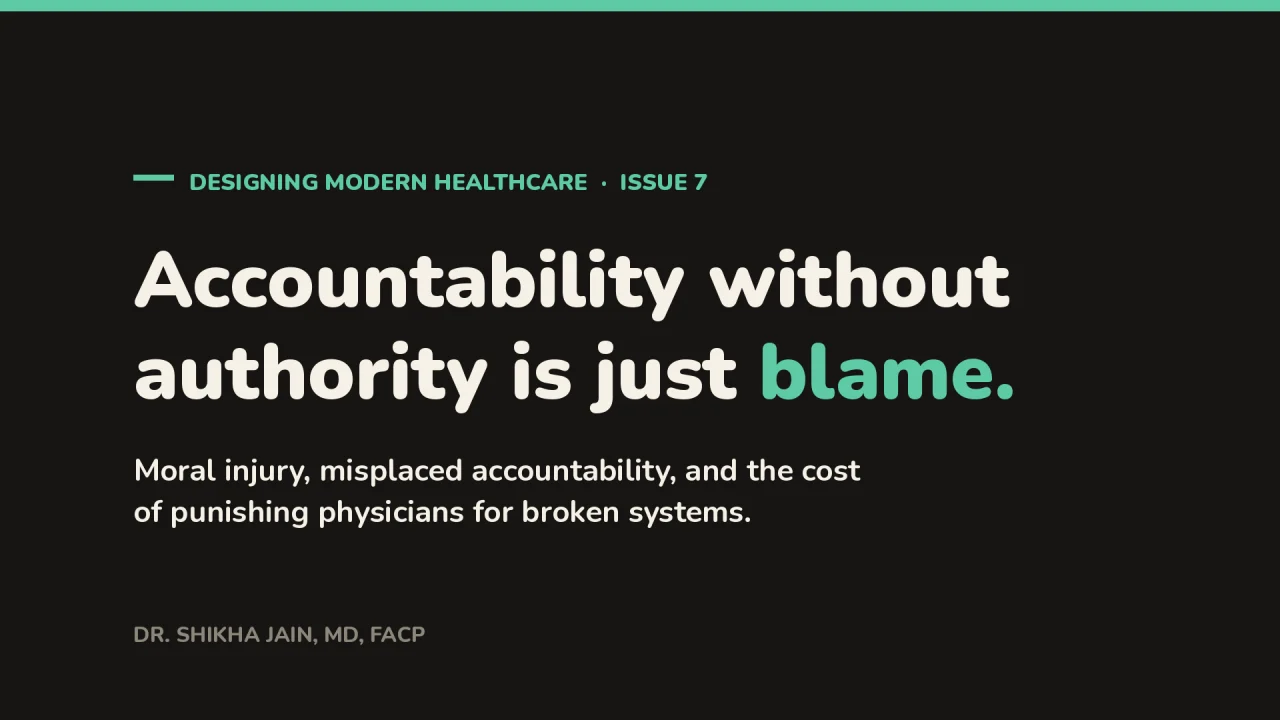
Accountability Without Authority Is Just Blame
The following composite illustrates a familiar pattern in oncology care; it does not describe a single patient.
A woman with newly diagnosed cancer was ready to start chemotherapy. The plan was set, the consent was signed, and the start date was on the calendar. Then her insurer denied the treatment.
What followed was invisible to her. Her oncologist and the care team spent days on phone calls, peer-to-peer reviews, and letters of appeal, assembling guidelines and literature to justify a regimen that was already the standard of care. Eventually it was approved. By then, her start date had was delayed.
What she experienced was simple: she was ready, and her doctor made her wait. She was frightened and angry, and she had every right to be. Her anger landed on the one person she could see. The physician who had spent the week fighting for her care became the person she blamed for its delay.
Many oncologists will recognize this situation. Many will also recognize what can come next: a complaint, an incident report, a conversation with a supervisor about a delay driven by decisions outside the physician’s control.
That is the subject of this issue.
The structural thesis
Every health system distributes two things: authority over how care is delivered, and accountability when it goes wrong. In a well-designed system, those two travel together. In American healthcare, they have come apart.
Physicians hold accountability for outcomes shaped by systems they do not control: insurer decisions, lab turnaround, staffing models, scheduling templates, and supply chains. When any of those fail, the physician is the one whose name is on the chart, the one in the room with the patient, and the one most easily identified by the mechanisms we use to assign responsibility.
Accountability without authority is not accountability.
It is blame with a paper trail.
1. Anger follows visibility, not causation
Patients cannot see an insurer’s utilization review queue. They cannot see a lab’s processing backlog or a clinic’s vacancy rate for medical assistants. They see their doctor. So when care is delayed, the frustration that belongs to the system lands on the most visible person in it.
The scale of the invisible work is not small. In the American Medical Association’s 2025 survey of 1,000 physicians, 95% said prior authorization delays patients’ access to necessary care, and physicians reported handling an average of 40 prior authorization requests per week. Seventy-nine percent said patients abandon treatment because of authorization problems, and 26% said prior authorization had led to a serious adverse event for a patient, including hospitalization, permanent impairment, or death.
In oncology, the stakes of delay are measurable. A 2020 meta-analysis in The BMJ found that across seven major cancers, every four-week delay in treatment was associated with a higher risk of death: 6% to 8% for surgery, and more for some systemic and radiation therapies. A patient’s anger about a delayed start is not irrational. It is clinically justified. It is simply aimed at the wrong target.
When I spoke with Chicago Health for its feature on physicians and the strain of a broken system, I made this point about insurers: they never have to sit across from the patient. “They don’t have to have those hard conversations. We do.” The same is true of every upstream failure. The system’s decisions are made out of sight. Their consequences are explained, and absorbed, at the bedside.
2. Our accountability systems are built to find a name
Consider two illustrative scenarios.
Lab results come back late, so a patient’s treatment is delayed. The patient complains. The delay is reported against the physician, who has no control over the lab, and the physician is counseled and then disciplined.
A clinic is short-staffed, so there is no one available to room patients, take vital signs, and complete check-in. Every visit starts late, and the delay compounds through the day. A patient misses a downstream appointment, and the report says the physician was running behind. The root cause was a staffing model. The consequence lands on a person.
In neither case did anyone act in bad faith. The patient was right to be upset. The nurse or staff member who filed the report was also working short and answering to a metric. The problem is architectural: when incident reporting, complaint routing, and patient experience systems attach an event to an individual without examining its causes, an operational failure can become a personal performance concern. A process that answers who without asking why cannot reliably assign responsibility.
Patient safety has known how to do this better for more than two decades. David Marx’s 2001 primer helped articulate just culture for healthcare leaders. Contemporary just culture frameworks distinguish among human error, at-risk behavior, and reckless behavior, while examining the system conditions that shape each and matching the response accordingly. Adopting the language of just culture for clinical safety events does not ensure that the same principles guide complaints, delays, and operational failures. Whenever attribution precedes causal analysis, the promise of just culture is left unfulfilled.
3. The cost: moral injury, team fracture, and a system that cannot learn
Surgeon Simon Talbot and psychiatrist Wendy Dean argued in 2018 that much clinician distress is better understood as moral injury: the lasting harm of repeatedly being unable to provide care consistent with one’s professional values. The term originated in work with combat veterans. It fits medicine because the injury comes not from the work itself, but from institutional constraints that force clinicians to act against their values.
Being held personally responsible for those same constraints deepens the wound. It is one thing to be unable to get a patient’s chemotherapy approved on time. It is another to be formally reprimanded for the delay. An unjust reprimand adds another harm: it tells a physician that the institution cannot, or will not, distinguish between their conduct and its own design.
This misattribution has three costs that should concern every health system leader.
- It erodes trust. Clinicians learn that effort spent fighting the system on a patient’s behalf offers no protection when the system fails. This can discourage advocacy, deepen disengagement, and contribute to decisions to leave. The Chicago Health feature cited survey data showing that 35% of physicians surveyed in 2025 said they had considered leaving medical practice since the start of that year. We cannot afford to lose clinicians to preventable organizational failures, and blame for what one cannot control is among the most preventable.
- It fractures teams. Physicians, nurses, medical assistants, and front desk staff are all working short and all measured on metrics they cannot fully control. When accountability flows toward the nearest individual, colleagues are positioned as each other’s reporters instead of each other’s partners.
- It corrupts the data. This is the cost leaders most often miss. When a lab delay is logged only as one physician’s performance issue, its operational cause can disappear from the data leaders use to identify problems. When a rooming backlog is filed simply as “provider running late,” the staffing gap can remain hidden. The system cannot fix what it has mislabeled. So it happens again tomorrow, to the next patient and the next doctor.
The key insight: When accountability flows to whoever is closest to the patient instead of whoever controls the process, the system loses its ability to learn from its own failures. Misattributed blame is not only unfair to clinicians. It is a data quality problem, and it keeps broken processes broken.
What this means for leaders
Redesign here means removing friction, not adding oversight. Physicians do not need another committee or another reporting requirement. They need accountability systems that can tell the difference between a person and a process.
- Separate operational events from conduct reporting. Lab turnaround delays, rooming backlogs, and authorization delays should be coded as system events with a named operational owner, not filed against the attending of record.
- Add a causal step before attribution. Before a complaint becomes a counseling conversation, someone should be required to answer a single question: what caused this delay? If the answer is upstream, the report goes upstream.
- Measure the upstream steps. Publish lab turnaround, time to rooming, staffing ratios, and prior authorization turnaround alongside physician productivity and patient experience metrics, so the data shows where delays begin.
- Fund prior authorization as infrastructure. Until we are able to overhal the prior authorization system nationally, dedicate authorization teams with escalation pathways. They help prevent avoidable delays in time-sensitive cancer treatment.
- Tell patients the truth about delays. When a delay is caused by an insurer or an operational failure, patients deserve to know that. Clear, honest communication protects the therapeutic relationship and directs frustration toward the processes that can actually be changed.
- Close the loop. When a clinician is cleared because a delay was operational, say so explicitly. An accusation that is never formally resolved does its own damage.
None of this lowers the bar for physicians. Physicians are not asking to be exempt from accountability. We are asking that accountability follow authority.
What I’m asking you
Not ‘what do you think.’ Something I can use.
If you lead a health system, a department, or a clinic: when a patient complaint names a physician, what happens in the first 72 hours? Is there a defined step that asks what caused the delay before deciding who is responsible? Reply and describe it concretely, or tell me plainly that there isn’t one.
If you are a clinician: have you been formally held responsible for a failure you had no power to prevent? What happened next, and what would have made it right?
I’m collecting these because the systems that get this right are rarely written about, and I want to document what they do differently.
A system that cannot tell the difference between a person and a process will keep punishing people and keep protecting the process.
Next issue: what it looks like when a health system is designed to learn from its failures instead of assigning them.