Sendurai Mani, Associate Director of Translational Oncology at Legorreta Cancer Center, shared on LinkedIn:
“Top 200 Most Influential Cancer Papers – Paper 15:
The Discovery of p53, From a Mysterious Viral Partner to Cancer’s ‘Guardian of the Genome’
I recently shared an AI-generated (Claude) list of the top 200 papers that have shaped cancer research on LinkedIn:
Today, I share more about Paper 15.
What if one of the most important proteins in cancer biology was discovered almost by accident while scientists were studying a tumor – causing virus?
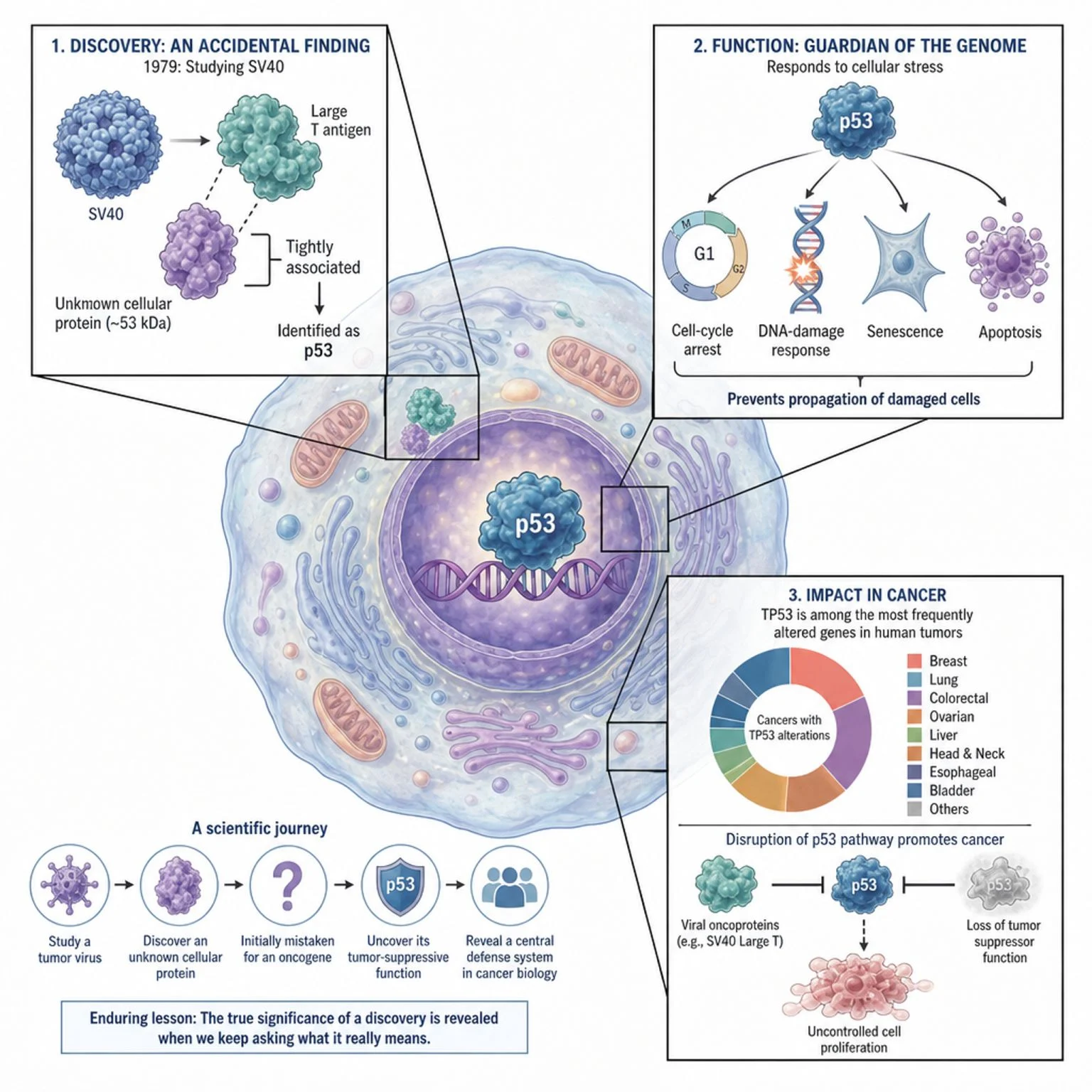
In 1979, David Lane and Lionel Crawford published a landmark Nature paper while studying SV40, a virus that can transform cells. They were examining SV40’s large T antigen, a viral protein essential for transformation, when they made an unexpected discovery: T antigen was tightly associated with a cellular protein of about 53,000 daltons.
In the same year, Linzer and Levine and DeLeo AB and team independently identified the same protein. That protein became known as p53. The discovery was fascinating because scientists initially misunderstood p53’s role.
Because p53 accumulated in transformed cells and interacted with viral transforming proteins, early experiments led researchers to believe that it might itself be an oncogene.
It took years of additional work to show almost the opposite. Normal, wild-type p53 is one of our most important tumor suppressors. In response to stresses such as DNA damage, p53 can trigger cell – cycle arrest, DNA – damage responses, senescence, and apoptosis, helping prevent damaged cells from proliferating.
This earned p53 its famous description:
‘Guardian of the genome.’ And its importance in human cancer is extraordinary.
The TP53 pathway is disrupted across an enormous spectrum of cancers, and TP53 itself is among the most frequently altered genes in human tumors.
The story also revealed a key point about how tumor viruses cause cancer. Viral oncogenic proteins, such as the SV40 large T antigen, can promote transformation partly by interfering with the cell’s growth – control machinery, including p53.
The scientific journey is remarkable: Study a tumor virus – discover an unknown cellular protein – initially mistake it for an oncogene – uncover its tumor – suppressive function – reveal one of cancer biology’s central defense systems.
More than four decades later, researchers are still trying to exploit p53 therapeutically, from restoring mutant p53 function to targeting vulnerabilities created by its loss.
The enduring lesson:
Some discoveries become important not because we understand them immediately, but because scientists keep asking what they really mean.
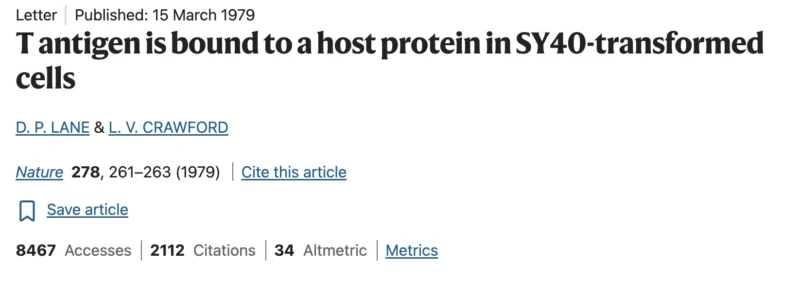
Title: T antigen is bound to a host protein in SY40-transformed cells
Authors: D. P. Lane, L. V. Crawford
Other articles from Sendurai Mani on OncoDaily.