Sendurai Mani, Associate Director of Translational Oncology at the Legorreta Cancer Center, is presenting a series exploring some of the most influential scientific papers that have shaped the field of cancer research on LinkedIn:
Paper 2: When Cancer Needs Two Hits: Knudson’s Tumor Suppressor Breakthrough
“What if cancer requires not one failure – but two?
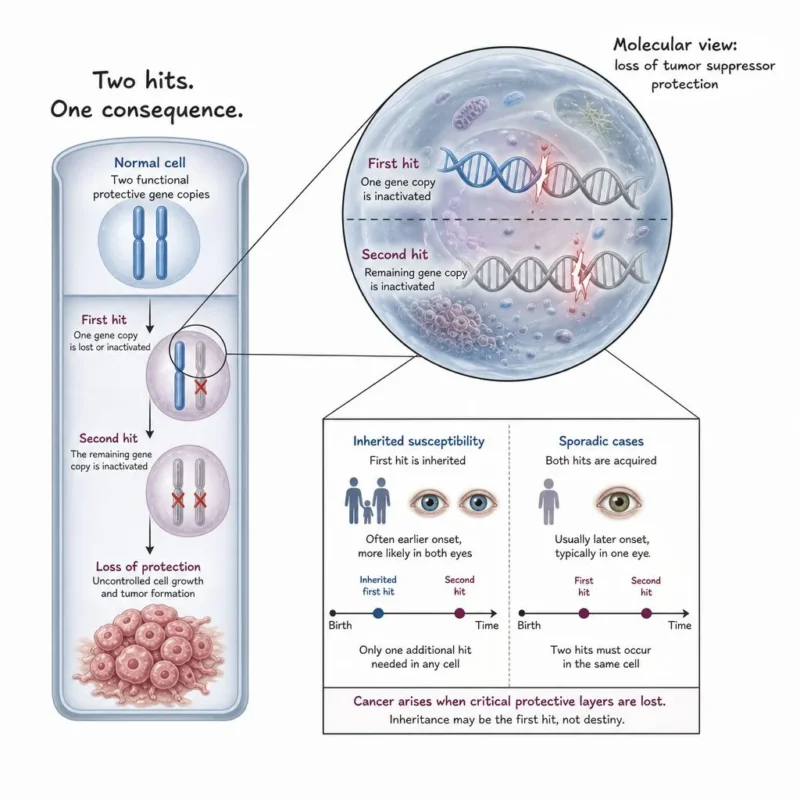
In 1971, Alfred Knudson proposed a deceptively simple explanation for a rare childhood eye cancer, retinoblastoma: tumor formation occurs after both copies of a protective gene are lost or inactivated.
This became known as the two-hit hypothesis.
Knudson noticed that inherited and non-inherited retinoblastoma followed different patterns. Children with inherited susceptibility often develop tumors earlier and in both eyes, consistent with inheriting one damaged gene copy and needing only one additional ‘hit.’ Sporadic cases generally required two acquired hits in the same retinal cell.
The idea fundamentally changed how we understand cancer.
Until then, cancer research had largely focused on genes that become abnormally active and drive growth. Knudson revealed the equally important opposite: genes whose normal role is to restrain proliferation, repair DNA damage, or protect cellular order. Cancer can emerge when those safeguards are removed.
This framework became the foundation of tumor suppressor biology, helping guide discoveries such as RB1, TP53, BRCA1, and BRCA2.
The enduring lesson remains central to precision oncology: inherited risk is often not destiny. It can be the first hit – while cancer develops when critical layers of cellular protection are lost.”
Title: Mutation and Cancer: Statistical Study of Retinoblastoma
Author: Alfred G. Knudson, Jr