Samra Turajlić, Group Leader at Cancer Research UK Manchester Institute, shared Cancer Research UK Manchester Institute’s post on LinkedIn, adding:
“Very proud to see this work out!
The tumour microbiome is a fascinating field, but also a difficult one to advance with confidence. A central challenge has been distinguishing genuine biological signals from contamination.
I am enormously grateful to Alice C. Martin, who led this work with exceptional care and rigour. Alice tackled the decontamination challenge and showed that our findings were reproducible across geographically independent patient cohorts. Working with Anne-Laure Cattin they optimised methods that allowed us to detect and localise bacteria in situ within tumours—an important step towards establishing that what we were seeing was real.
For me, one of the great lessons from this study was the power of interdisciplinary science.
We identified an anaerobic bacterium, and needed expertise far outside our own. Maximiliano Gutierrez and Parise Lockwood were the perfect collaborators, bringing the expertise from their work in TB needed to help us understand and interrogate it.
Susan Bullman, a key leader in the field of host-microbiome-tumour interactions, helped us take another critical step: isolating live bacteria directly from tumours to give us another level of confidence.
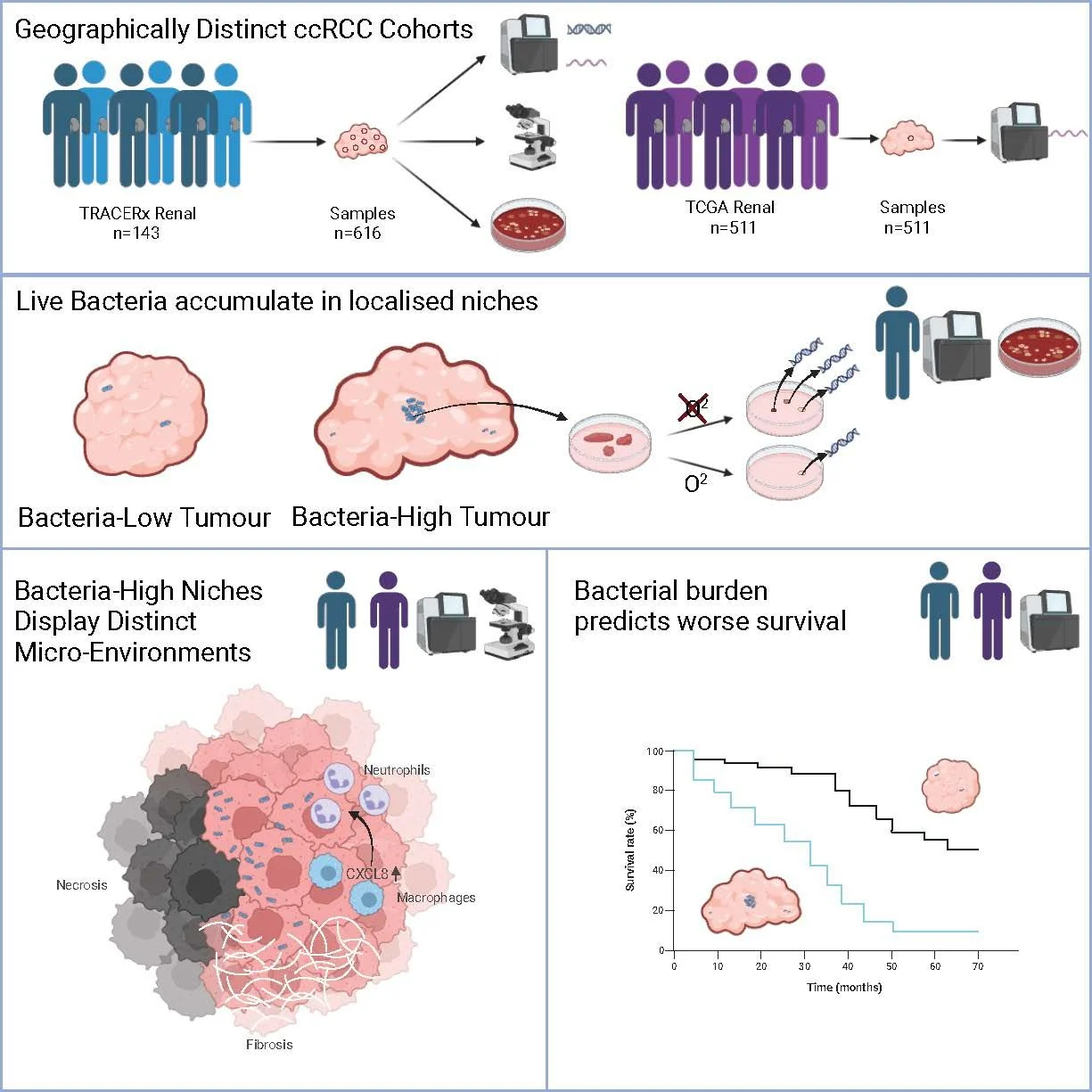
Together, these complementary approaches allowed us to move from an association between bacterial burden and poorer survival in kidney cancer towards a more robust biological picture of bacteria occupying specific localised tumour niches.
As ever, team science doesn’t just deepen the insights—it makes them more robust!
And who knows… we might even tempt Maximiliano Gutierrez into studying cancer!”
Quoting Cancer Research UK Manchester Institute’s post:
“New Paper! Exploring how bacteria in the tumour microenvironment might impact cancer survivability.
Bacteria are one of the many complex factors that influence how our immune system interacts with a tumour, and so understanding their contribution is key to making treatments such as immunotherapy more effective.
Work led by Alice C. Martin, in the lab of our Institute Director, Samra Turajlić at The Francis Crick Institute investigated this question in a type of kidney cancer called clear cell renal cell carcinoma (ccRCC).
By studying data from two large patient cohorts, the team were able to spot certain bacteria species accumulating in niches within the kidney tumour environment. Moreover, high levels of these bacteria were associated with worse outcomes from the disease.
Examining tumour samples and the results of cell culture experiments to explain this relationship, the presence of live bacteria was observed to sustain the production of signals that attract neutrophil immune cells into the tumour. Neutrophil-rich immune cell profiles are a well known marker of more aggressive kidney cancer disease with worse outcomes for patients.
This research lays the groundwork for future explorations into the therapeutic potential of these bacteria, and contributes valuable knowledge to our understanding of the complex landscapes within tumours!”
Title: Bacteria inside kidney tumors associate with myeloid inflammation and disease progression: A TRACERx Renal study
Authors: Alice C. Martin, Anne-Laure Cattin, Parise K. Lockwood, Martha A. Zepeda-Rivera, Clara Becker, Taja Barber, Irene Lobon, Krupa Thakkar, Leo J. Bickley, Zayd Tippu, Laura Marandino, Marija Miletic, Lucy Meader, Mary Green, Donald Bell, Brian Hanley, Barbara Ibarzo Yus, Fiona Byrne, Charlotte Spencer, Scott T.C. Shepherd, Annika Fendler, Lewis Au, Daqi Deng, Ángel Fernández Sanromán, Sarah Rudman, James Larkin, Kevin Litchfield, Maximiliano G. Gutierrez, Samra Turajlic
Read the Full Article on Med by Cell Press
You can also read: Renal Function and Oncological Outcomes After Radical Cystectomy for Muscle-Invasive Bladder Cancer