





Sami (Papacek) Mansfield, Founder of Cancer Wellness for Life, shared a post on LinkedIn:
“Today is Juneteenth.
On June 19, 1865, enslaved people in Texas finally learned they were free – two and a half years after the Emancipation Proclamation. The freedom existed. It just hadn’t reached them yet.
That gap – between a right that exists on paper and one that actually reaches you – didn’t end in 1865. It still shows up in cancer care.
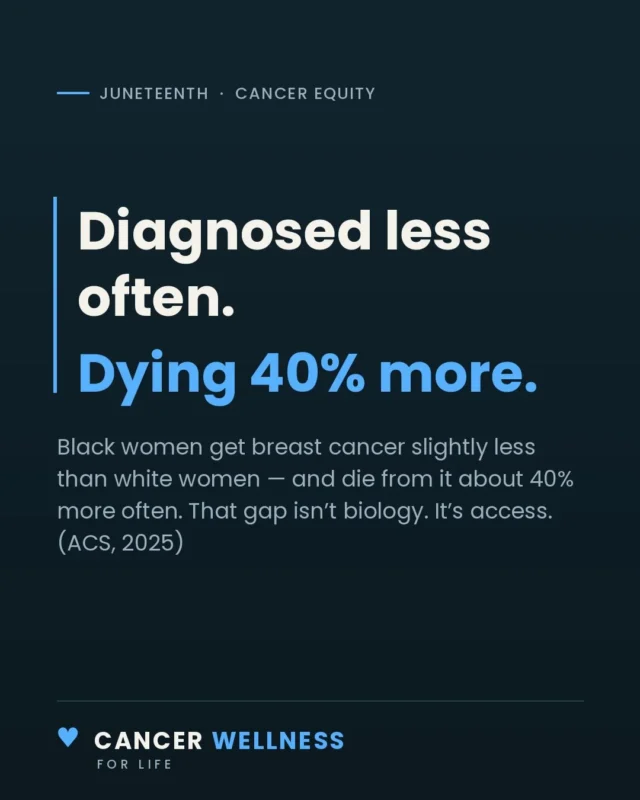
Black women are diagnosed with breast cancer slightly less often than white women, yet die from it about 40% more often. For endometrial cancer, the death rate is nearly double (American Cancer Society, 2025). These gaps aren’t written in biology. They’re written in access, delay, trust, and who gets offered the full standard of care.
That gap – between a right that exists on paper and one that actually reaches you – didn’t end in 1865. It still shows up in cancer care.
Black women are diagnosed with breast cancer slightly less often than white women – yet die from it about 40% more often (American Cancer Society, 2025).
Black men face roughly double the prostate cancer death rate. For colorectal, cervical, and liver cancers, the mortality gap runs 40-50% higher.
These gaps aren’t written in biology. They’re written in access, delay, trust, and who gets offered the full standard of care.
Everything we talk about – early screening, prevention, exercise oncology, survivorship support – only counts if it reaches everyone. Otherwise we’ve built one more freedom that arrives late.
But statistics don’t close gaps. People do.
Through my leadership program with Cancer Nation, I met Jennifer – a survivor, educator, and advocate for Black women facing endometrial cancer, exactly the disease where that ~2x mortality gap is widest.
Her work, and the work of ECANA Women (the Endometrial Cancer Action Network for African-Americans), is what ‘access’ looks like when someone decides to build it: education, community, and a seat at the table for women the system overlooks.
Everything we talk about – screening, prevention, exercise oncology, survivorship – only counts if it reaches everyone. Juneteenth reminds us that ‘available’ and ‘accessible’ are not the same word.
Today, pay attention to individuals like Jennifer, ask, listen and learn. Support ECANA. That’s a freedom worth helping arrive on time.”
Other articles about ECANA on OncoDaily.