Sahar Mansour, Professor of Radiology at Kasr Al-Ainy Hospital, Cairo University, shared on LinkedIn:
“When “Stable for 10 Years” May Not Be Enough
Recently at Baheya Foundation, we encountered a breast cancer case that highlights the value of AI-assisted screening.
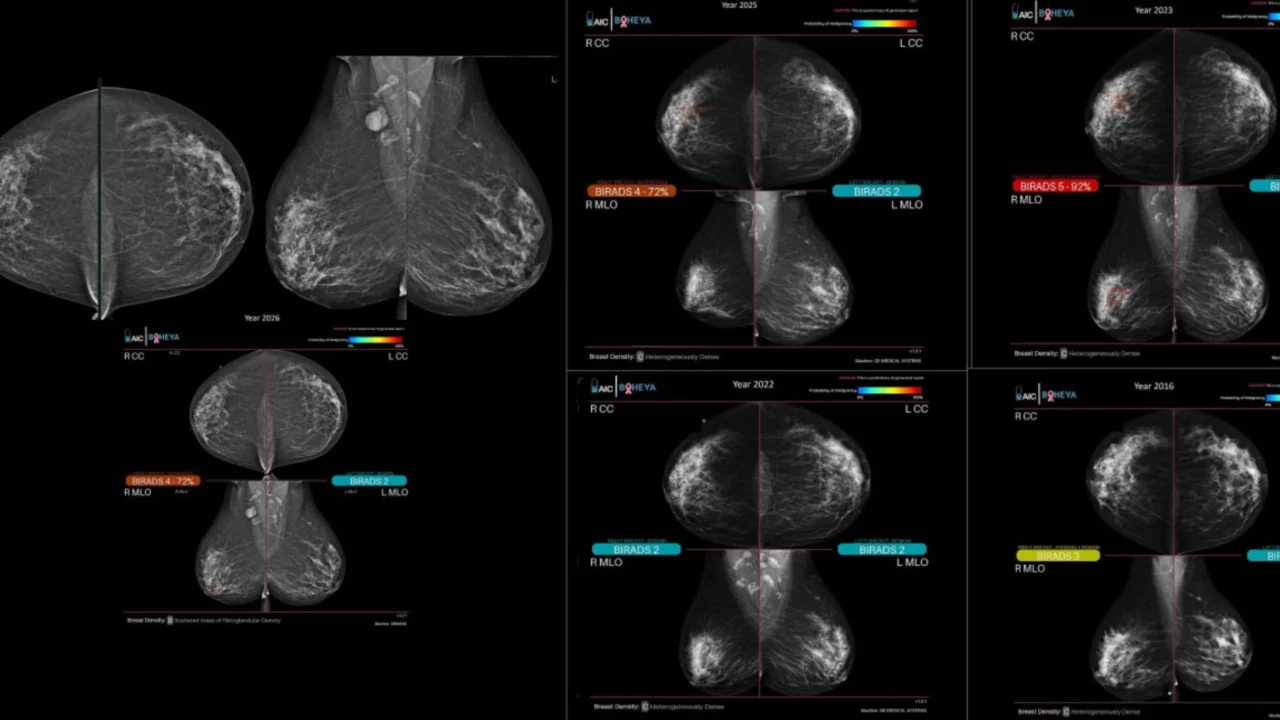
In 2016, a screening mammogram showed an upper outer breast asymmetry. Targeted ultrasound demonstrated condensed glandular tissue, and the finding was classified as probably benign (BI-RADS 3).
Over the following years, the mammographic appearance remained essentially stable and was eventually regarded as benign due to long-term stability.
In 2026, following implementation of our institutionally trained breast AI model (AIC-BAHEYA), the same area was flagged as suspicious. Targeted ultrasound revealed an infiltrative breast carcinoma measuring approximately 4 cm (arrows)
What is interesting was the AI retrospective analysis.
When prior mammograms were reviewed using AI, the same area had been consistently flagged since 2023, based on subtle increases in density and faint superimposed architectural distortion that were difficult to appreciate against a familiar background pattern.
This case raises an important observation:
Radiologists sometimes become reassured by years of stability and familiarity with a patient’s glandular tissue distribution, making subtle malignant evolution harder to perceive?
The real question is not whether AI detected the cancer in 2026.
If an AI model trained on our own screening population had been available earlier, could this cancer have been detected years sooner?
This is not about AI replacing radiologists. It is about AI serving as a Safety Net that never becomes accustomed to a finding and continuously questions what appears unchanged.
- Detecting subtle change within apparent stability
- Reducing false negatives and incidence of missed carcinomas.
- Providing an additional layer of vigilance in screening
Used AI tool (AIC-BAHEYA) developed through collaboration between Applied Innovation Center – AIC and Baheya Foundation.
Special acknowledgment to Eng. Tamer Elsharnouby, Dr. Ahmed Rozeka, Dr. Amr Moustafa, and Dr. Mohammed Gomaa, Dr. Mohamed Emara.”
You can also read: AI-Based Triage and Decision Support in Mammography and Digital Tomosynthesis for Breast Cancer Screening