






Roupen Odabashian, Oncologist at Abbotsford Regional Hospital and Cancer Centre, Founder at MeDucation AI, Podcast Host at OncoDaily, shared Nikolai Slavov’s post on X, adding:
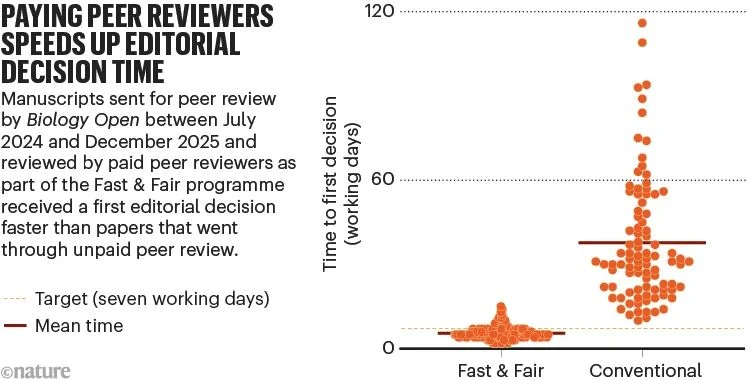
“A biology journal paid its peer reviewers, and the time to a first editorial decision dropped by 85 percent. From nearly 38 working days down to 5.5. And the reviews got better, not worse, judged by how useful editors found them in actually making a decision.
Sit with how counterintuitive that is. We tend to assume paying reviewers would attract mercenaries and degrade quality. The opposite happened. Biology Open’s Fast and Fair program pre-contracted reviewers with relevant expertise, so instead of an editor emailing nine researchers and waiting weeks for two to say yes, they pull from a ready pool, pick two primaries and three backups, and it’s done.
What this really exposes is that peer review was never slow because the science was hard. It was slow because we built the whole thing on unpaid, unscheduled, purely voluntary labor and then acted surprised when it moved at the speed of goodwill. Put a real incentive and a little structure on it, and the bottleneck mostly disappears.
I think about this constantly in medicine. The evidence I rely on for patients moves through this exact pipeline, and every extra month a paper sits in review is a month that knowledge isn’t at the bedside. A 38-day-to-5-day compression is not a workflow nicety. It’s the difference between current evidence and stale evidence.
The open question is whether this scales past one journal. Paying reviewers costs money, and the incentives in academic publishing are not exactly aligned toward spending it. But if a small journal can cut decision time by 85 percent and raise quality at the same time, the burden of proof shifts. Why is anyone still defending the unpaid model?
Would you review faster and better if you were paid and pre-committed? Be honest.”
Quoting Nikolai Slavov’s, Director of Parallel Squared Technology Institute and Distinguished Professor at Northeastern University, post:
“A biology journal paid peer reviewers. This cut the time to a first editorial decision by 85% while increasing review quality.
Paying peer reviewers led to faster first editorial decisions – an average of 5.5 working days, down from nearly 38 for unpaid reviews.
The review quality, as judged by handling editors on the basis of helpfulness in making an editorial decision, went up.
Who benefits from Fast and Fair peer review?
It benefits everybody. It benefits authors because they get a fast and high-quality review. It benefits editors because the editors handling the manuscripts don’t have to spend a lot of time finding reviewers. They can just look up all our pre-contracted reviewers that have the relevant expertise and select two as primary and three as alternatives and boom, it’s done. Our editors are all academics running labs, just like me. Under conventional peer review, editors would invite, on average, nine researchers – and it could take days or weeks to find reviewers. The reviewers benefit because they have a motivation to perform a high-quality review fast, and they’re compensated for their efforts.
Do you see this model changing peer reviewer across the larger ecosystem ?”
Other articles featuring Roupen Odabashian on OncoDaily.