Preeti S., Director of Competitive and Scientific Intelligence at PSTRIDE Solutions, shared a post on LinkedIn:
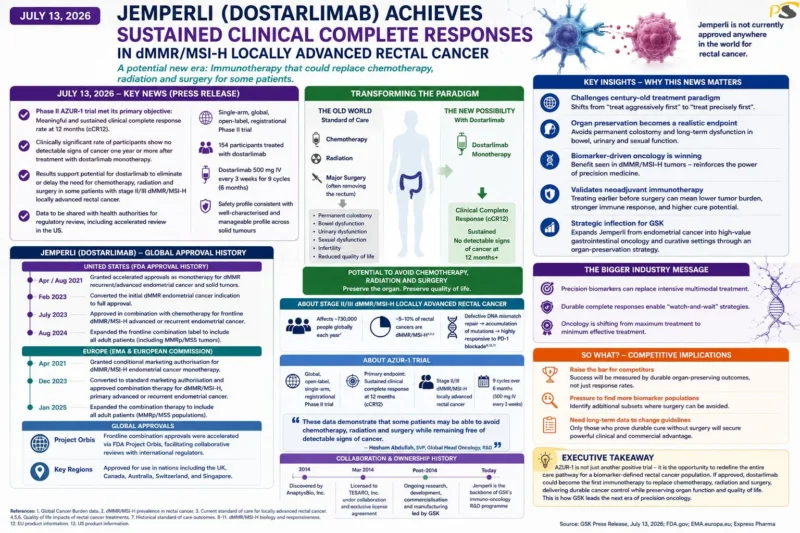
“What if the biggest breakthrough in oncology wasn’t a new drug… but a treatment that made other treatments unnecessary?
For decades, patients with locally advanced rectal cancer followed a familiar path:
- Chemotherapy
- Radiation
- Major surgery
On July 13, GSK’s AZUR-1 interim data introduced a different possibility.
Jemperli (dostarlimab) achieved sustained clinical complete responses (cCR12) in dMMR/MSI-H locally advanced rectal cancer, supporting the potential for some patients to avoid chemotherapy, radiation, and surgery altogether.
This isn’t just a new indication. It’s a new treatment philosophy.
Key Insights:
- The real innovation isn’t PD-1. It’s treatment subtraction.
Success is no longer measured by adding more therapies – it is measured by safely eliminating them. - Jemperli is moving from “life extension” to “treatment replacement.”
If approved, it could become the first immunotherapy capable of replacing an entire multimodal treatment pathway for this biomarker-defined population. - Organ preservation becomes the new value proposition.
The biggest benefit may not simply be controlling cancer – it may be preserving normal life. - Precision medicine keeps raising the bar.
Only 5–10% of rectal cancers are dMMR/MSI-H, yet this subgroup could redefine the future treatment algorithm.
SO WHAT?
The competitive question is no longer:
“Who has the best PD-1 inhibitor?”
It is:
“Who can safely eliminate chemotherapy, radiation, and surgery?”
That changes the benchmark for every immuno-oncology company.
The next generation of winners will not simply deliver better drugs. They will deliver less treatment, better quality of life, and durable cures.
Final Thought
AZUR-1 isn’t just changing rectal cancer. It’s changing the definition of value in oncology—from adding more treatments to eliminating them.”