






Preetam Jain, Consultant Medical Oncologist and Hemato-Oncologist at Bombay Hospital and Medical Research Centre, shared a post on X:
“Anthracycline Benefit in High-Risk Breast Cancer
1) Is it time to reconsider the role of Anthracyclines in HR+ HER2- Breast Cancer?
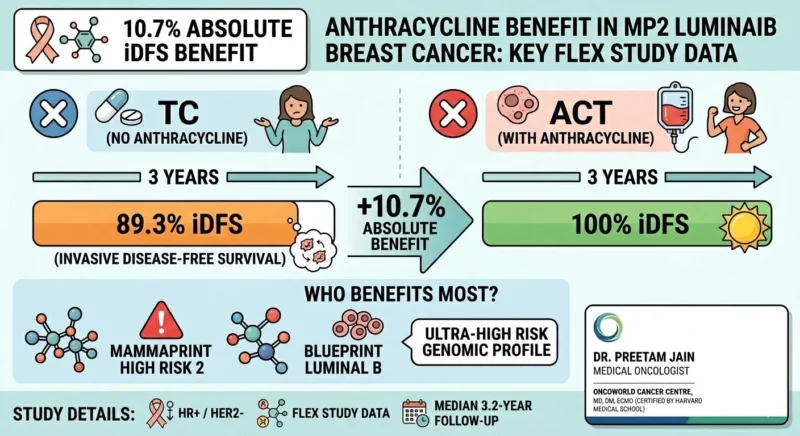
New data from the FLEX study reveals a striking 10.7% absolute iDFS benefit for a specific subset of patients. Here is why genomic subtyping matters more than ever.
2) The study focused on patients identified by MammaPrint as High Risk 2 (MP2) and BluePrint as Luminal B.
For years, we’ve debated if TC is “enough.” In this ultra-high-risk genomic group, the data suggests it might not be.
3) The Results (3-Year iDFS):
ACT (Anthracycline-based): 100%
TC (Non-Anthracycline): 89.3%
That’s a 10.7% absolute benefit at a median 3.2-year follow-up. In oncology, an absolute gain of this magnitude is a practice-changing signal.
4) Why does this matter?
Precision medicine isn’t just about de-escalation; it’s about right-escalation.
5) By identifying MP2/Luminal B signatures, we can pinpoint patients who derive maximum benefit from more intensive regimens, ensuring we don’t undertreat aggressive biology.
While we await longer-term follow-up, the FLEX data reinforces that genomic profiling is essential for tailoring adjuvant therapy.
2026 NCCN Guidelines Now Support This Approach.
The NCCN now recognizes MammaPrint + BluePrint to identify which HR+/HER2- patients benefit most from anthracycline. Consequently, this marks the first endorsed genomic tool for this decision.
Individualized care = Better outcomes.
Dr Preetam Jain, Medical Oncologist, Director, OncoWorld Cancer Centre.
A quick clinical insights for the Oncologist to practice:
Q: Who sees the biggest gain from Anthracyclines?
A: Patients with MP2 + Luminal B signatures. Data shows a significant 10.7% absolute iDFS benefit at 3 years.
Q: Can we de-escalate in High Risk 1?
A: FLEX data suggests TC yields strong outcomes here, though clinical judgment remains key for individualization.
Q: The Workflow?
A: MammaPrint to determine chemo benefit.
BluePrint + Risk Level to select between TC vs. ACT.”
Other articles about Breast Cancer on OncoDaily.