Pavlos Msaouel, Associate Professor of Genitourinary Medical Oncology at MD Anderson Cancer Center, shared on LinkedIn:
“Now published in Urologic Oncology Seminars and Original Investigations: consensus statements from the International Kidney Cancer Symposium North America 2025 Think Tank on advancing clinical trials for rare renal cell carcinoma subtypes.
Title: Advancing clinical trials for rare renal cell carcinoma subtypes: Consensus statements from the International Kidney Cancer Symposium North America 2025 think tank
Authors: Pavlos Msaouel, Salvatore La Rosa, Edwin Jason Abel, Laurence Albiges, Pedro C Barata, Stephanie A Berg, David A Braun, James Brugarolas, Matthew T Campbell, Marie I Carlo, Katie Coleman, Nicholas G Cost, Arighno Das, Arpita Desai, Nazli Dizman, Daniela Drago, Minas Economides, Daniel M Geynisman, Meghan Griffith, Tasha Hall, Elizabeth P Henske, Eric Jonasch, Prateek Khanna, Ritesh R Kotecha, Amy Luckenbaugh, Jodi K Maranchie, Viraj Master, Allison M May, Robert J Motzer, Moshe C Ornstein, Michael V Ortiz, Sumanta K Pal, Jose R Perez, Brian Rini, Daniel D Shapiro, Brian M Shuch, Adam E Singer, Eric A Singer, Walter M Stadler, Michael Staehler, Nizar M Tannir, Ulka N Vaishampayan, Wenxin Xu, Wesley Yip, Niki M Zacharias, Martin H Voss
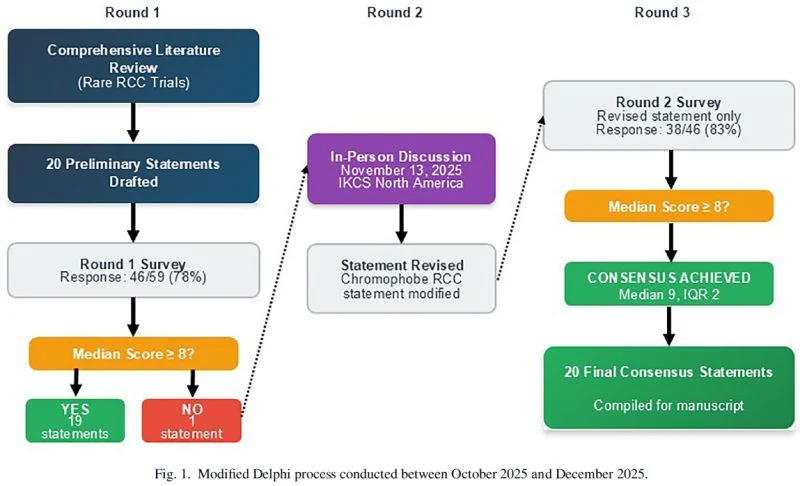
Co-chaired with Martin Voss and organized with Salvatore La Rosa and the Kidney Cancer Association, this modified Delphi engaged 46 panelists spanning oncology, urology, pathology, genetics, biostatistics, regulatory affairs, industry, and patient advocacy (KCA, KCCure, Chromophobe and Oncocytic Tumor Alliance).
Three rounds, including the November 13, 2025 Think Tank in Denver, produced 20 consensus statements (median ≥8/10) in five domains. Several recommendations have direct implications for drug development:
- Generate evidence within biologically coherent, histology-specific or molecularly defined cohorts. Basket and platform trials can share infrastructure while preserving separate, prospectively planned analyses.
- Use randomized trials when feasible, particularly in papillary RCC. For ultra-rare subtypes, develop rigorous single-arm and adaptive approaches with appropriate external controls and explicit plans for confirmation.
- Recognize the work still needed in chromophobe RCC: stronger therapeutic hypotheses, collaborations, and referral networks before dedicated randomized trials become reliably feasible.
- Build access into the protocol. Patient advocacy partnerships, consented natural-history registries, travel support, and remote trial operations are essential to recruitment and participation.
- Connect clinical development to disease-specific models and pharmacodynamic biomarkers, so that trials help explain treatment activity and resistance.
Next steps include the establishment of shared registries with consistent diagnostic and outcome assessment, development of subtype-specific trials, and engaging patients, sponsors, and regulators early.”
You can also read:
LITESPARK-011 Trial: Belzutifan Plus Lenvatinib vs Cabozantinib in Advanced RCC