Patrick Hwu, President and CEO at Moffitt Cancer Center, shared on Linkedin:
“What if T cells are not failing because they are exhausted, but because they cannot properly switch on in the first place?
In advanced ovarian cancer, fluid called ascites can build up in the abdomen. This fluid creates a complex tumor environment filled with cancer cells, immune cells and unusually high levels of fats, or lipids.
Researchers found that some of these lipids can interfere with T cells, the immune cells responsible for recognizing and attacking cancer.
Normally, receptors on the surface of a T cell gather into tiny clusters when they recognize a threat. This clustering acts like an alarm, activating the T cell so it can multiply, produce cancer-killing molecules and attack its target.
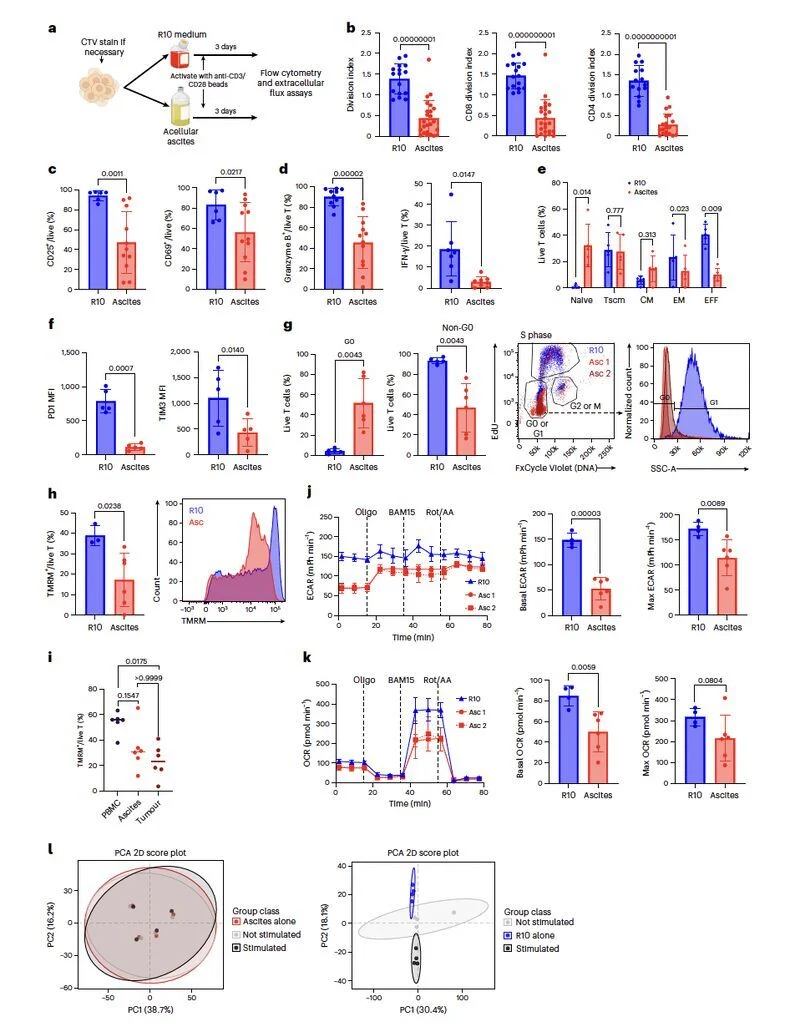
But in ovarian cancer ascites, lipids altered the T cell’s outer membrane and disrupted how those receptors moved, clustered and recycled back to the cell surface. The T cells remained alive, but their activation signal was weakened before they could fully respond.
The researchers identified one lipid, called 18:0–18:2 phosphatidylcholine, that reduced T-cell activation, growth and cancer-killing ability at levels similar to those found in patient ascites.
When the researchers removed lipids from the fluid, T-cell signaling and function improved, suggesting that these fats are an important part of the immune-suppressing environment.
The team also discovered a potential way around this barrier: T cells that were already actively stimulated before entering the ascites continued to function much better.
In laboratory experiments, recently activated CAR T cells maintained their cancer-killing ability, while older CAR T cells that had returned to a resting state were more easily suppressed.
Why this matters: This study provides a new explanation for why T-cell therapies have struggled against ovarian cancer. Rather than simply exhausting or killing T cells, tumor-associated lipids may prevent them from properly switching on in the first place.
The findings also suggest that shortening the CAR T-cell manufacturing process, so the cells are infused while they are still highly active, could help them resist this lipid-rich environment.
The big takeaway: The environment around a tumor can be just as important as the cancer itself. By understanding how ovarian cancer ascites blocks T-cell activation, researchers may be able to design stronger and more effective cellular therapies.”
Read the full study.
Title: Lipids in ovarian cancer ascites impair T cell activation by disrupting TCR dynamics
Authors: Erica G. Brown, Ewoud B. Compeer, Zhiyang Gan, Andre R. Kelly, Alexander A. Shestov, Laura Córdoba Espejo, Mitchell T. Evans, Alan Y. Liu, Noelle H. Naughton, Tanay S. Parnaik, Jemma H. Larson, Bruce R. Blazar, Caroline R. Bartman, Joshua D. Rabinowitz, Michael L. Dustin, Daniel J. Powell Jr & Roddy S. O’Connor
Other articles featuring Patrick Hwu on OncoDaily.