






Olubukola Ayodele, Breast Cancer Lead at University Hospitals of Leicester NHS Trust, shared a post on LinkedIn:
“At oncology conferences, we often clap when we see a “positive” clinical trial.
A statistically significant p value.
A hazard ratio below 1.
A curve separating beautifully on a slide.
And rightly so. These studies represent years of work, scientific innovation and hope.
But afterwards, I often reflect on how differently patients interpret these results.
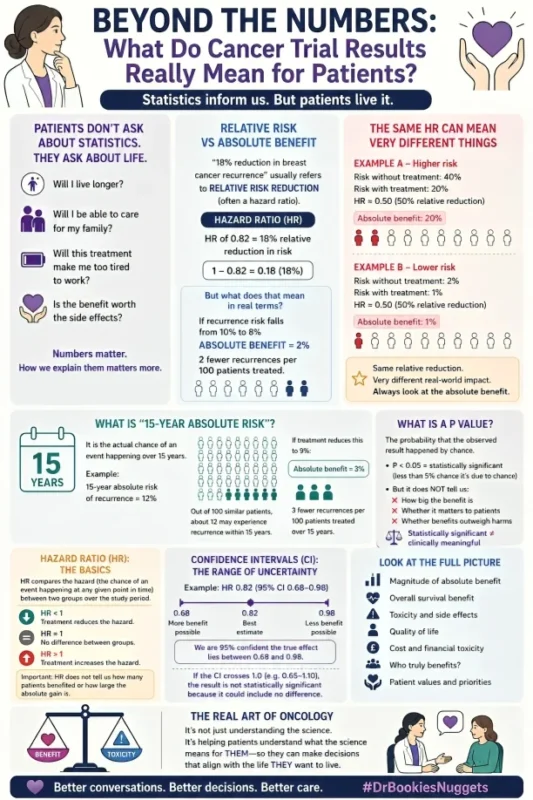
Because patients are not asking:
“What was the hazard ratio?”
They are asking:
“Will I live longer?”
“Will I be well enough to work?”
“Will I still be able to care for my family?”
“Will this treatment make me sick?”
“Is the benefit worth the side effects?”
And this is where oncology becomes far more complex than statistics.
Take a statement like:
“18% reduction in breast cancer recurrence.”
To many people, that sounds like:
18 out of 100 women avoided recurrence.
But that is usually not what the statistic means.
Often, this refers to a hazard ratio, which compares the relative risk between two groups over time.
For example:
A hazard ratio of 0.82 means the treatment reduced the relative risk of recurrence by 18% compared with the control group.
But relative reductions can sound much larger than the actual benefit experienced by patients.
Imagine:
• Without treatment, 10 out of 100 patients develop recurrence
• With treatment, 8 out of 100 patients develop recurrence
The absolute benefit is 2%.
So the treatment prevented recurrence in 2 extra patients out of every 100 treated.
Suddenly, the conversation feels very different.
Especially when treatment may also bring:
• fatigue
• diarrhoea
• neuropathy
• menopausal symptoms
• cardiotoxicity
• lung toxicity
• fertility implications
• financial toxicity
• repeated hospital visits
Some therapies are transformative and have changed the natural history of breast cancer but modern oncology is increasingly forcing us to think beyond statistical significance alone and consider:
• magnitude of benefit
• quality of life
• toxicity burden
• financial cost
• patient priorities
Because patients value outcomes differently.
Some will accept significant toxicity for even a small reduction in recurrence risk.
Others prioritise independence, work, family and preserving quality of life.
Neither perspective is wrong.
This is why communication matters.
Not just presenting statistics.
But translating them.
Humanising them.
Contextualising them.
Because behind every hazard ratio is a human being trying to decide how they want to live THEIR life.
With ASCO just days away and data coming fast, perhaps this is a gentle reminder for all of us.
Not only to ask: “Did the trial meet its endpoint?” But also think, “How will we explain what this truly means to the patient sitting in front of us?”
That is the real art of oncology.”
Other article about Clinical Trials on OncoDaily.