Olubukola Ayodele, Breast Cancer Lead at University Hospitals of Leicester NHS Trust, shared on LinkedIn:
“The 5-year survival.
We hear this phrase often in oncology. And understandably so. It is simple. Easy to communicate. Often reassuring. But in breast cancer, I sometimes wonder whether 5-year survival has become a little too comfortable as a headline. Because breast cancer is not one disease and not all subtypes follow the same clock.
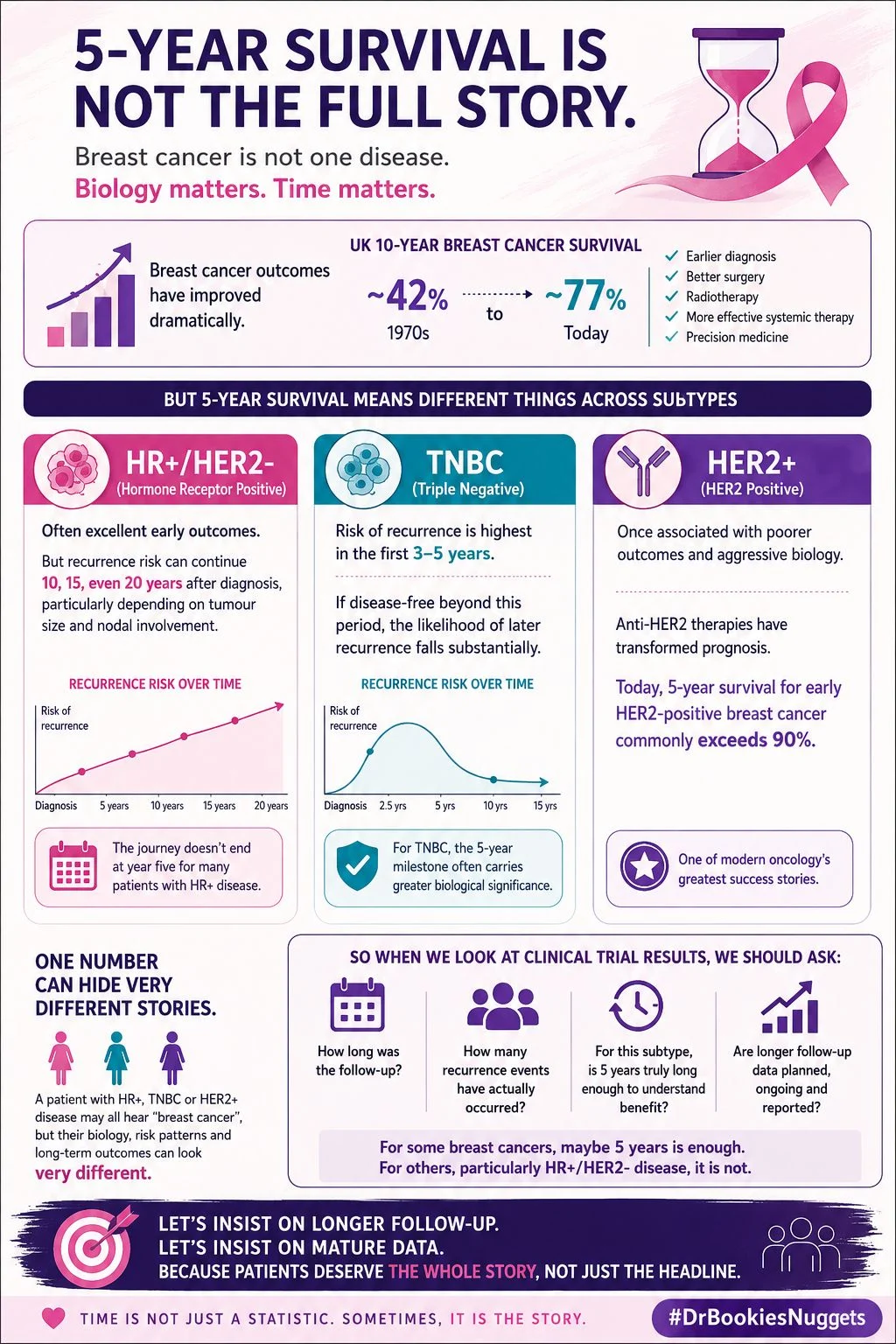
Over the last 30 years, outcomes have improved dramatically. In the UK, 10-year breast cancer survival has risen from around 42% in the 1970s to almost 77% today.
That is real progress.Earlier diagnosis. Better surgery. Radiotherapy. More effective systemic therapy. Precision medicine. But when we move beyond the headline figure of 5-year survival, the biology becomes far more interesting.
- HR+/HER2- breast cancer
Often associated with excellent early outcomes.
However, this is also where 5-year survival can be misleading. We know recurrence risk can continue 10, 15, even 20 years after diagnosis, particularly depending on tumour size and nodal involvement. So for many patients, being well at year five does not necessarily mean the journey is over.
- Triple negative breast cancer (TNBC)
TNBC behaves differently.
The risk of recurrence is often highest within the first 2–5 years. Encouragingly, if patients remain disease-free beyond this period, the likelihood of later relapse falls substantially.
For TNBC, the 5-year milestone carries a different biological meaning.
- HER2-positive breast cancer
HER2-positive disease tells another remarkable story.
Once associated with poorer outcomes and aggressive biology, anti-HER2 therapies have transformed prognosis.
Today, 5-year survival for early HER2-positive breast cancer commonly exceeds 90%. One of modern oncology’s genuine success stories. And this is why I sometimes pause when we quote “5-year survival” as though it means the same thing across all breast cancers. Because it does not. A single survival figure can hide very different patterns of recurrence and risk.
This is also why, when clinical trial results are presented, we should look beyond the headline.
- How long was the follow-up?
- How many recurrence events have actually occurred?
- And for this subtype, is 5 years truly long enough to understand benefit?
For some breast cancers, maybe. For others, particularly HR+/HER2- disease, perhaps not.
So maybe the question is not simply:
‘What is the 5-year survival?’
But:
‘Have we followed patients long enough to understand what survival really looks like?’
Because in breast oncology, time is not just a statistic. Sometimes, it is the story.”