






Olubukola Ayodele, Breast Cancer Lead at University Hospitals of Leicester NHS Trust, shared a post on LinkedIn:
“In oncology, we often ask: ‘Does this treatment work?’
However perhaps the more important question is: ‘Who does it actually work for?’
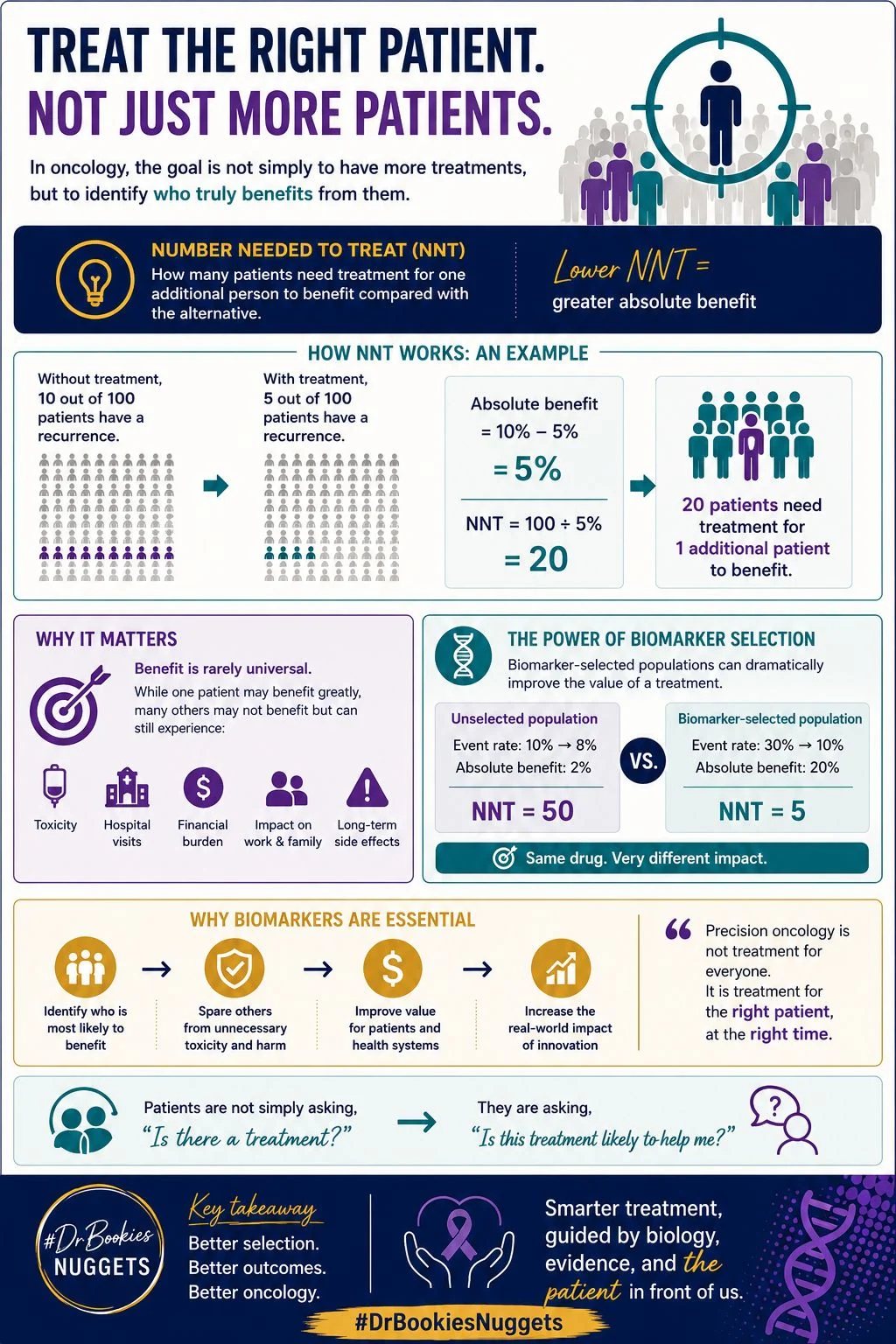
This is where a concept called Number Needed to Treat (NNT) becomes incredibly helpful.
NNT tells us how many patients need to receive a treatment for one additional person to benefit compared with the alternative.
Lower NNT generally means greater absolute benefit.
For example:
If recurrence risk falls from 10% to 5%, the absolute benefit is 5%.
That gives an NNT of 20.
In practical terms: 20 patients receive treatment for 1 additional patient to benefit.
This does not mean the treatment lacks value.
For the patient who benefits, the impact may be profound, even life-changing.
But NNT reminds us of something important: benefit is rarely universal.
Because many patients may still experience:
- toxicity
- hospital visits
- financial burden
- disruption to work and family life
- and sometimes long-term side effects
This is where modern oncology is evolving.
The goal is not simply to develop more treatments but to identify who truly benefits from them.
This is why BIOMARKERS matter.
Biomarker-selected populations can dramatically change treatment value.
A therapy with an NNT of 50 in an unselected population may have an NNT of 8 in a biomarker-defined group.
Same drug.
Very different impact.
This is the promise of precision oncology. Not treatment for everyone but treatment for the RIGHT patient.
Because without biomarkers, we risk exposing many patients to toxicity and inconvenience while only a small proportion derive meaningful benefit.
That is not a criticism of innovation.
It is a reminder that innovation alone is not enough.
SELECTION MATTERS.
This is why biomarker research and equitable access to testing matter just as much as the drugs themselves.
Patients are not simply asking:
‘Is there a treatment?’
They are asking: “Is this treatment likely to help me?”
That is a very different question.
The future of oncology is not simply more treatment but smarter treatment, guided by biology, evidence, and the patient in front of us.”
More posts featuring Olubukola Ayodele.