


Nicholas Restifo, Chief Medical Officer at Medici Therapeutics, shared on LinkedIn:
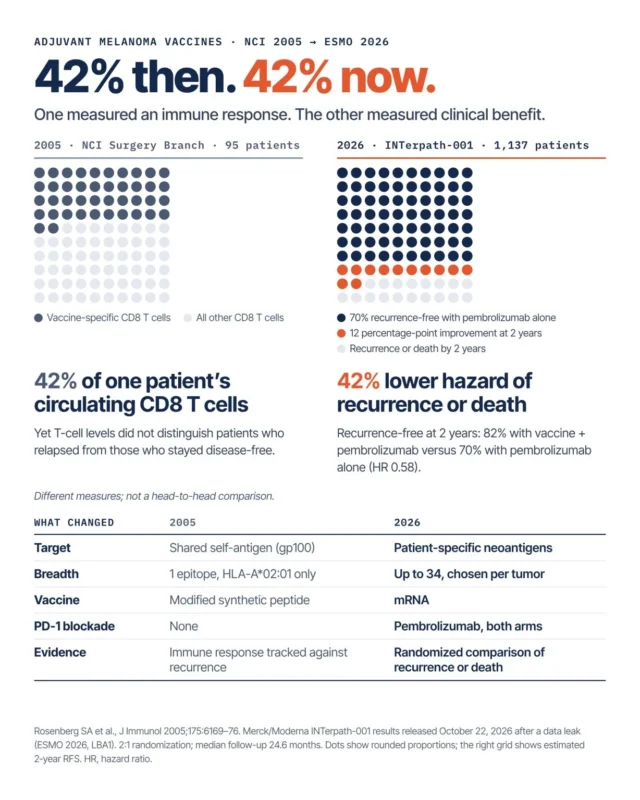
“42% then. 42% now. From counting T cells to changing outcomes.
In 2005, our NCI Surgery Branch team vaccinated 95 melanoma patients who were disease-free but at high risk of recurrence. We generated extraordinary immune responses. In one patient, 42% of circulating CD8 T cells recognized the vaccine antigen.
Yet T-cell levels did not distinguish patients who relapsed from those who stayed disease-free. That result has stayed with me for twenty years.
Today a different 42% leaked.
After screenshots surfaced online, ESMO released Merck and Moderna’s Phase 3 INTerpath-001 results ahead of Saturday’s presentation. In 1,137 patients with resected stage IIB–IV melanoma, adding the personalized mRNA vaccine intismeran autogene to pembrolizumab cut the risk of recurrence or death by 42% (HR 0.58).
Recurrence-free at two years: 82% versus 70%.
Distant metastasis or death: down 38%.
Our 42% measured an immune response. Today’s measures a clinical benefit. That is the distance between immunogenicity and efficacy.
Both studies began with high-risk patients and no visible disease. So what changed?
- The targets. We vaccinated against gp100, a normal melanocyte protein. Immune tolerance limits the strongest self-reactive T cells. Mutation-derived neoantigens offer targets beyond that constraint.
- The breadth. One peptide in one HLA group versus up to 34 personalized neoantigens. More targets create more opportunities to recognize cancer – and fewer routes to escape.
- The delivery. Peptide injections versus mRNA that turns the patient’s own cells into antigen producers.
- The brakes. Our adjuvant trial had no checkpoint blockade. Every patient in this Phase 3 received pembrolizumab.
That last point has a history. In 2003, our group reported in PNAS that anti-CTLA-4 – the antibody that became ipilimumab – combined with gp100 vaccination produced regressions in metastatic melanoma, including two complete responses, but also serious autoimmune toxicity, a hard trade for patients with no visible disease. We had already put those ingredients together. We did not carry the combination into our adjuvant trial.
Which change mattered most? This trial cannot disentangle them. It establishes that adding this vaccine to PD-1 blockade lowers the risk of recurrence.
And the timing is striking. During the first six months, the arms looked the same (HR 0.99). Thereafter, the HR was 0.42 in a prespecified analysis. A delayed benefit fits an immune response gathering strength.
We still need to know which T cells deliver that benefit. Our 2005 measurements were not wrong; our understanding was incomplete. A tetramer can tell you what a T cell recognizes. It cannot tell you whether that cell will reach a tumor and destroy it.
Next come less immunogenic cancers and established disease.
Twenty years later, this is the kind of progress worth staying in the fight for.
References in the first comment.”
Other articles featuring Nicholas Restifo on OncoDaily.