






Nicholas Hornstein, Assistant Professor at Northwell Health, shared on LinkedIn:
“New paper from the TheGutOncLab, led by Northwell Cancer Institute resident Lingzhi Liu.
We usually define EOCRC as CRC diagnosed before 50.
28? 48? Same bucket. Biologically, that always made me scratch my head.
We looked at the molecular background and outcomes of ~7000 patients with Colorectal Cancer (thanks cBioPortal and Project Genie!) and, rather than simply comparing <50 vs ≥50, broke patients down by decade:
- 18–29
- 30–39
- 40–49
- ≥50
Trends are clearer, biology a little more obvious.
APC mutations were ~50% more common in patients ≥50 than in those under 30.
That signals clear biological difference in these groups.
APC/WNT is basically the canonical starting point we teach for colorectal tumorigenesis.
Yet in our youngest patients, half of cancers didn’t have an APC mutation at all.
SMAD4 (as scary or worse than TP53 IMO) went the opposite direction.
SMAD4 mutations were roughly 2x as common in our youngest patients compared with older patients.
That points toward greater disruption of TGF-β signaling in very young CRC, a pathway associated with metastatic behavior, treatment resistance, and aggressive biology.
And then perhaps the most clinically interesting finding:
POLE alterations were nearly 2x as common in patients under 40 as in those over 40.
These can be extraordinarily immunogenic tumors, including MSS CRCs (that wouldn’t be picked up by IHC alone).
In a 2024 series of POLE/POLD1 proofreading-deficient mCRC, ICI produced an 89% ORR.
For context: dMMR/MSI-H was 54%.
We also saw enrichment of several chromatin-remodeling genes, while KRAS and TP53 were basically unchanged with age.
So where does this fit?
Prior studies have told us that EOCRC looks different.
This data add another piece: Maybe the arbitrary age-50 line that works for epidemiology doesn’t work nearly as well for biology.
And clinically, this is another reason I think broad NGS matters in young patients with CRC.
Don’t assume their cancer simply got the usual CRC playbook 30 years early.
It may have taken a very different road to get there.
Great work by Lingzhi Liu and the whole team, including Udhay Grewal and Tim Brown.
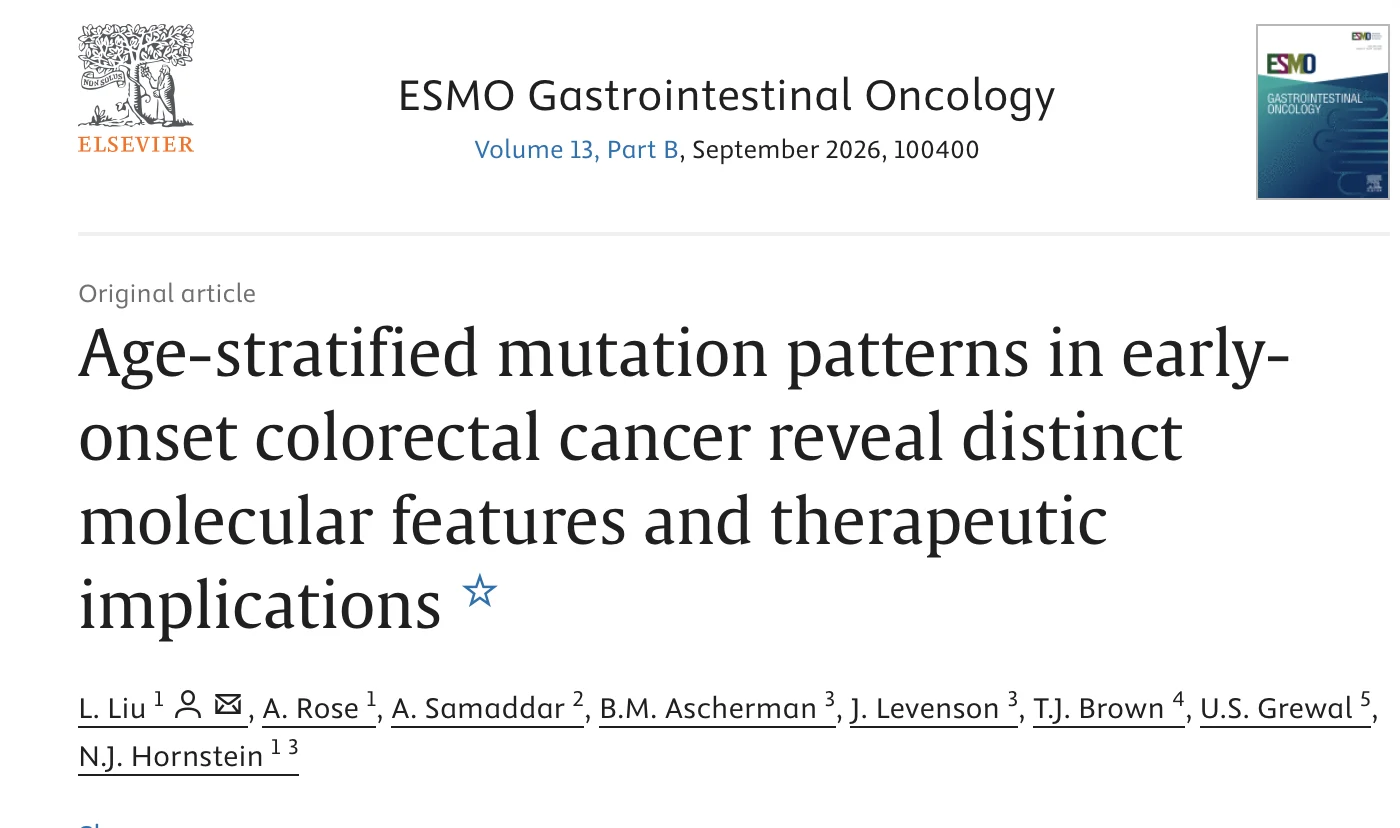
Title: Age-stratified mutation patterns in early-onset colorectal cancer reveal distinct molecular features and therapeutic implications
Authors: L. Liu, A. Rose, A. Samaddar, B.M. Ascherman, J. Levenson, T.J. Brown, U.S. Grewal, N.J. Hornstein
Read the Full Article.
Other articles featuring Nicholas Hornstein on OncoDaily.