Morgan Farley, Research Fellow Cancer Care Services Royal Brisbane/QUT at Royal Brisbane and Women’s Hospital, shared on LinkedIn:
“Exercise physiology is not an optional extra in cancer care. It is an investment with a measurable return.
A major new economic analysis from Exercise and Sports Science Australia (ESSA) and Deloitte Access Economics estimated that Exercise Physiologists generated $1.09 billion in net economic benefit over three years, or $2.50 in economic benefit for every $1 invested, across six health condition groups nationally.
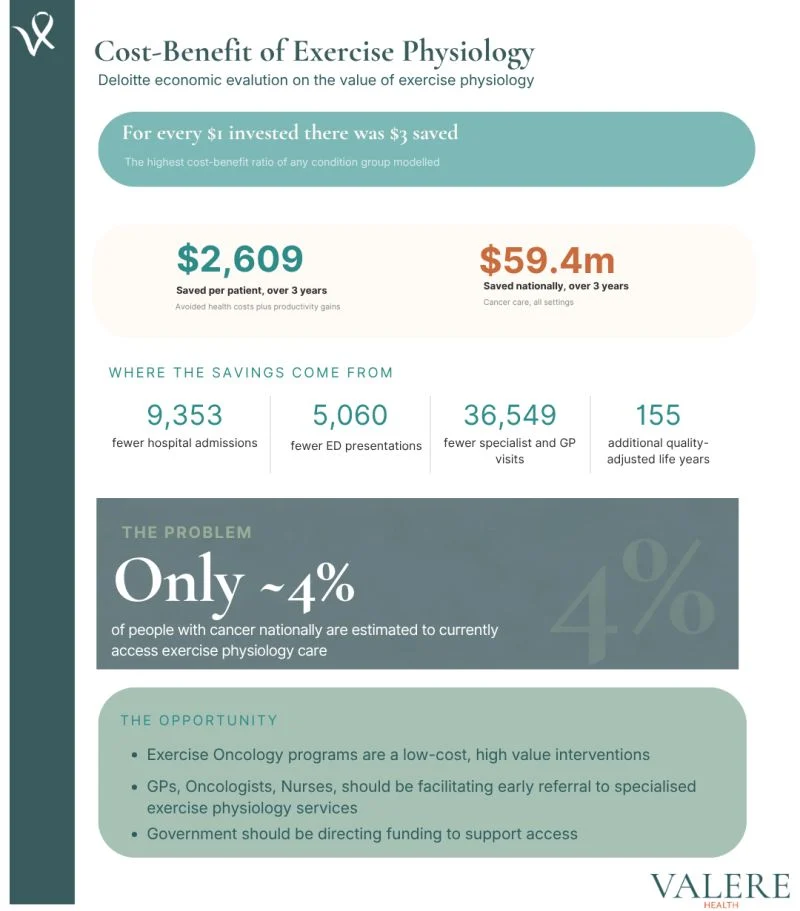
Cancer produced the strongest result of any condition group modelled:
$3.00 in economic benefit for every $1 invested, the highest return of the six
$2,609 net benefit per patient, also the highest of the six
$59.4 million in net economic benefit over three years
9,353 avoided hospital admissions
5,060 avoided emergency department presentations
155 additional quality-adjusted life years
The problem: Only an estimated 4% of people with cancer access Exercise Physiology services.
I have spent the last eight years building Valere around exactly this evidence.
What we see in clinic every week, people managing treatment better, returning to work sooner, staying out of hospital, holding onto their independence, is now backed by economic modelling.
Exercise physiology cannot keep sitting at the edge of cancer care. It needs to be embedded in it, with proper referral pathways, sustainable funding and equitable access, from the point of diagnosis through survivorship.”
Other articles about Exercise and Sports Science Australia on OncoDaily.